Quranic Answer
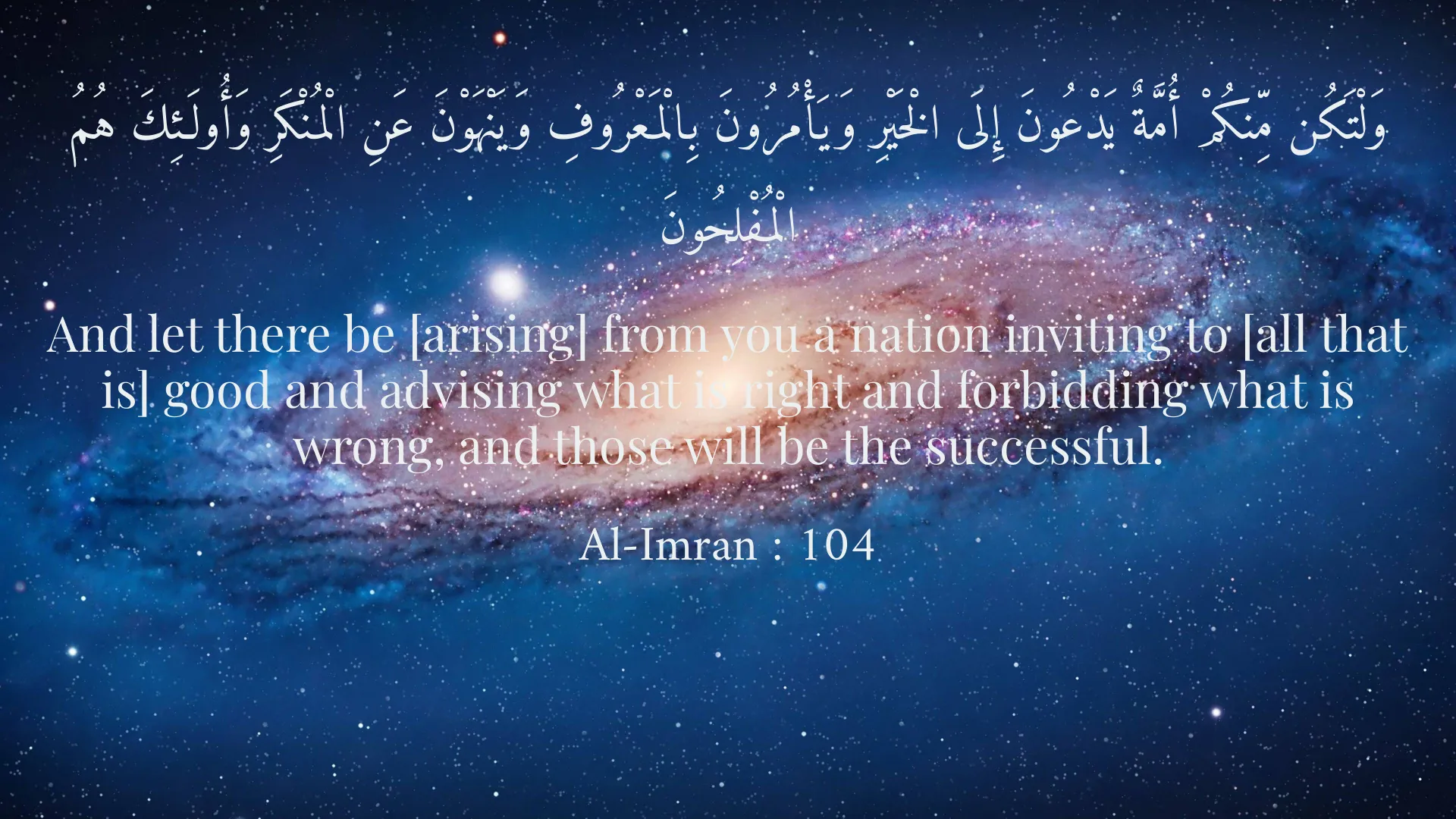
The Holy Quran is a divine scripture that lays down not only the rules governing the individual believer but also the ethical and moral fabric of society as a whole. Among the many principles that it espouses, one stands out prominently: the duty of enjoining good and forbidding wrong. This responsibility is underscored in various verses, particularly in Surah Al-Imran, verse 104, which commands believers to engage in activities that promote good, advise what is right, and deter what is considered wrong. The passage states: 'And let there be [arising] from you a nation inviting to [all that is] good and advising what is right and forbidding what is wrong, and those will be the successful.' This powerful verse outlines not just expectations but also a collective goal for Muslims: to nurture a community centered around ethical behavior and moral integrity. At first glance, one may interpret this duty of enjoining good and forbidding wrong as confined to specific religious leaders or scholars, but the Quran makes it clear that such responsibility is not exclusive to a designated group. On the contrary, the verse emphasizes the need for a collective effort among all believers. This collective responsibility is further reinforced in Surah Al-Ma'idah, verse 54, where Allah reminds the faithful that if they do not carry out their duties towards each other, He will raise up a community that will fulfill these obligations. The verse reads: 'O you who have believed, whoever of you should revert from his religion - Allah will bring forth a people He will love and who will love Him.' This highlights a critical point—the notion that the duty to guide others towards righteousness and to lead a life exemplifying moral principles is incumbent upon all Muslims, not just the select few. This concept of communal responsibility is deeply ingrained in Islamic teachings. The importance of a community working together to uphold morals and ethics cannot be overstated. In many societies, the deterioration of moral values often results from indifference and a lack of accountability among individuals. When individuals observe wrongful acts yet choose to remain silent, they not only fail to fulfill their duty but also contribute to a societal norm of complacency. Conversely, when members of the community are actively engaged in promoting good and discouraging evil, the outcome is a healthier, more vibrant society that is far less prone to moral decay. Enjoining good and forbidding wrong can take many forms. It can involve simple acts of kindness, encouraging others to perform good deeds, or alerting them when their actions deviate from moral or ethical guidelines. It can also extend to social and political realms, where advocacy for justice and equality can be seen as manifestations of this critical duty. Communities that fail to engage in such activities often risk the wrath of divine displeasure, as indicated in the Quran. Thus, this responsibility serves both as a moral obligation and a vital component in maintaining societal balance. Moreover, this communal effort promotes awareness and consciousness among individuals concerning their responsibilities to each other and to their broader landscape. It creates an interdependent network of believers where actions resonate with one another, thereby fostering a culture of accountability and care. In this network, individuals are encouraged and supported in their pursuit of goodness while being gently reminded of their obligations if they stray from the path of virtue. The significance of this principle can also be observed in the context of Prophet Muhammad's teachings and practices. The Prophet himself exemplified the values of enjoining good and forbidding wrong throughout his life. His interactions with his companions, the way he led by example, and even how he dealt with societal injustices are testament to the belief that every believer holds responsibility not only for their own actions but for those of their community as well. Just as the Prophet did, believers today are called to be proactive in their admonitions, aiming for a society that embodies Islamic moral standards at its core. Importantly, enjoining good and forbidding wrong must be approached with a sense of wisdom and compassion. Allah emphasizes that while believers should strive to correct wrongdoings, they must do so with kindness and without causing harm or sparking animosity. The ability to balance the two—encouraging good and discouraging evil—requires both knowledge of Islamic principles and a deep understanding of human psychology. This form of moral guidance is best received when it is wrapped in empathy and sincerity. In conclusion, the Quran makes it abundantly clear that the duty of enjoining good and forbidding wrong is not limited to a select group but is a collective responsibility that rests upon all Muslims. This fundamental principle plays a pivotal role in shaping the moral landscape of the community. When believers collectively engage in promoting good and addressing wrongdoings, they foster a society that values ethical conduct and mutual accountability. By stepping up to this divine injunction, each individual contributes to forming a compassionate and just community reflective of true Islamic values—one where righteous actions are encouraged, and wrongful actions are gently admonished, preserving the overall well-being of society. It is only through this holistic approach that Muslims can fulfill their role as stewards of goodness and agents of change in a world that desperately requires moral guidance.
Related Verses
وَلْتَكُن مِّنكُمْ أُمَّةٌ يَدْعُونَ إِلَى الْخَيْرِ وَيَأْمُرُونَ بِالْمَعْرُوفِ وَيَنْهَوْنَ عَنِ الْمُنْكَرِ وَأُولَـئِكَ هُمُ الْمُفْلِحُونَ
And let there be [arising] from you a nation inviting to [all that is] good and advising what is right and forbidding what is wrong, and those will be the successful.
Al-Imran : 104
يَا أَيُّهَا الَّذِينَ آمَنُوا مَن يَرْتَدَّ مِنكُمْ عَنْ دِينِهِ فَسَوْفَ يَأْتِي اللَّهُ بِقَوْمٍ يُحِبُّهُمْ وَيُحِبُّونَهُ أَذِلَّةٍ عَلَى الْمُؤْمِنِينَ أَعِزَّةٍ عَلَى الْكَافِرِينَ
O you who have believed, whoever of you should revert from his religion - Allah will bring forth a people He will love and they will love Him.
Al-Ma'idah : 54
Short Story
Once upon a time in a small town, a young man named Hossein decided to act according to the verses of the Quran. He began speaking in his neighborhood where many people were engaging in wrongdoings, reminding them of what is right and good. Certainly, through his behavior and words, he influenced many and was able to change numerous opinions. Eventually, the crowd joined him and not just encouraged themselves but also inspired others towards goodness and honesty.