Quranic Answer
In the precious teachings of the Holy Quran, forgiveness and pardoning others are not merely moral virtues but are presented as deeply valuable actions with extensive spiritual, social, and divine dimensions. This value is so high that Allah Almighty has repeatedly invited believers to embrace it in His Book, considering this attribute as one of His beloved qualities. Indeed, forgiving others is a reflection of Allah's attributes of 'Al-Ghaffar' (The All-Forgiving) and 'Ar-Rahman' (The Most Merciful), who Himself is infinitely forgiving and merciful. When a person chooses to forgive, they are in fact taking a step towards emulating divine ethics and bringing themselves closer to the source of divine mercy and compassion. One of the most prominent verses in this regard is Surah An-Nur, verse 22, which states: "And let not those among you who are blessed with graces and wealth swear not to give [any longer] to their relatives and the needy and the emigrants for the cause of Allah, but let them pardon and overlook. Would you not like that Allah should forgive you? And Allah is Forgiving and Merciful." This verse clearly indicates that forgiving others, especially those who might have wronged us, is a path to attaining divine forgiveness. Allah Almighty asks us that if we wish for Him to forgive our sins, we should also be forgiving towards the mistakes of others. This is a spiritual transaction; we forgive so that we may be forgiven. This cycle of forgiveness brings spiritual tranquility to the individual and lays the foundation for a society built on love and empathy. Pardoning and forgiveness reduce internal grudges and resentments, freeing the human heart from the heavy burden of hatred and revenge. Holding a grudge is like carrying a heavy load that not only does not harm the person we bear a grudge against but keeps us in perpetual suffering and torment. The Quran emphasizes liberating oneself from these psychological burdens. When you forgive someone, you are essentially freeing yourself from the prison of bitterness and anger, creating space for spiritual growth and inner peace. This inner freedom has an invaluable worth that no material reward can replace. Furthermore, many verses emphasize the importance of controlling anger and forgiving. In Surah Ali 'Imran, verse 134, we read that the righteous are those "who restrain anger and who pardon the people - and Allah loves the doers of good." This shows that forgiveness is not only a moral act but one of the prominent characteristics of 'Muhsinin' (doers of good) who are beloved and pleasing to Allah. From a social perspective, forgiveness and reconciliation play a vital role in strengthening human relationships. In Surah Ash-Shura, verse 40, it is stated: "And the repayment of a bad action is the like thereof, but whoever pardons and makes reconciliation - his reward is [due] from Allah. Indeed, He does not like wrongdoers." This verse allows for justice and retribution but immediately points to the high value of pardoning and reconciliation. Choosing the path of forgiveness and reconciliation not only helps to heal divisions and conflicts but also provides a basis for peaceful coexistence and strengthens the foundations of society. This act is a sign of wisdom, magnanimity, and foresight, seeking to create an atmosphere of peace and love instead of insisting on revenge and escalating hostilities. Therefore, the value of forgiveness extends beyond a mere act of benevolence. Forgiveness is a spiritual investment whose dividends return to us both in this world and the hereafter. In this world, it brings spiritual peace, better relationships, and liberation from the bondage of grudges; and in the hereafter, it will bring immense reward from Allah. One who forgives not only gives the other party an opportunity to compensate and may transform their heart but, more importantly, purifies their own heart and draws closer to the divine presence. This act demonstrates strength of character and a noble spirit, not weakness or ignorance. In truth, forgiveness is a real sign of strength and faith, as only a strong individual who relies on Allah can forgo their right and relinquish revenge. Ultimately, the Quran teaches us that forgiveness is a path to perfection, spiritual growth, and attaining the infinite pleasure of the Lord.
Related Verses
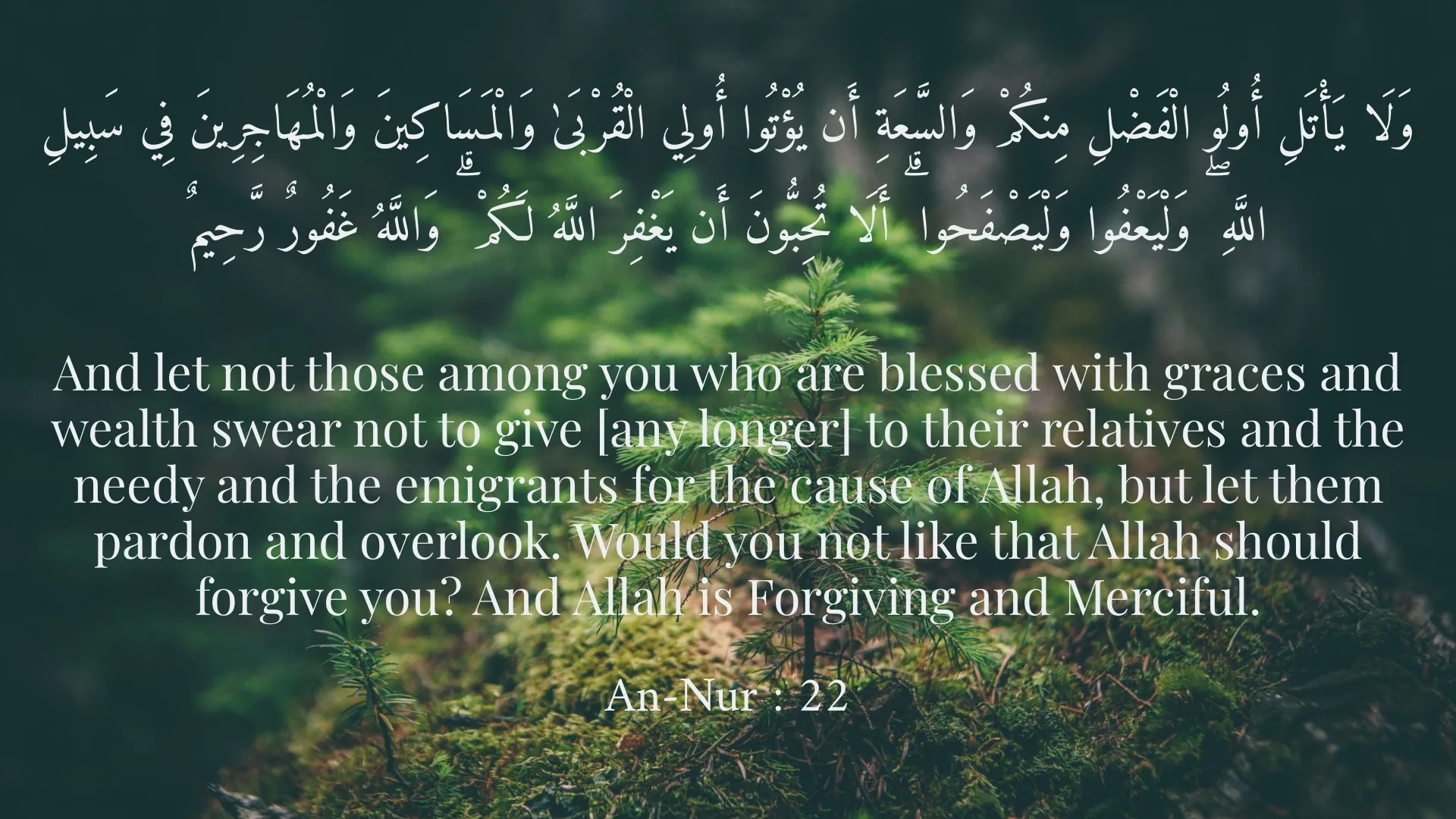
وَلَا يَأْتَلِ أُولُو الْفَضْلِ مِنكُمْ وَالسَّعَةِ أَن يُؤْتُوا أُولِي الْقُرْبَىٰ وَالْمَسَاكِينَ وَالْمُهَاجِرِينَ فِي سَبِيلِ اللَّهِ ۖ وَلْيَعْفُوا وَلْيَصْفَحُوا ۗ أَلَا تُحِبُّونَ أَن يَغْفِرَ اللَّهُ لَكُمْ ۗ وَاللَّهُ غَفُورٌ رَّحِيمٌ
And let not those among you who are blessed with graces and wealth swear not to give [any longer] to their relatives and the needy and the emigrants for the cause of Allah, but let them pardon and overlook. Would you not like that Allah should forgive you? And Allah is Forgiving and Merciful.
An-Nur : 22
وَجَزَاءُ سَيِّئَةٍ سَيِّئَةٌ مِّثْلُهَا ۖ فَمَن عَفَا وَأَصْلَحَ فَأَجْرُهُ عَلَى اللَّهِ ۚ إِنَّهُ لَا يُحِبُّ الظَّالِمِينَ
And the repayment of a bad action is the like thereof, but whoever pardons and makes reconciliation - his reward is [due] from Allah. Indeed, He does not like wrongdoers.
Ash-Shura : 40
الَّذِينَ يُنفِقُونَ فِي السَّرَّاءِ وَالضَّرَّاءِ وَالْكَاظِمِينَ الْغَيْظَ وَالْعَافِينَ عَنِ النَّاسِ ۗ وَاللَّهُ يُحِبُّ الْمُحْسِنِينَ
Those who spend [in the cause of Allah] during ease and hardship and who restrain anger and who pardon the people - and Allah loves the doers of good.
Ali 'Imran : 134
Short Story
It is narrated in Saadi's Gulistan that a king became enraged with a minister who had criticized him and ordered him to be imprisoned. The minister sought refuge in God day and night in prison. After some time, the king's enemies harbored resentment towards him and prepared to conspire. The king, realizing the loyalty of his former minister, softened his heart and ordered his release. When the minister returned, the king forgave him and even rewarded him, saying: 'I overlooked your fault, for I knew that peace and tranquility come from forgiveness.' It was then that both the king and the minister found true peace, for forgiveness not only freed the prisoner's heart but also liberated the king from the bondage of malice and anger, opening a path for rebuilding and unity.