Quranic Answer
In the sublime and luminous teachings of the Holy Quran, there is a profound and unbreakable link between the concept of 'free will' and 'individual responsibility,' which forms the fundamental basis of the divine moral system and justice. This connection is the core essence of human creation and the purpose behind the revelation of heavenly books and the sending of prophets. The Quran clearly states that humans are beings endowed with choice; that is, they possess the ability to choose between the path of truth and falsehood, good and evil, and obedience and disobedience. This freedom of will is a divine gift that distinguishes humans from other creations, making them worthy of divine injunctions and, ultimately, reward or punishment. If humans were compelled to act, then neither reward nor punishment would have any meaning. However, since Allah Almighty, in numerous verses, calls upon humans to reflect, choose, and act, this signifies an emphasis on their free will. Sura Al-Kahf, verse 29, Allah says: "And say, 'The truth is from your Lord, so whoever wills - let him believe; and whoever wills - let him disbelieve.'" This verse clearly indicates that God has shown humanity the path, but the choice to accept or reject it rests with them. This choice is the cornerstone of individual responsibility. Since humans have the power to choose, they are held accountable for their actions and choices. This responsibility manifests not only in this worldly life but also fully in the Hereafter, where everyone will be recompensed or punished based on what they have done. Individual responsibility in the Quran means that no one bears the burden of another's sin, and every soul is responsible for its own deeds. In Sura An-Najm, verses 39 to 41, this truth is beautifully articulated: "And that there is not for man except what he endeavors; And that his endeavor is going to be seen; Then he will be recompensed for it with the fullest recompense." These verses demonstrate the inseparable link between human voluntary action and its consequences. Every action a person performs with their free will, whether good or evil, will have its effects and repercussions, and the individual is responsible for those outcomes. This responsibility encompasses various aspects of life, including worship, transactions, ethics, and social behaviors. For this reason, the Quran emphasizes the necessity of reflection, intellect, and avoidance of blind imitation, because correct thought and reflection are prerequisites for a conscious and responsible choice. Furthermore, the Quran also introduces the concept of divine decree (Qada wa Qadar), but this concept never implies determinism or the negation of free will. Rather, Qada wa Qadar refers to Allah's eternal knowledge of events and His overall governance of existence. Allah knows what choices humans will make with their free will, but He does not compel them to do anything. This divine knowledge does not negate human will and choice; rather, these two aspects are in harmony within a wise and just system. Humans make choices by their own will, and consequently, they step onto a path that Allah was already aware of through His eternal knowledge. This delicate balance between free will and divine knowledge is a sign of Allah's infinite wisdom and justice, which has made humans worthy of trial and choice. Therefore, it can be concluded that free will is not only linked to individual responsibility but is also its foundation. Without free will, individual responsibility would be meaningless, and without individual responsibility, the divine system of reward and punishment and the concept of justice would be baseless. The Quran introduces humanity as a chosen being, Allah's vicegerent on Earth, and this status entails accepting great responsibilities. Every decision, every word, and every action that originates from us is recorded in our deeds, and on the Day of Judgment, we will see its outcome. This accountability not only provides order and stability to the individual but also to society, as every person knows that the consequences of their actions directly revert to them. This Quranic teaching provides a strong motivation to move towards good and shun evil, guiding humanity towards perfection and felicity.
Related Verses
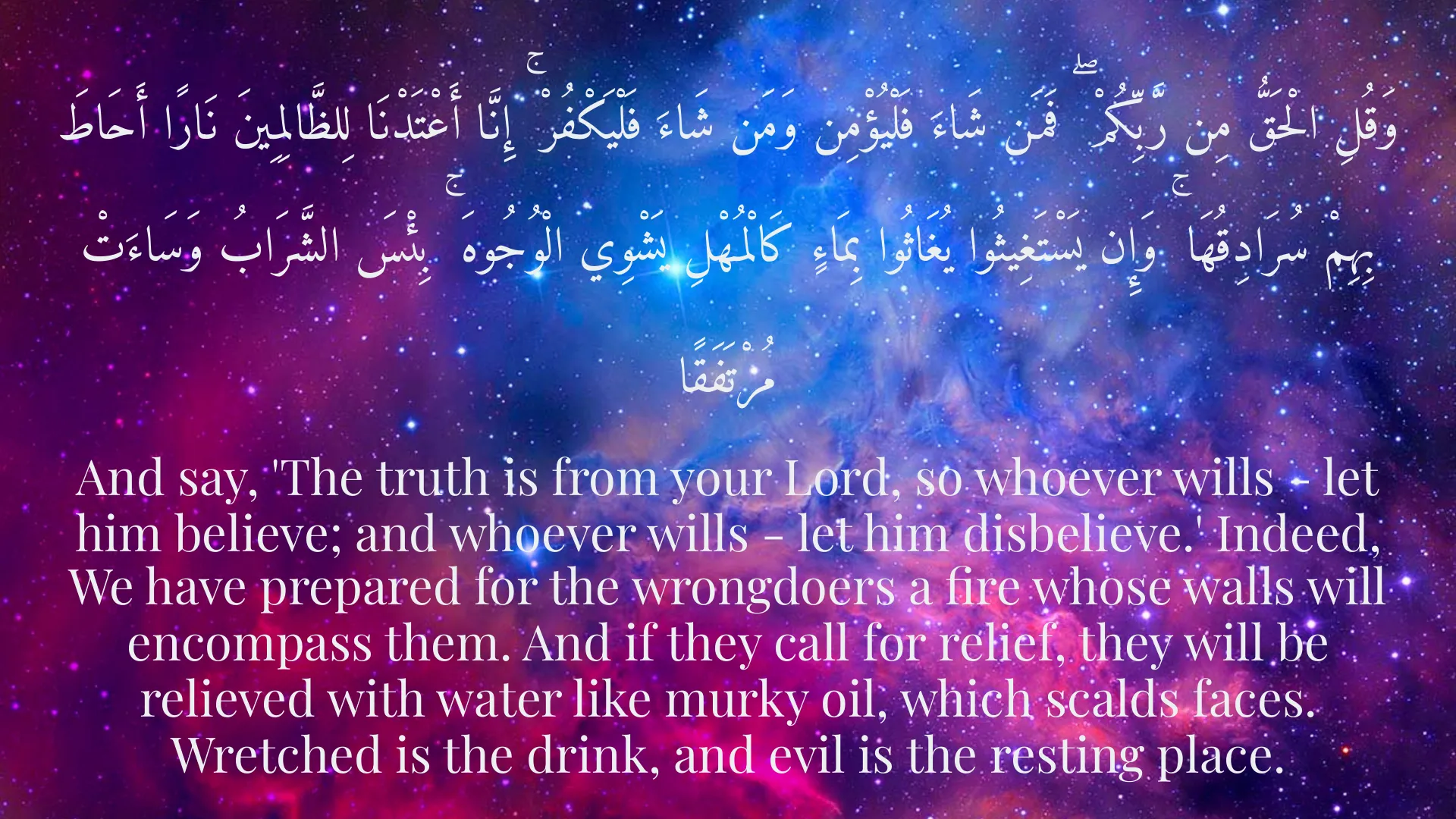
وَقُلِ الْحَقُّ مِن رَّبِّكُمْ ۖ فَمَن شَاءَ فَلْيُؤْمِن وَمَن شَاءَ فَلْيَكْفُرْ ۚ إِنَّا أَعْتَدْنَا لِلظَّالِمِينَ نَارًا أَحَاطَ بِهِمْ سُرَادِقُهَا ۚ وَإِن يَسْتَغِيثُوا يُغَاثُوا بِمَاءٍ كَالْمُهْلِ يَشْوِي الْوُجُوهَ ۚ بِئْسَ الشَّرَابُ وَسَاءَتْ مُرْتَفَقًا
And say, 'The truth is from your Lord, so whoever wills - let him believe; and whoever wills - let him disbelieve.' Indeed, We have prepared for the wrongdoers a fire whose walls will encompass them. And if they call for relief, they will be relieved with water like murky oil, which scalds faces. Wretched is the drink, and evil is the resting place.
Al-Kahf : 29
وَأَن لَّيْسَ لِلْإِنسَانِ إِلَّا مَا سَعَىٰ
And that there is not for man except what he endeavors;
An-Najm : 39
وَأَنَّ سَعْيَهُ سَوْفَ يُرَىٰ
And that his endeavor is going to be seen;
An-Najm : 40
ثُمَّ يُجْزَاهُ الْجَزَاءَ الْأَوْفَىٰ
Then he will be recompensed for it with the fullest recompense.
An-Najm : 41
إِنَّا هَدَيْنَاهُ السَّبِيلَ إِمَّا شَاكِرًا وَإِمَّا كَفُورًا
Indeed, We guided him to the way, be he grateful or ungrateful.
Al-Insan : 3
Short Story
A sage from Sa'di's Bustan recounted that once, a just king put two of his courtiers to the test. He gave one the opportunity to attain high ranks through diligence and honesty, and the other the chance to choose the path of negligence through idleness and carelessness. Time passed, and the one who had chosen the path of effort and integrity gained respect and honor among the people and prospered, while the other, who had pursued heedlessness, fell into disgrace and was deprived of blessings. The king smiled and said: 'This reward and punishment were not due to my compulsion, but rather to their own free will and actions. Everyone shall reap the consequence of their deeds, according to what they sow.' This story teaches us that our destiny is shaped not by compulsion, but by our own hands and choices, and the responsibility for every action lies with the doer.