Quranic Answer
Is hope without action, faith? This question delves deeply into the nature of faith in Islam and its intrinsic relationship with the practical aspects of life. From the perspective of the Holy Quran, faith (Iman) is not merely a mental assent or a passive wish; rather, it is a dynamic synthesis of firm belief, verbal affirmation, and righteous deeds (Amal Salih). The Quran repeatedly pairs "those who believe and do righteous deeds" (الذين آمنوا وعملوا الصالحات), signifying the inseparable connection between faith and action. This constant pairing explicitly underscores the practical dimension of faith; an Iman that remains hidden within the heart and does not manifest in one's conduct and actions is incomplete and fruitless. Allah Almighty introduces faith not just as an internal state, but as a driving force for individual and societal transformation and improvement. Hope (Raja') is indeed a vital component of faith. Hope in divine mercy, hope for eternal rewards, and hope for relief from difficulties serve as powerful motivators that keep individuals steadfast on the path of truth. This hope acts as a beacon, illuminating the path through darkness and helping individuals persevere through hardships, avoiding despair (Qunut), which is strongly condemned in the Quran. However, this hope should never lead to passivity or idleness. The Quran explicitly states that mere wishes and hopes, unaccompanied by effort and action, hold no real value and can even lead to delusion and self-deception. True hope is one that propels an individual towards striving, exertion, and the performance of good deeds. It is an active energy that encourages a person to utilize all their capabilities, and then, only after sincere effort, to entrust the outcome to God (Tawakkul). In other words, hope and action are like two wings for flight; one without the other cannot bring a person to their destination. Hope points to the goal, and action paves the way to achieve it. For instance, in Surah Al-Kahf, verse 110, Allah says: "So whoever would hope for the meeting with his Lord - let him do righteous work and not associate anyone with the worship of his Lord." This verse clearly illustrates that hope for meeting one's Lord and attaining divine rewards is conditional upon performing righteous deeds. Hope without action is akin to sowing a seed in barren, salty land; it will never bear fruit. This verse lays down a fundamental principle: every noble hope requires practical and sincere effort. If someone truly hopes for the Hereafter and divine reward, this hope must lead them to perform actions that are pleasing to Allah. The Quran, in numerous verses, emphasizes that divine reward is based on good deeds, not solely on claims of faith or baseless hopes. For example, in Surah Az-Zalzalah, verses 7 and 8, we read: "So whoever does an atom's weight of good will see it, and whoever does an atom's weight of evil will see it." These verses underscore the critical importance of the weight of actions, not just raw intentions or unpursued hopes. Action is the criterion for judgment and the determinant of one's destiny. This precision in accountability for deeds demonstrates that no action, small or large, is overlooked, and every true hope must be accompanied by proportionate action to be fruitful. Tawakkul (reliance on God), which means entrusting one's affairs to God, is often mistakenly interpreted as hope without action. In reality, true Tawakkul comes after exerting maximum effort and utilizing all available means. The Prophet Muhammad (peace be upon him) famously advised: "Tie your camel, and then rely [on Allah]." This renowned Hadith beautifully encapsulates the concept of active reliance. A person must strive to their utmost ability, prepare the necessary means and tools, and then, with hope in divine assistance and grace, leave the ultimate outcome to God. Without this initial effort, Tawakkul loses its true meaning; instead, it leans towards laziness, indolence, and lack of responsibility, which are reprehensible in Islam. Tawakkul is not the denial of means but trust in the Causer of means after employing them. Paradise, the ultimate destination for believers, is also attained through righteous deeds. In Quranic verses, entry into Paradise is consistently linked with the phrase "those who believe and do righteous deeds." For example, in Surah Al-Baqarah, verse 277, it states: "Indeed, those who believe and do righteous deeds and establish prayer and give zakat - they will have their reward with their Lord, and no fear will be upon them, nor will they grieve." This verse explicitly shows that reward is not merely for theoretical faith and hope, but for their accompaniment with righteous worship and social deeds. Righteous action here includes prayer (connection with God) and zakat (connection with society), demonstrating the comprehensiveness of Islam. Hope without action can lead to a sense of false security and arrogance. An individual might erroneously assume that merely possessing "hope" in God's mercy will suffice to avert punishment, negating the need to strive away from sins or fulfill obligations. This viewpoint not only contradicts Quranic teachings but also paves the way for moral and spiritual decline. The Quran continuously warns humanity not to despair of God's mercy (Qunut), nor to feel secure from His plan. The balance between Khawf (fear of punishment) and Raja' (hope in mercy) is the factor that keeps a believer on the path of moderation and righteous action. This balance prevents extremism in either aspect, driving individuals towards responsibility and continuous effort. In Surah Al-Asr, Allah clearly states that humanity is in loss, "Except for those who have believed and done righteous deeds and advised each other to truth and advised each other to patience." This concise Surah outlines the path to human salvation, encompassing faith (internal belief), righteous action (practical aspect), and advising each other to truth and patience (social and steadfastness aspects). None of these pillars is complete without the others. Hope, as a driving force, is embedded within this structure, breathing life into action and patience. This verse alone is sufficient to show that faith without action and social responsibility is incomplete and ineffective. In conclusion, hope is undoubtedly an inseparable part of faith and a potent motivator for action. However, this hope only gains its true meaning when it transforms into movement and effort. Hope without action is not only incomplete faith but can also become an obstacle to human growth and perfection, preventing individuals from achieving their full potential. True faith is always active and productive; within it, hope illuminates the heart, and action sets the hands in motion. Together, these two pave the way for humanity's ascent towards divine pleasure. Active faith is that in which every hope transforms into the seed of a righteous deed, and by relying on divine grace and continuous effort, one attains success in this world and the Hereafter.
Related Verses
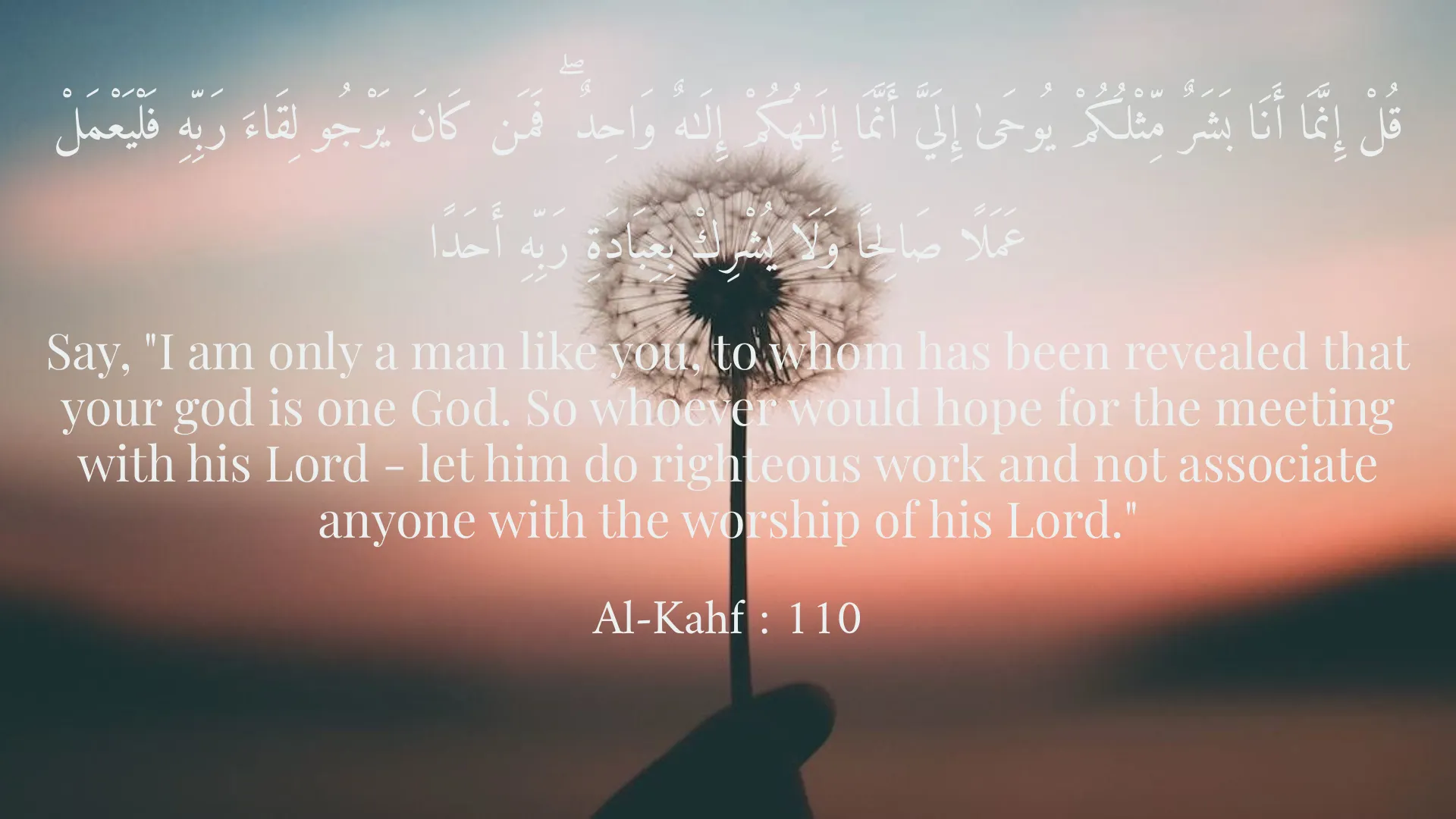
قُلْ إِنَّمَا أَنَا بَشَرٌ مِّثْلُكُمْ يُوحَىٰ إِلَيَّ أَنَّمَا إِلَٰهُكُمْ إِلَٰهٌ وَاحِدٌ ۖ فَمَن كَانَ يَرْجُو لِقَاءَ رَبِّهِ فَلْيَعْمَلْ عَمَلًا صَالِحًا وَلَا يُشْرِكْ بِعِبَادَةِ رَبِّهِ أَحَدًا
Say, "I am only a man like you, to whom has been revealed that your god is one God. So whoever would hope for the meeting with his Lord - let him do righteous work and not associate anyone with the worship of his Lord."
Al-Kahf : 110
وَقُلِ اعْمَلُوا فَسَيَرَى اللَّهُ عَمَلَكُمْ وَرَسُولُهُ وَالْمُؤْمِنُونَ ۖ وَسَتُرَدُّونَ إِلَىٰ عَالِمِ الْغَيْبِ وَالشَّهَادَةِ فَيُنَبِّئُكُم بِمَا كُنتُمْ تَعْمَلُونَ
And say, "Work, for Allah will see your deeds, and [so will] His Messenger and the believers. And you will be returned to the Knower of the unseen and the witnessed, and He will inform you of what you used to do."
At-Tawbah : 105
وَالْعَصْرِ ﴿١﴾ إِنَّ الْإِنسَانَ لَفِي خُسْرٍ ﴿٢﴾ إِلَّا الَّذِينَ آمَنُوا وَعَمِلُوا الصَّالِحَاتِ وَتَوَاصَوْا بِالْحَقِّ وَتَوَاصَوْا بِالصَّبْرِ ﴿٣﴾
By time, (1) Indeed, mankind is in loss, (2) Except for those who have believed and done righteous deeds and advised each other to truth and advised each other to patience. (3)
Al-Asr : 1-3
Short Story
Once upon a time, in a bustling town, lived two close friends named Ahmed and Hasan. Ahmed always harbored grand wishes; he dreamed of a large house, abundant wealth, and a life filled with tranquility, often saying, "God is Generous and the Provider, I hope His grace will encompass me, and my life will flourish without effort." Yet, he did nothing but daydream. In contrast, Hasan also held lofty hopes in his heart, but his hope was intertwined with the sweat of his brow and ceaseless effort, day and night. He would say, "I hope for God's mercy, but I know this mercy descends upon those who act and sow the seeds of effort." Years passed. Ahmed continued to sit at home, content with his dreams, while Hasan worked diligently, tilling the land and engaging in trade. One day, upon witnessing Hasan's success, Ahmed remarked, "What a time! You've achieved all your aspirations, but I, with all my hopes and dreams, am still stuck in the same place." Hasan smiled and said, "My dear friend, hope is like wings; it makes you soar. But if you don't flap your wings, you will never gain altitude. My hope was the driving force behind my actions, and I never ceased striving. God rewards those who strive and have hope, not those who merely wish and wait." Ahmed took heed of Hasan's words, and from that day on, he linked his hope with righteous deeds, and thus tasted the sweet fruit of success.