Quranic Answer
In the Holy Quran, the concept of justice is profoundly woven through the fabric of moral teachings and societal regulations, highlighting the necessity of addressing injustice as one of the gravest sins. Divine perfection and justice are central to the concept of God in Islam; thus, the command to uphold justice becomes integral to the faith of believers. Allah, in His infinite wisdom, emphasizes human responsibility towards injustice, establishing a clear moral compass for individuals in their societal conduct. One of the most compelling references to justice in the Quran is found in Surah An-Nisa, verse 135, which states: 'O you who have believed, be persistently standing firm in justice, witnesses for Allah, even if it be against yourselves or parents and relatives.' This verse serves as a clarion call to believers, urging individuals to maintain their integrity and commitment to justice, regardless of the circumstances they may face. The emphasis placed on standing firm 'even if it be against yourselves or parents and relatives' underscores the universal nature of justice; it transcends personal relationships and societal ties. This commitment to truth and fairness is imperative, as silence in the face of injustice signifies complicity and a neglect of one's moral duties. The necessity of combating injustice is reiterated throughout the Quran, reinforcing that it is not merely an option but rather an inherent responsibility of every believer. In Surah Al-Baqarah, verse 281, Allah articulates an explicit warning against the dangers of indifference, stating: 'And fear a Day when you will be returned to Allah. Then every soul will be compensated for what it earned, and they will not be dealt with unjustly.' This directive not only addresses the accountability believers have to one another but also frames their actions within the context of divine scrutiny. The awareness of divine accountability fosters a sense of urgency in individuals to not remain passive bystanders amidst injustice. The Quran makes it crystal clear that part of the responsibility of believers is to 'enjoin what is right and forbid what is wrong.' This principle serves as a foundational aspect of Islamic teaching. The act of enjoining good and forbidding evil transcends the personal boundary of one's life, engulfing communal and societal life. Muslims are encouraged to actively engage in societal issues, particularly those that concern rights, equitable treatment, and the dismantling of oppressive systems. The teachings advocate that apathy towards oppression is a detriment not only to the oppressed victim but also to society's moral fabric as a whole. Indifference towards injustice is condemned in the Quran, as it can perpetuate a culture of oppression that affects many, leading to societal decay and the rampant spread of wrongdoing. A society that stands idly by while injustice flourishes gives tacit approval to oppression, thus ensuring that such injustices remain unchallenged. The Quran places a high premium on awareness, encouraging individuals to not only acknowledge when injustice occurs but also to take up the mantle to address it. This becomes not only a personal obligation but a duty for the community at large. Moreover, the Quran’s call for social justice extends beyond mere verbal denouncements; it encompasses active participation in reforming society and advocating for the marginalized. The significant theme here is that each individual has a role to play in promoting justice. The concept of collective responsibility propounded in Islamic teachings means that believers cannot afford to remain complacent while injustice permeates their lives. Additionally, it is essential to recognize that the struggle against injustice is often fraught with challenges. Those who dare to speak out or act in the face of oppression may face personal loss, persecution, or social ostracization. However, the Quran empowers individuals with the assurance that enduring this struggle for justice aligns them with the values cherished by Allah. Standing against injustice demonstrates faith in action, positioning the believer within a long line of prophets and righteous figures who championed justice throughout history. Moreover, the Quran does not merely present justice as an abstract ideal but as a tangible and achievable goal. This is witnessed in its detailed principles regarding economic, social, and political justice. For instance, the prohibition of usury (Riba) and unethical trading practices in the Quran aims at establishing fairness in economic dealings and protecting the rights of the most vulnerable in society. This legal framework is instrumental in combating systemic injustice, highlighting the necessity of equitable systems that afford protection to all members of society, especially the disenfranchised. In conclusion, the Quran presents a holistic view of justice as a divine command that intersects with the lifeblood of community and individual duty. The call to action against injustice is profound and pervasive. It carries deep moral implications, serving not only as a reminder of one's responsibilities as a believer but also as a necessary measure to cultivate a society based on equity and compassion. Justice, as articulated in the Quran, becomes a fundamental principle of faith; nurturing the spirit of fighting against oppression is imperative for personal and collective development. To be indifferent to wrongdoing is to betray one's humanity, and to embrace justice is to engage in the divine pursuit of upholding the rights and dignity of every soul. In this light, the role of believers in fostering a just society becomes not only an act of faith but one of paramount importance in creating a world steeped in compassion, respect, and equality.
Related Verses
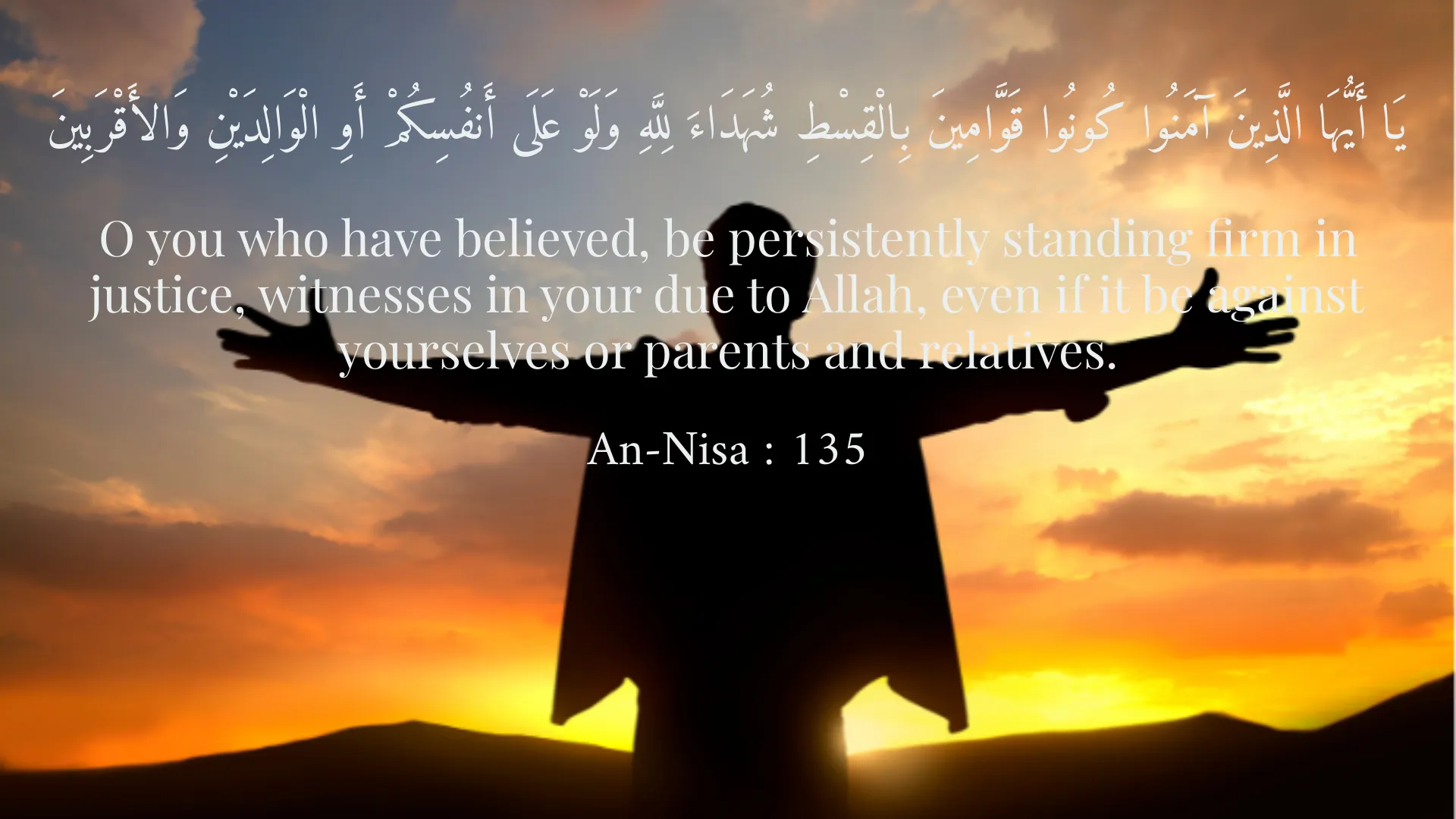
يَا أَيُّهَا الَّذِينَ آمَنُوا كُونُوا قَوَّامِينَ بِالْقِسْطِ شُهَدَاءَ لِلَّهِ وَلَوْ عَلَى أَنفُسِكُمْ أَوِ الْوَالِدَيْنِ وَالأَقْرَبِينَ
O you who have believed, be persistently standing firm in justice, witnesses in your due to Allah, even if it be against yourselves or parents and relatives.
An-Nisa : 135
وَاتَّقُوا يَوْمًا تُرْجَعُونَ فِيهِ إِلَى اللَّهِ ۖ ثُمَّ تُوَفَّى كُلُّ نَفْسٍ مَّا كَسَبَتْ وَهُمْ لَا يُظْلَمُونَ
And fear a Day when you will be returned to Allah, then every soul will be compensated for what it earned, and they will not be treated unjustly.
Al-Baqarah : 281
Short Story
One day, a man noticed an injustice happening to a child in the market. He initially thought about remaining indifferent, but he recalled the verses from the Quran and decided to take action. He raised his voice and called on others to help. His action not only contributed to ending the injustice but also encouraged others to stand against injustice. From that day on, he never accepted indifference in the form of silence.