Quranic Answer
In the luminous teachings of the Holy Quran, the concept of repentance (Tawbah) and returning to Allah holds an immensely vital and foundational place. Allah Almighty has repeatedly called His servants to repentance and seeking forgiveness, keeping the door of His mercy and pardon perpetually open. The answer to whether one must repent separately for each sin requires a deeper understanding of the nature of Tawbah in Islam and the boundless expanse of Divine Mercy. The Quran places a special emphasis on 'Tawbah Nasuhah,' a sincere and pure repentance that originates from the depths of one's being and impacts all aspects of a person's life. This type of repentance is not merely a verbal declaration or an outward act, but an inner transformation that includes genuine remorse for past sins, a firm resolve to abandon those sins in the present and future, and making amends (where possible and necessary). Such a repentance purifies the inner self and guides one back to the straight path. Generally, it can be said that it is not necessary to perform a separate and independent verbal repentance for every minor or major sin. In fact, when a person repents for all their sins generally and with sincere intention, and firmly resolves not to return to disobedience, this comprehensive and all-encompassing repentance can include all their past transgressions, both those they remember and those they have forgotten. Allah's mercy is so vast and extensive that if a servant turns to Him with sincerity and devotion, Allah will forgive and pardon all their sins, whether great or small. Verse 8 of Surah At-Tahrim explicitly mentions 'Tawbah Nasuhah': 'O you who have believed, repent to Allah with sincere repentance; perhaps your Lord will remove from you your misdeeds and admit you into Gardens beneath which rivers flow.' This verse indicates that Tawbah Nasuhah is a comprehensive and all-encompassing repentance that can erase sins. However, in cases where a significant and specific sin has been committed, or a sin that involves the rights of other people (Huquq al-Ibad), it is recommended that, in addition to general repentance, a specific act of seeking forgiveness and repentance be performed for that particular sin. For instance, if someone has wrongfully taken another's property, mere remorse and seeking forgiveness from Allah is not enough; they must return the property to its owner or seek their forgiveness. This aspect of repentance, rectifying the rights of others, is strongly emphasized in the Holy Quran and the Sunnah of the Prophet (PBUH). Thus, for sins related to the rights of Allah (Huquq Allah, such as neglecting prayers or fasting), Tawbah Nasuhah and a sincere turning of the heart towards Allah are generally sufficient. But for Huquq al-Ibad (rights of people), in addition to remorse and a decision to abandon the sin, there is also a need to gain the satisfaction of the wronged party. It should be understood that repentance is a process, not a singular event. That is, a believer is constantly returning to Allah, and whenever a sin is committed, they should immediately turn back to Allah and seek His forgiveness. This continuity in repentance and seeking forgiveness leads to the purification of the soul and a closer relationship with Allah. In Surah Hud, verse 3, we read: 'And [saying], 'Seek forgiveness of your Lord and then repent to Him, [and] He will let you enjoy a good provision for a specified term and give every possessor of grace his due grace.'' This verse also emphasizes the continuity of seeking forgiveness and repentance, indicating that they are complementary. Therefore, whenever a person remembers a sin for which they have not repented, it is good to specifically seek forgiveness and repent for that sin. This act demonstrates the servant's diligence and care in purifying their book of deeds, although a general Tawbah Nasuhah is sufficient to cover past sins. Ultimately, the most important aspect of repentance is sincerity and purity of intention. Allah looks at the inner state and intentions of individuals, not merely the outward appearances of their actions. If repentance is accompanied by genuine remorse, a firm decision to abandon sin, and a resolute will to return to obedience to Allah, there is hope that Allah will forgive all sins, and this includes sins for which no separate repentance has been specifically made. The principle is that a person should never despair of Allah's mercy, and whenever a slip occurs, they should immediately return to the Most Merciful Lord and seek His forgiveness. This continuity in returning and seeking forgiveness is the essence of a believing life and leads to spiritual growth and elevation. Therefore, while Tawbah Nasuhah is comprehensive, if a specific sin is in mind that was committed intentionally and knowingly, and its negative effects still remain, or it is related to the rights of another, a specific repentance for that sin, along with making amends, is more strongly recommended. But for a multitude of minor or forgotten sins, the general and comprehensive repentance suffices, and the vast mercy of Allah encompasses all.
Related Verses
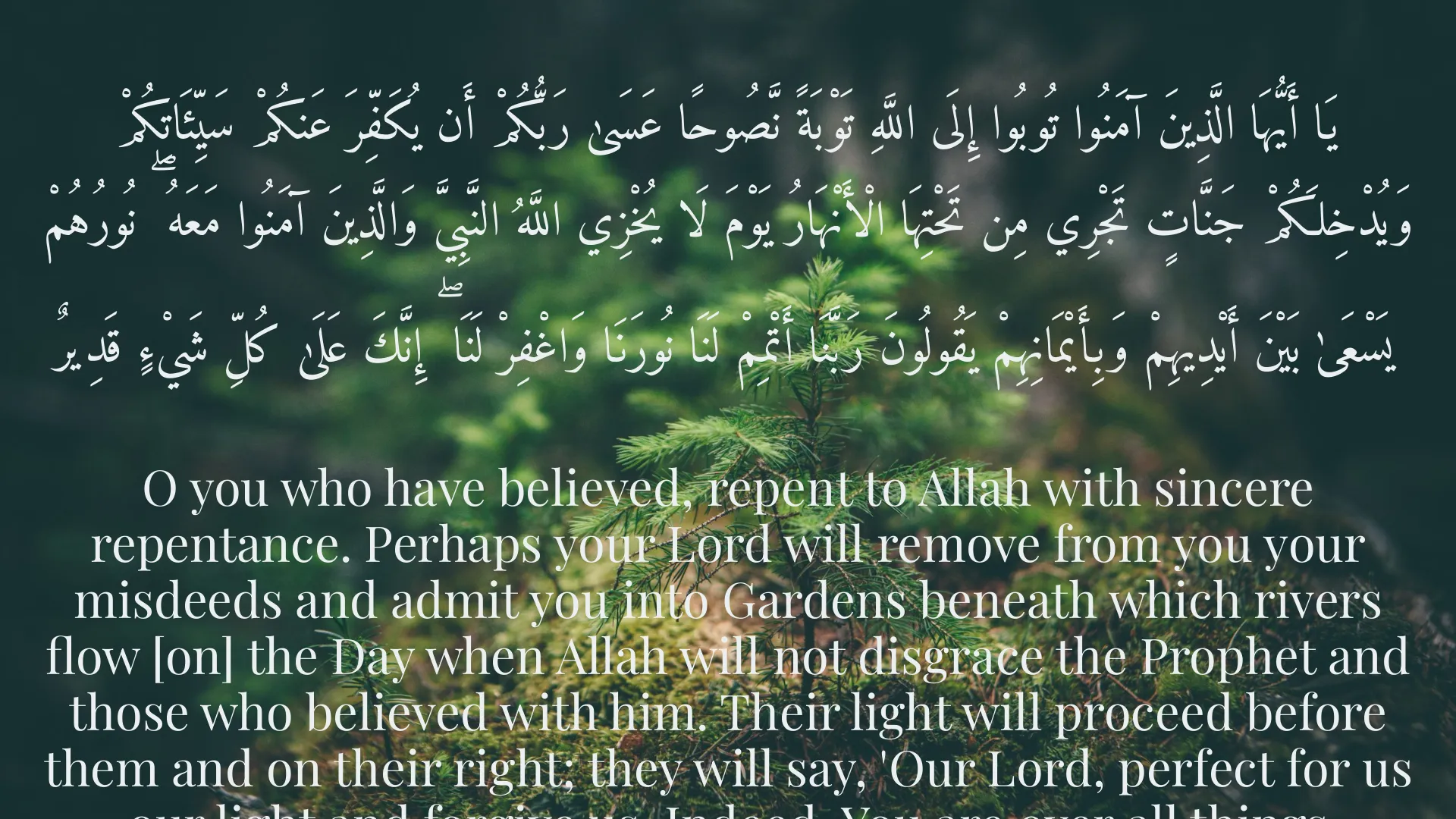
يَا أَيُّهَا الَّذِينَ آمَنُوا تُوبُوا إِلَى اللَّهِ تَوْبَةً نَّصُوحًا عَسَىٰ رَبُّكُمْ أَن يُكَفِّرَ عَنكُمْ سَيِّئَاتِكُمْ وَيُدْخِلَكُمْ جَنَّاتٍ تَجْرِي مِن تَحْتِهَا الْأَنْهَارُ يَوْمَ لَا يُخْزِي اللَّهُ النَّبِيَّ وَالَّذِينَ آمَنُوا مَعَهُ ۖ نُورُهُمْ يَسْعَىٰ بَيْنَ أَيْدِيهِمْ وَبِأَيْمَانِهِمْ يَقُولُونَ رَبَّنَا أَتْمِمْ لَنَا نُورَنَا وَاغْفِرْ لَنَا ۖ إِنَّكَ عَلَىٰ كُلِّ شَيْءٍ قَدِيرٌ
O you who have believed, repent to Allah with sincere repentance. Perhaps your Lord will remove from you your misdeeds and admit you into Gardens beneath which rivers flow [on] the Day when Allah will not disgrace the Prophet and those who believed with him. Their light will proceed before them and on their right; they will say, 'Our Lord, perfect for us our light and forgive us. Indeed, You are over all things competent.'
At-Tahrim : 8
وَتُوبُوا إِلَى اللَّهِ جَمِيعًا أَيُّهَا الْمُؤْمِنُونَ لَعَلَّكُمْ تُفْلِحُونَ
And repent to Allah all of you, O believers, that you may succeed.
An-Nur : 31
إِلَّا مَن تَابَ وَآمَنَ وَعَمِلَ عَمَلًا صَالِحًا فَأُولَٰئِكَ يُبَدِّلُ اللَّهُ سَيِّئَاتِهِمْ حَسَنَاتٍ ۗ وَكَانَ اللَّهُ غَفُورًا رَّحِيمًا
Except for those who repent, believe and do righteous work. For them Allah will change their evil deeds into good ones. And Allah is ever Oft-Forgiving, Most Merciful.
Al-Furqan : 70
Short Story
They say there was a wise man in his time, and a disciple asked him: 'O Sheikh, I have committed so many sins, both small and large; must I repent separately for each one to be forgiven?' The wise man smiled and said: 'O young one, if you truly repent and your heart returns to God, and you resolve never to tread that crooked path again, then your return is like a rain that washes away all the dust from your heart, both what you saw and what you forgot. Did not God say: 'Tawbah Nasuhah'? Tawbah Nasuhah means a repentance that cleanses the heart and turns you back from the root. But if you wrong a brother, or take his property, until you return his right, neither his heart nor God's heart will be pleased with you. So, repent with a pure heart, and fulfill what is due to people, for God's mercy is boundless and He is closer to His servants than they can imagine.'