Quranic Answer
Is it possible to be free from fear from the perspective of the Quran? This profound question delves into the very core of human experience and spiritual well-being, and the Quran offers a remarkably comprehensive and uplifting answer. While it's important to distinguish between natural, protective caution (like fearing a dangerous animal) and debilitating, paralyzing fear or chronic anxiety, the Quran unequivocally teaches that freedom from the latter is not only possible but is a hallmark of true faith and a blessed state for the sincere believer. The sacred text lays out a clear spiritual methodology to transcend the anxieties and apprehensions that often plague the human heart, transforming fear into profound peace, resilience, and unwavering trust in the Divine. At the heart of the Quranic antidote to fear lies the concept of Tawakkul, which signifies complete trust and reliance upon Allah. This is not a passive surrender to fate, but rather an active and conscious choice to exert one's best effort in any situation, then entrust the outcome entirely to God. When a person genuinely internalizes the belief that Allah is the ultimate orchestrator of all affairs, the All-Powerful, the All-Knowing, and the Most Merciful, then the fear of poverty, loss, failure, illness, or even death begins to diminish significantly. The Quran repeatedly reminds us of Allah's absolute sovereignty and control over everything in the heavens and the earth. For instance, in Surah At-Tawbah (9:51), Allah says: "Say, 'Nothing will ever befall us except what Allah has ordained for us. He is our Protector.' And in Allah let the believers put their trust." This verse encapsulates the essence of Tawakkul: a firm conviction that whatever transpires is by Divine decree, and knowing that Allah is one's ultimate Guardian brings immense comfort and dispels crippling fear. When one truly relies on Allah, the transient nature of worldly losses becomes apparent, and the fear associated with them dissipates, replaced by serenity derived from divine assurance. This deep trust liberates the soul from the chains of apprehension about the future, allowing one to face life's uncertainties with a calm heart. Another cornerstone in overcoming fear is Dhikr, the remembrance of Allah. The Quran famously states in Surah Ar-Ra'd (13:28): "Unquestionably, by the remembrance of Allah hearts are assured." This verse presents a direct and powerful remedy for anxiety and fear. Constant awareness of Allah's presence, His attributes, and His promises brings profound tranquility. Whether through formal prayers (Salat), reciting the Quran, making supplications (Du'a), or simply contemplating His majesty and mercy, Dhikr shifts the focus from the problem to the All-Capable Solution. When the heart is filled with the remembrance of its Creator, there is little room for the whispers of fear and despair. Dhikr is a spiritual anchor that grounds the believer amidst life's storms, reminding them that they are never alone, that God is ever-present, hearing, seeing, and capable of all things. It cultivates an inner sanctuary where peace reigns supreme, irrespective of external circumstances. This continuous connection with the Divine empowers the individual, replacing feelings of helplessness with strength and confidence in Allah's support. Furthermore, the Quran frequently emphasizes Sabr (Patience) and Salat (Prayer) as indispensable tools for navigating life's challenges, including fear. In Surah Al-Baqarah (2:153), Allah commands: "O you who have believed, seek help through patience and prayer. Indeed, Allah is with the patient." Prayer serves as a direct channel of communication with Allah, providing solace, guidance, and spiritual fortitude. It is a moment of complete surrender and communion, where one lays bare their fears and anxieties before their Creator, seeking His infinite help and mercy. Patience, on the other hand, involves enduring hardships and difficulties with steadfastness and faith, understanding that trials are part of life's divine design and often serve to purify and strengthen the believer. By embracing patience, one learns to accept what cannot be changed and to trust in the wisdom behind every decree, thereby reducing the fear of adverse outcomes. These two practices, woven into the fabric of daily life, act as a spiritual shield against the arrows of fear and despair, reinforcing the believer's inner resilience and their connection to a higher power. The Quran also introduces the concept of Taqwa, which is often translated as "God-consciousness" or "fear of Allah," but in its profoundest sense, it means being mindful of Allah, fearing His displeasure, and striving to live righteously. Paradoxically, this "fear" of Allah (which is more akin to reverence, awe, and cautious obedience) is what liberates one from all other fears. When one fears God alone and prioritizes His commands, they become fearless of human judgment, worldly loss, or any created thing. As Allah states in Surah Yunus (10:62-63): "Unquestionably, the friends of Allah – no fear will there be concerning them, nor will they grieve. Those who believed and were constantly mindful [of Allah]." This promise highlights that those who achieve a high level of Taqwa and true faith are granted a state of inner tranquility where worldly fears and sorrows cannot penetrate. This doesn't imply immunity from life's tests, but rather an internal fortitude and certainty that allows them to face any challenge with peace, knowing that God is with them. Their perspective shifts from the temporal to the eternal, making worldly anxieties seem trivial in comparison. In essence, the Quran teaches that true freedom from debilitating fear is a spiritual journey achieved through a profound and active relationship with Allah. It involves cultivating sincere trust (Tawakkul), constant remembrance (Dhikr), seeking strength through prayer and patience, and developing a deep reverence for God (Taqwa) that eclipses all other fears. When the heart is anchored in Allah, the storms of life may rage, but the inner sanctuary of peace remains unshaken. It is a state where the believer is resilient, accepting of divine decree, and always hopeful in Allah's mercy and wisdom, thereby experiencing a true liberation from the oppressive grip of fear and a profound sense of inner calm. This comprehensive spiritual approach allows individuals to navigate the complexities of life not with apprehension, but with courage, wisdom, and an unwavering reliance on their Creator.
Related Verses
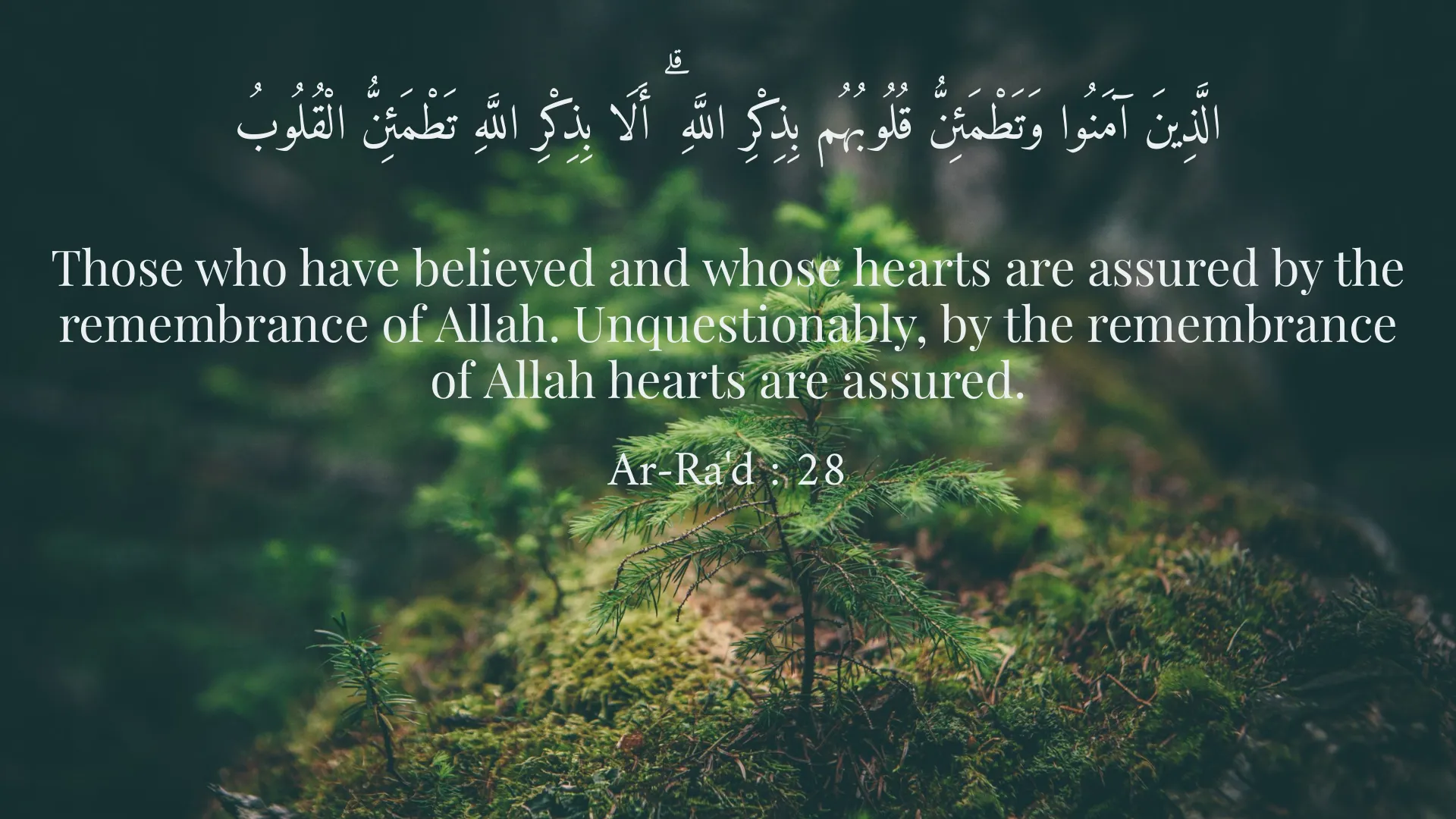
الَّذِينَ آمَنُوا وَتَطْمَئِنُّ قُلُوبُهُم بِذِكْرِ اللَّهِ ۗ أَلَا بِذِكْرِ اللَّهِ تَطْمَئِنُّ الْقُلُوبُ
Those who have believed and whose hearts are assured by the remembrance of Allah. Unquestionably, by the remembrance of Allah hearts are assured.
Ar-Ra'd : 28
أَلَا إِنَّ أَوْلِيَاءَ اللَّهِ لَا خَوْفٌ عَلَيْهِمْ وَلَا هُمْ يَحْزَنُونَ
Unquestionably, the friends of Allah – no fear will there be concerning them, nor will they grieve.
Yunus : 62
الَّذِينَ آمَنُوا وَكَانُوا يَتَّقُونَ
Those who believed and were constantly mindful [of Allah].
Yunus : 63
يَاأَيُّهَا الَّذِينَ آمَنُوا اسْتَعِينُوا بِالصَّبْرِ وَالصَّلَاةِ ۚ إِنَّ اللَّهَ مَعَ الصَّابِرِينَ
O you who have believed, seek help through patience and prayer. Indeed, Allah is with the patient.
Al-Baqarah : 153
Short Story
It is narrated that a man asked a dervish, "How is it that with all your poverty, you never grieve and fear nothing?" The dervish laughed and said, "O brother! He who has nothing, what can he lose to be sorrowful? And what can he fear that might perish? A king who loses his throne grieves, but I, who am not attached to this world, what should I fear? I have entrusted my heart to the Creator of the world, and He is the best Guardian." This anecdote reminds us that true peace and freedom from fear come from detaching from worldly attachments and trusting in God.