Quranic Answer
The Holy Quran, regarded as the ultimate guide for Muslims and a treasure trove of wisdom, encompasses a diverse range of themes, including morality, spirituality, and guidance for daily life. A critical and often overlooked aspect of the Quran is its profound references to nature and the universe, directing believers to reflect upon the creation around them. The relationship between nature and worship reverberates through the verses of the Quran, inviting individuals to not merely observe but also engage in deep contemplation of the divine signs manifested in the environment. In this article, we will explore the Quranic perspective on nature, its significance as a form of worship, and the implications of such reflections for personal spirituality and environmental stewardship. One of the compelling verses that encapsulate this theme is found in Surah Al-Imran, verse 191, which states: "Indeed, in the creation of the heavens and the earth and the alternation of the night and the day are signs for those of understanding." This verse serves as an invitation for believers to delve deeper into the wonders of the natural world. It suggests that the mere act of observing the celestial bodies and the rhythmic transition between night and day can lead to a greater understanding of Allah (SWT). The utilization of the phrase "those of understanding" implies that contemplation is a prerequisite for true appreciation and recognition of the signs of God. Such reflections not only elevate one’s spiritual awareness but also invoke gratitude towards the Creator for His magnificent creations. Furthermore, in Surah Al-An'am, verse 80, Allah encourages people to think critically about the phenomena they witness in nature: "Do you not see that Allah sends down rain from the heavens?" In this statement, the Quran highlights the cyclical process of life powered by divine will. The act of rain descending from the sky signifies nourishment and sustenance that supports life on Earth. By inviting individuals to observe these signs, the Quran prompts believers to recognize the omnipotence of Allah through a humble but profound acknowledgment of the natural processes that are often taken for granted. This deeper understanding of nature can foster a sense of connection with the Creator and a greater sense of responsibility toward His creations. Islamic tradition reinforces the idea that contemplating the natural world parallels acts of worship. The Prophet Muhammad (peace be upon him) articulated that "A man contemplating the creation of Allah is better than a person engaged in worship while oblivious to the signs of Allah." This profound statement emphasizes that introspection and meditation over nature's wonders can be equally, if not more, valuable than traditional forms of worship. When individuals take the time to investigate the ecological intricacies—the beauty of a flower, the complexity of ecosystems, or the behavior of animals—they simultaneously honor God, as they manifest the attributes and creativity of the divine. Moreover, nurturing and maintaining the environment is invaluable in Islam; it is indeed another dimension of worship. Caring for the planet reflects the Quranic teachings of stewardship (Khilafah) of the Earth, which positions humans as guardians of the environment. This mirrors the sentiment encapsulated in another Quranic verse: "And do good in the same way Allah has done good to you" (Surah Al-Qasas, 77). By fostering a sense of responsibility toward the environment, individuals can translate their reflections on nature into actions that protect and preserve the beauty bestowed upon them by Allah. The interconnectedness of worship, nature, and personal spirituality underscores a holistic understanding of faith in Islam. The Quran serves not only as a spiritual guide, but it also contains principles and practices that promote mental, emotional, and physical well-being. For instance, spending time in nature has been shown to have medicinal benefits for mental health, alleviating symptoms of anxiety and depression, and enhancing overall wellness. Through the lens of Islam, one can argue that engaging with nature can contribute to a person's spiritual health. The simplicity and tranquility found in natural settings can open pathways to deeper meditation and reflection, enriching one's spiritual journey. In conclusion, the Quran's emphasis on nature as a reflection of divine will effectively transforms the mundane act of observation into a profound experience of worship. Reflecting on the wonders of creation invites believers to deepen their relationship with Allah, acknowledges His infinite power, and cultivates a sense of gratitude for the provision of resources. Additionally, the Quran calls for a profound respect for the environment, aligning with contemporary environmental movements advocating for sustainability and conservation. Therefore, believers can find both spiritual fulfillment and a moral obligation in caring for nature, creating a symbiotic relationship that nurtures faith and fosters a commitment to environmental stewardship. Ultimately, the Quran teaches us that engaging with the natural world is not just an act of observation but a means of worship that brings us closer to the divine and enhances our understanding of Allah and His creation.
Related Verses
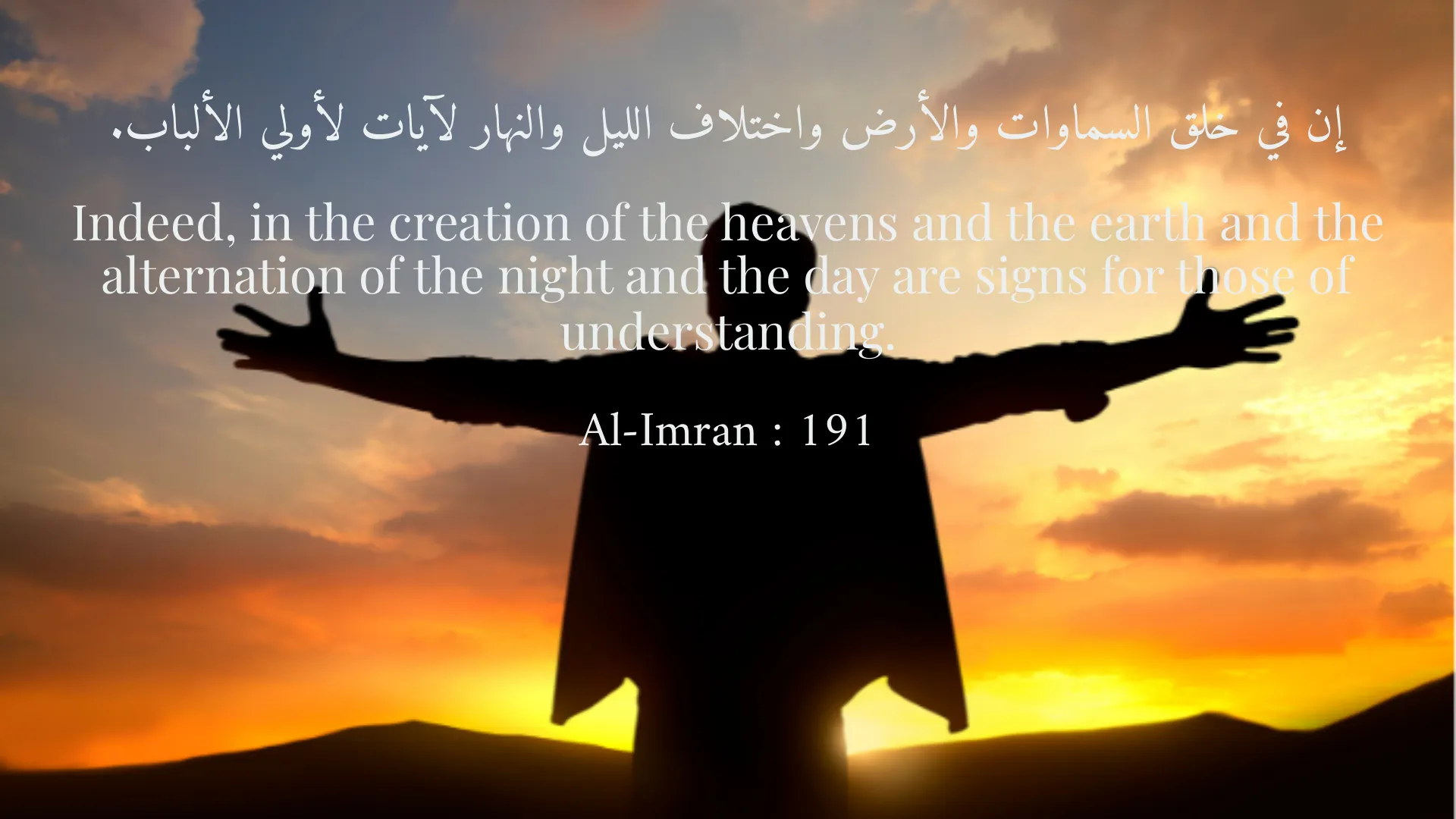
إن في خلق السماوات والأرض واختلاف الليل والنهار لآيات لأولي الألباب.
Indeed, in the creation of the heavens and the earth and the alternation of the night and the day are signs for those of understanding.
Al-Imran : 191
ألم تر أن الله ينزل من السماء ماء فيحيي به الأرض بعد موتها.
Do you not see that Allah sends down rain from the heavens, giving life to the earth after its lifelessness?
Al-An'am : 80
Short Story
One day, a man sat in the desert, admiring the beautiful nature around him. He contemplated the creation of Allah, and a sense of wonder and admiration for divine power blossomed in his heart. In that moment, he realized that looking at nature was a form of worship that brought him closer to God and enriched his life.