Quranic Answer
The Holy Quran, revered as the divine scripture of Islam, extensively elaborates on the concept of worship and the intricate relationship between humans and God. Worship, in the Islamic context, transcends mere rituals such as prayer and fasting; it encapsulates every action performed with a pure and good intention. This broad definition invites individuals to engage in a lifelong journey toward spiritual fulfillment and closeness to the Divine. In Surah Al-Baqarah, verse 177, it is proclaimed, 'The righteousness is not that you turn your faces toward the east or the west, but [true] righteousness is in one who believes in Allah, the Last Day, the Angels, the Book, and the Prophets.' This profound verse indicates a pivotal aspect of Islamic teaching: the external acts of worship, while important, are not the core of righteousness. Rather, it is the internal belief and intention behind one's actions that truly define a person’s faith. If an individual executes their deeds with the sincere intention of drawing nearer to God, those actions evolve into acts of worship. It extends the understanding of worship beyond the boundaries of traditional practices to encompass everyday interactions and experiences. The beauty of this concept is illustrated through various dimensions of human behavior, including the simplest of gestures such as a loving gaze. If a person looks at another with sincerity and genuine love, this gaze becomes a highlight of worshipfulness. Such a perspective expands the notion of worship to include various emotional connections that people share, particularly within familial and social relationships. It reveals that love and compassion are not just virtues but are also core strengths of one's spiritual and everyday life. God emphasizes the significance of loving others throughout the Quran. A notable reference is found in Surah Al-Imran, verse 31, where it states: 'Say, 'If you love Allah, then follow me, so Allah will love you.' This verse underscores a fundamental principle within Islamic belief: mutual love. Love acts as a bridge that brings people closer not only to God but also to one another. Hence, the reciprocal nature of love illustrates how relationships can be elevated into spiritual experiences. To further comprehend the expansive nature of worship as described in Islamic teachings, it is essential to delve deeper into the underlying tenets that shape these beliefs. The notion of intention, or 'niyyah,' plays a crucial role in Islamic practices. It serves as the compass guiding the believer’s actions and transforming mundane activities into worship. For instance, when a person provides for their family or works diligently to support their community, it is their intention that determines whether these actions are acts of worship or simply daily chores. In this light, the mundane becomes the sacred, and significance is infused into every corner of life. Moreover, this understanding emphasizes the principle of accountability. According to Islam, individuals are encouraged to cultivate a consciousness of God, called 'taqwa', in their daily interactions. This heightened awareness fosters a sense of responsibility towards oneself and others, thus paving the way for ethical behavior and social justice. Actions performed not just with the aim of pleasing God but also with an understanding of their impact on others highlight the interconnectedness of humanity and the divine. Consequently, when individuals build their lives on love, compassion, and sincere intentions, they are forming a robust spiritual framework shaped by worship manifested in all aspects of life. Additionally, the Quran encourages believers to engage in acts of service and kindness towards others. This is exemplified in multiple narrations, where the Prophet Muhammad (peace be upon him) showcased the importance of assisting those in need, fostering communal bonds, and spreading goodness. Such actions reflect the spiritual essence of Islam, where serving humanity becomes synonymous with serving God. Thus, acts of charity, whether through financial aid, emotional support, or simply offering a kind word, can all be viewed as worship, reinforcing the reciprocal relationship of love and compassion encouraged in the Quran. Furthermore, reflection and meditation are also integral components of worship in Islam. Believers are encouraged to ponder the wonders of creation and the intricacies of life as a means to strengthen their relationship with God. By engaging in deep reflection, individuals can cultivate gratitude, patience, and humility—qualities that are essential in navigating life's complexities. Such reflective practices contribute to personal growth and development, creating an individual capable of contributing positively to society and fostering loving relationships. In conclusion, the concept of worship in the Holy Quran extends far beyond the realm of traditional rituals on a prayer rug. It invites believers to recognize and embrace the spiritual dimension of every action taken, grounded in pure intentions and love towards others. The verses that call upon individuals to believe in God and to engage in mutual love serve as a reminder that worship can be found in moments of connection, kindness, and sincerity. As these spiritual principles are embraced, they enrich both the personal and communal lives of individuals, creating a more profound relationship with the Divine and a more compassionate society. Ultimately, the Quran illuminates the path toward a genuine understanding of worship—one where love unites humanity, and every act is an opportunity for spiritual growth.
Related Verses
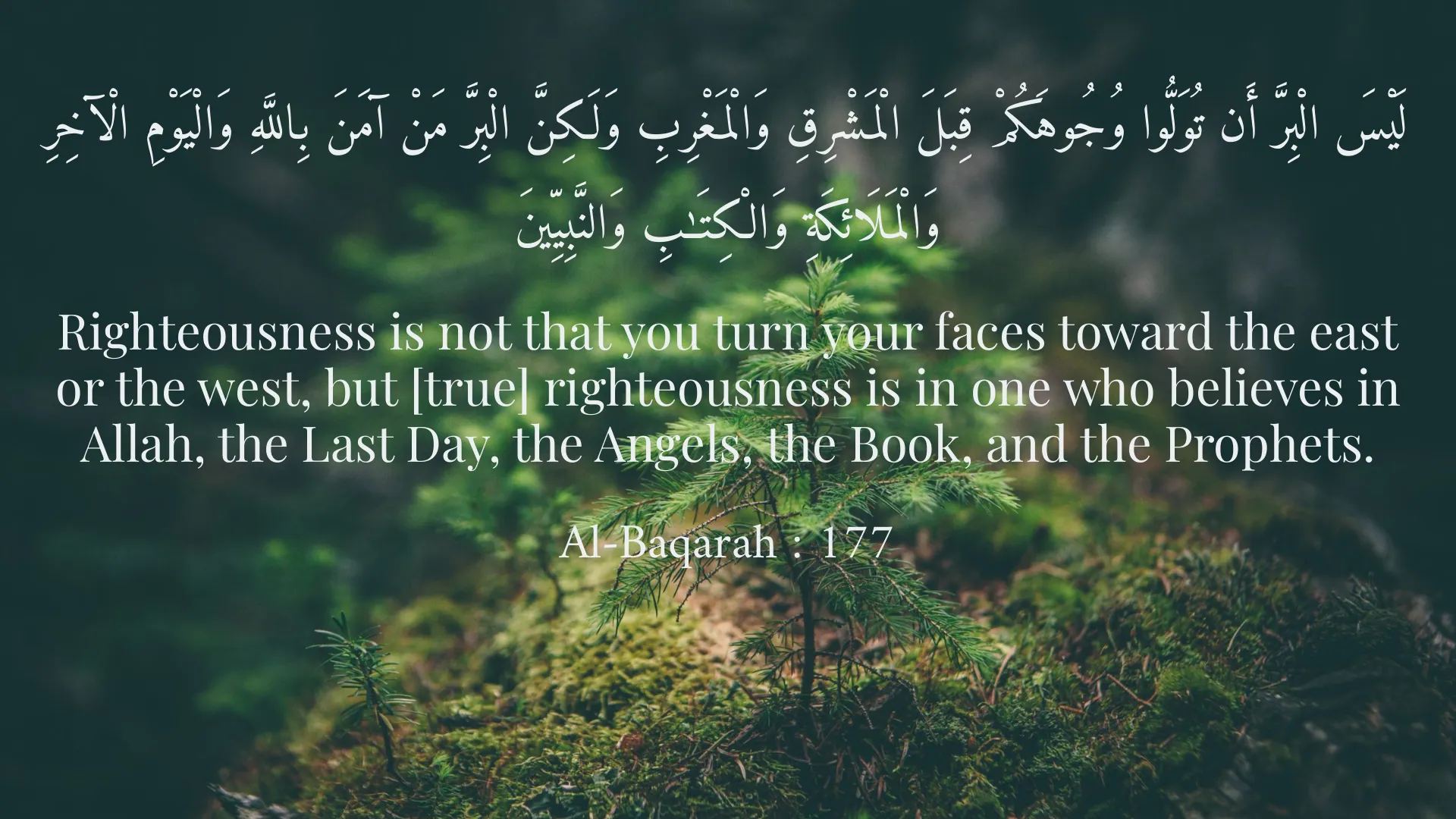
لَيْسَ الْبِرَّ أَن تُوَلُّوا وُجُوهَكُمْ قِبَلَ الْمَشْرِقِ وَالْمَغْرِبِ وَلَـكِنَّ الْبِرَّ مَنْ آمَنَ بِاللَّهِ وَالْيَوْمِ الْآخِرِ وَالْمَلَائِكَةِ وَالْكِتَـٰبِ وَالنَّبِيِّينَ
Righteousness is not that you turn your faces toward the east or the west, but [true] righteousness is in one who believes in Allah, the Last Day, the Angels, the Book, and the Prophets.
Al-Baqarah : 177
قُلْ إِن كُنتُمْ تُحِبُّونَ اللَّهَ فَاتَّبِعُونِي يُحْبِبْكُمُ اللَّهُ
Say, 'If you love Allah, then follow me, so Allah will love you.'
Al-Imran : 31
Short Story
One day, amidst the marketplace, a knowledgeable man looked at others with a loving gaze. He knew that his loving look not only influenced their faces but also warmed their hearts. He recalled God's words that say, 'If you want Allah to love you, you must show love.' Living with this perspective, he was beloved by many.