Quranic Answer
This profound question touches upon the very essence of the spiritual journey for any truth-seeker. The Islamic understanding of faith (Iman) and the role of knowledge (Ilm) within it is far more dynamic than a static, unchangeable belief. The Holy Quran, our divine guide, teaches us that faith is not merely a conviction of the heart but a continuous journey, an unending growth, and an evolving state that requires constant nourishment, deepening, and strengthening through knowledge. The explicit answer from the Quran to your question is that while your initial faith is valuable and a blessed starting point, it is never 'sufficient' in the sense of being the end of the road; rather, you must always strive to increase it through the acquisition of knowledge and understanding. The Roots of Faith in the Heart and its Need for Knowledge's Nourishment: Faith—belief in Allah, His angels, His books, His messengers, the Last Day, and Divine Decree—forms the backbone of a Muslim's identity. The Quran emphasizes the critical importance of heartfelt belief and submission to divine will in numerous verses. It is this inner conviction that grants tranquility, safeguards one from polytheism and disbelief, and guides towards the pure monotheism of Islam. However, is this initial faith, which might have been formed through tradition or environment, enough to navigate life's myriad challenges and attain higher degrees of proximity to Allah? The Quran clearly indicates that faith has the potential for growth and increase. In Surah Al-Anfal, verse 2, Allah states: "Indeed, the believers are only those who, when Allah is mentioned, their hearts tremble, and when His verses are recited to them, it increases them in faith; and upon their Lord they rely." This verse explicitly states that the recitation of divine verses (which are sources of knowledge) leads to an increase in faith. This signifies that faith is a living entity that requires constant nourishment from the springs of knowledge and understanding to thrive and flourish. The Exalted Status of Knowledge in the Quranic Vision: The Holy Quran has repeatedly emphasized the unparalleled importance of knowledge. In Islam, the pursuit of knowledge is an obligation, not an optional endeavor. Allah Almighty clearly distinguishes between those who know and those who do not in Surah Az-Zumar, verse 9: "Say, 'Are those who know equal to those who do not know?' Only those of understanding will remember." This verse powerfully conveys that knowledge bestows insight and the ability to discern truth from falsehood, enabling one to learn from divine signs in the scripture and in the universe. Knowledge is not confined solely to religious sciences; it encompasses reflection on creation, the laws of nature, history, sociology, and anything that leads to a deeper recognition of Allah and His wisdom. The more a person learns, the more they grasp the signs of Allah's power, grandeur, wisdom, and justice. This deeper comprehension, in turn, strengthens and firmly roots their faith. The knowledge of Allah acquired through diligent study and reflection differs vastly from a belief based merely on imitation or inherited tradition. The Indivisible Link Between Faith and Knowledge: In Islam, faith and knowledge are two sides of the same coin—mutually reinforcing and inseparable. Faith without knowledge can lead to fanaticism, superficiality, or even superstition, and it may crumble when faced with doubts. Conversely, knowledge without faith might result in arrogance, nihilism, and a detachment from spirituality. Both must grow in tandem. The Quran consistently invites humanity to reflect, ponder, reason, and contemplate; these are all processes of acquiring knowledge and attaining certainty (yaqin). When a person examines the divine verses in the Quran with intellect and wisdom, or reflects upon the wonders of creation, they come to realize the Creator's magnificence, and their faith evolves from a mere belief to something closer to certainty and direct apprehension. Knowledge provides the tools to understand the complexities of religion and to address logical inquiries, thereby elevating one's faith from a simple conviction to a profound and unwavering certitude. This elevation enhances faith's resilience against temptations, doubts, and tribulations of the era. Knowledge, the Guiding Light for Righteous Deeds: Faith in Islam is not merely an internal conviction; it must manifest in action. Righteous deeds are the fruits of faith and knowledge. Knowledge teaches individuals how to worship Allah in the best manner, respect the rights of others, adorn themselves with noble character, and be constructive members of society. Without knowledge, one might perform actions that appear good but are in reality contrary to divine pleasure or even harmful. For instance, knowledge clarifies the rulings of prayer, fasting, charity (Zakat), and pilgrimage (Hajj), instructing on their correct performance. Furthermore, in human interactions, knowledge guides us towards justice, kindness, honesty, and trustworthiness. This amalgamation of knowledge and action transforms faith from a mental state into an active, purposeful way of life. The more one knows about divine commands and wisdom, the more precise, sincere, and effective their actions will be. An Everlasting Invitation to Excellence: Therefore, the answer to the question, "Is my faith sufficient, or should I seek more knowledge?" is always that one must seek more knowledge. This is an everlasting invitation to continuous growth and excellence. Even Prophet Muhammad (peace be upon him), who was the fountainhead of knowledge and wisdom, used to pray to Allah for an increase in knowledge: "And say, 'My Lord, increase me in knowledge'" (Quran 20:114). This verse teaches us that we should never feel that we have acquired enough knowledge or that our faith has reached its ultimate degree. The path to divine proximity is endless, and every step on this path requires greater insight and deeper understanding. This quest for increased knowledge is not only for religious sciences but for understanding and contemplating all aspects of creation. Every scientific discovery, every new insight into the universe, can open a fresh window to the Creator's grandeur and power, thereby strengthening faith exponentially. The goal is not to reach a point where knowledge is no longer needed, but to always be on the path of knowing and deepening one's faith; for the more you know, the greater your certainty will become, and the more your heart will be filled with tranquility. Your faith is like a seed that, to fully blossom, needs continuous watering with the pure water of knowledge and nurturing with righteous deeds to become a mighty and fruitful tree.
Related Verses
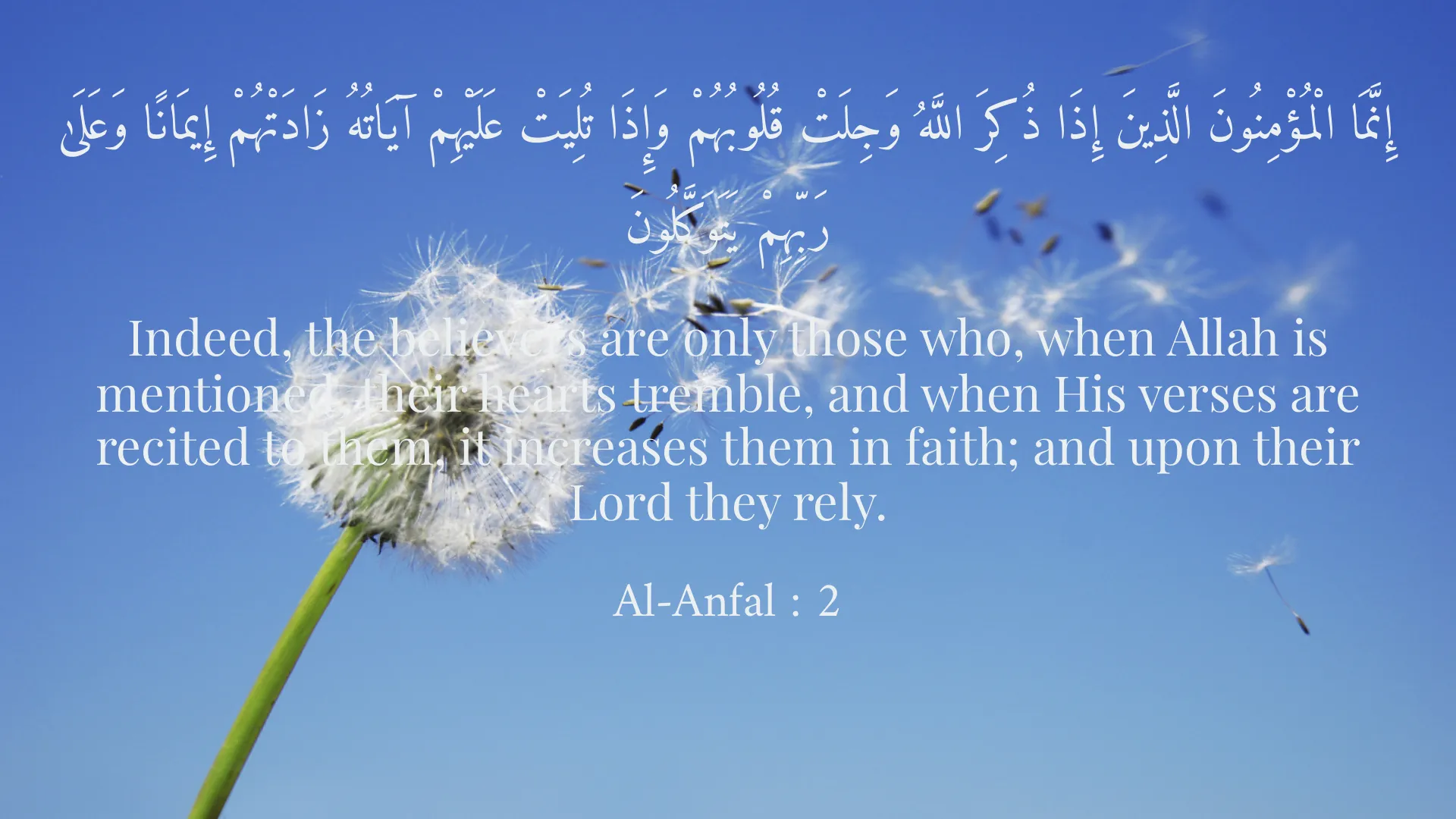
إِنَّمَا الْمُؤْمِنُونَ الَّذِينَ إِذَا ذُكِرَ اللَّهُ وَجِلَتْ قُلُوبُهُمْ وَإِذَا تُلِيَتْ عَلَيْهِمْ آيَاتُهُ زَادَتْهُمْ إِيمَانًا وَعَلَىٰ رَبِّهِمْ يَتَوَكَّلُونَ
Indeed, the believers are only those who, when Allah is mentioned, their hearts tremble, and when His verses are recited to them, it increases them in faith; and upon their Lord they rely.
Al-Anfal : 2
قُلْ هَلْ يَسْتَوِي الَّذِينَ يَعْلَمُونَ وَالَّذِينَ لَا يَعْلَمُونَ ۗ إِنَّمَا يَتَذَكَّرُ أُولُو الْأَلْبَابِ
Say, 'Are those who know equal to those who do not know?' Only those of understanding will remember.
Az-Zumar : 9
فَتَعَالَى اللَّهُ الْمَلِكُ الْحَقُّ ۗ وَلَا تَعْجَلْ بِالْقُرْآنِ مِن قَبْلِ أَن يُقْضَىٰ إِلَيْكَ وَحْيُهُ ۖ وَقُل رَّبِّ زِدْنِي عِلْمًا
So exalted is Allah, the Sovereign, the Truth. And, [O Muhammad], do not hasten with [recitation of] the Qur'an before its revelation has been completed to you, and say, 'My Lord, increase me in knowledge.'
Taha : 114
Short Story
In ancient times, in a city full of wisdom, lived a devout worshiper who dedicated himself to prayer and remembrance of God. He adhered to his faith with all his heart and felt he needed to know nothing more, for his heart was filled with divine love, and he fulfilled his religious duties. One day, an old, illuminated dervish passed through the city. The worshiper asked him, "O wise elder, is my simple and pure faith not sufficient for salvation?" The dervish, with a warm smile and a loving gaze, replied: "My young man, a tree with shallow roots will fall with the slightest breeze, but a tree whose roots delve deep and wide into the earth stands firm against storms. Your faith is like that tree; for it not to waver in the storms of doubt and temptation, it needs the deep roots of knowledge to truly blossom." The worshiper pondered the dervish's words and realized that faith is not merely a feeling but requires understanding. From then on, he began to seek knowledge, reading the Quran with deeper reflection, attending the lessons of scholars, and contemplating the signs of creation. As his knowledge increased, his faith also deepened and broadened, transforming from a simple belief into a firm certainty and an indescribable tranquility. He understood that seeking knowledge was not a burden but a gift that enhanced his proximity to the Divine, making his faith truly 'sufficient' – not in its static form, but in its dynamic, ever-growing essence.