Quranic Answer
The profound and fundamental question, "Is my life truly on God's path?", requires deep reflection on the verses of the Holy Quran and a precise understanding of divine teachings. The Quran is not merely a book of guidance; it is a comprehensive blueprint for a meaningful and purposeful life, leading humanity towards perfection and divine satisfaction. God's path is a way founded on monotheism (Tawhid), sincerity (Ikhlas), true faith (Iman), and righteous deeds (Amal Salih). Its ultimate goal is closeness to the Almighty and the attainment of well-being and happiness in this world and the hereafter. The Holy Quran invites humanity to self-knowledge and knowledge of God, emphasizing that the purpose of human creation is nothing but the servitude and worship of the Lord. In Surah Adh-Dhariyat, verse 56, Allah states: "And I did not create the jinn and mankind except to worship Me." This foundational verse illustrates that the core of being on God's path is recognizing one's existential purpose and striving to fulfill it through sincere worship. Worship is not limited to ritualistic acts; it encompasses all dimensions of individual and social life – from how we interact with others, to our livelihoods, raising children, and even how we use our time and resources. Any activity performed with a divine intention and aimed at gaining His pleasure can be a form of worship. To determine whether one is truly on God's path, we must look at several key criteria provided by the Quran. The first and most important criterion is "Iman" (faith). Faith is not merely an internal affirmation but is intrinsically linked with righteous deeds. In Surah Al-Baqarah, verse 277, we read: "Indeed, those who believe and do righteous deeds and establish prayer and give zakah - they will have their reward with their Lord, and no fear will be upon them, nor will they grieve." This verse clearly demonstrates that the path to salvation and peace (which are signs of being on God's path) is a combination of faith, good deeds, establishing prayer, and giving zakah. Establishing prayer means not just performing the physical acts, but upholding the true essence of prayer in one's life, fostering a deep spiritual connection with the Creator. Giving zakah (charity) is a symbol of attention to the rights of others and the purification of wealth and soul. Another criterion emphasized by the Quran is the "Sirat al-Mustaqim" (Straight Path). In every unit of prayer (rak'ah), we ask Allah: "Guide us to the straight path" (Surah Al-Fatiha, verse 5). The Straight Path is a way free from any deviation, extremism, or negligence, leading to divine pleasure. This path requires intellect, contemplation, and adherence to the teachings of prophets and divine saints. Being on the Straight Path means upholding justice in all aspects of life, from speech and conduct to transactions and judgments. It signifies abstaining from oppression, corruption, falsehood, backbiting, envy, and anything that contradicts moral and divine principles. Furthermore, Surah Al-Asr provides a summary of the criteria for being on God's path. In this Surah, Allah says: "By time, Indeed, mankind is in loss, Except for those who have believed and done righteous deeds and advised each other to truth and advised each other to patience." These three complementary criteria – "advising each other to truth" and "advising each other to patience" – indicate that God's path is not merely an individual journey; it has deep social dimensions. We have a responsibility to invite society towards truth and justice, and in this endeavor, we must be patient ourselves and encourage others to steadfastness in the path of truth. Enjoining good and forbidding evil (Amr bil Ma'ruf wa Nahy anil Munkar) is part of this social responsibility that is repeatedly emphasized in the Quran. How can we practically align our lives with God's path? 1. Sincerity in Intention (Ikhlas): Perform every action for the sake of Allah, avoiding ostentation and showing off. 2. Adherence to Religious Obligations: Diligently perform prayers, fasting, zakah, Hajj (if able), and other religious duties. 3. Kindness to Creation (Ihsan): Treat parents, relatives, neighbors, the poor, and the needy with goodness and compassion. Helping others is one of the most prominent righteous deeds. 4. Earning Lawful Sustenance (Halal): Strive to earn one's livelihood through lawful means, avoiding any forbidden income. 5. Self-Purification and Moral Development (Tahdhib an-Nafs): Constantly strive to rectify moral weaknesses; avoiding lies, backbiting, envy, arrogance, stinginess, and cultivating virtues such as truthfulness, trustworthiness, humility, gratitude, and contentment. 6. Contemplation of the Quran and the Prophet's Sunnah: A deeper understanding of religious teachings and emulating the life of Prophet Muhammad (PBUH) and his Household (Ahl al-Bayt) helps us to know the right path and remain firm upon it. 7. Repentance and Seeking Forgiveness (Tawbah and Istighfar): No human is flawless. The important thing is that whenever we commit a sin, we immediately repent and seek forgiveness from Allah, striving not to repeat that mistake. The door of repentance is always open, which itself is a sign of Allah's boundless mercy and a way back to His path. 8. Reliance on Allah (Tawakkul): In all stages of life, whether in successes or failures, rely on Allah and know that everything is by His will and decree. Ultimately, being on God's path is a dynamic and continuous process, not a fixed destination. This journey requires continuous effort, honest self-assessment, and seeking assistance from the Almighty. Every step taken with sincere intention and for the sake of Allah's pleasure brings a person closer to this path. Living on God's path means living a life where one experiences inner peace, spiritual contentment, and true purpose, knowing that they are under His protection and moving according to His commands. This inner assurance is the greatest worldly reward for those who tread this path.
Related Verses
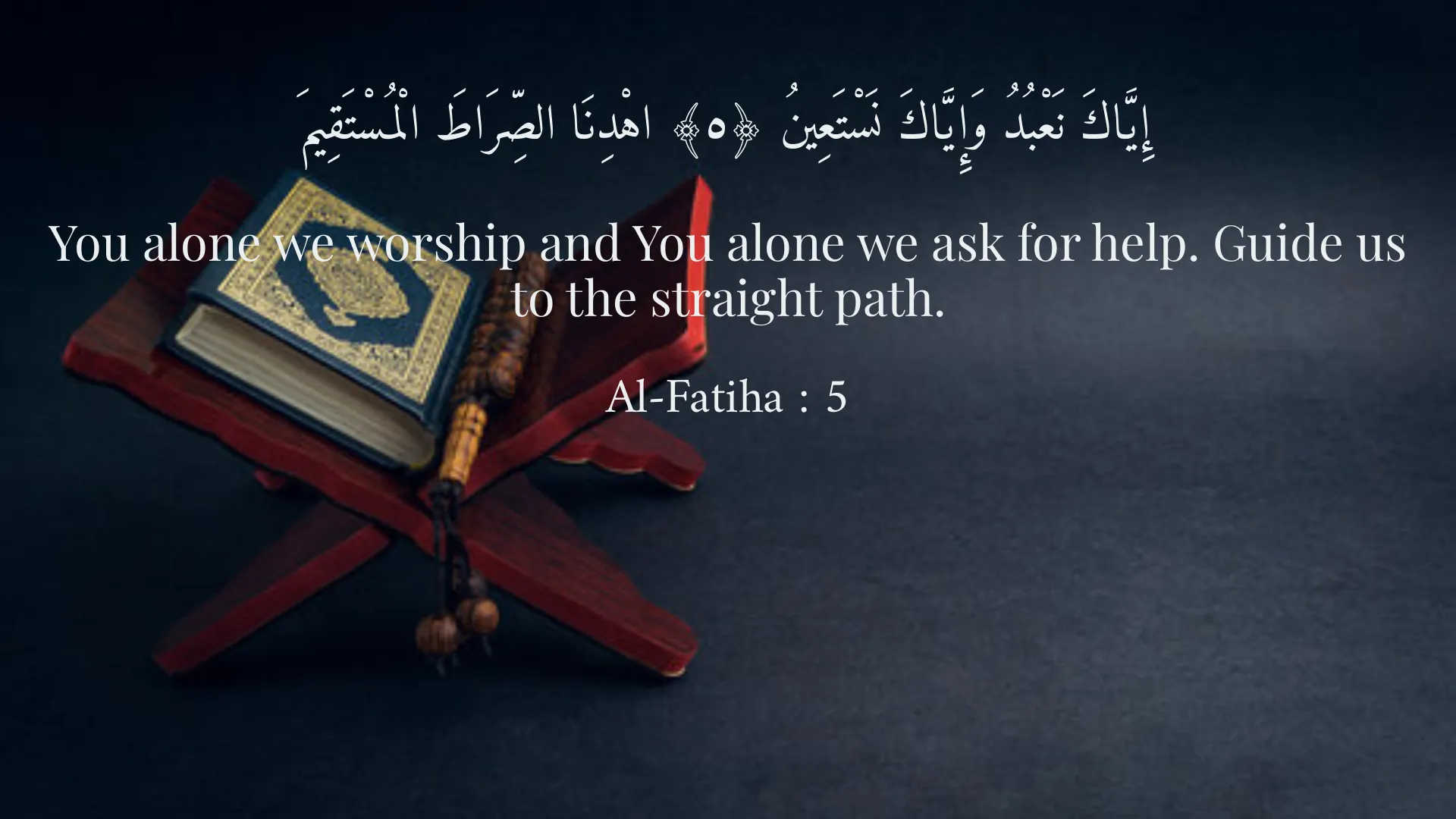
إِيَّاكَ نَعْبُدُ وَإِيَّاكَ نَسْتَعِينُ ﴿٥﴾ اهْدِنَا الصِّرَاطَ الْمُسْتَقِيمَ
You alone we worship and You alone we ask for help. Guide us to the straight path.
Al-Fatiha : 5
وَمَا خَلَقْتُ الْجِنَّ وَالْإِنسَ إِلَّا لِيَعْبُدُونِ
And I did not create the jinn and mankind except to worship Me.
Adh-Dhariyat : 56
إِنَّ الَّذِينَ آمَنُوا وَعَمِلُوا الصَّالِحَاتِ وَأَقَامُوا الصَّلَاةَ وَآتَوُا الزَّكَاةَ لَهُمْ أَجْرُهُمْ عِندَ رَبِّهِمْ وَلَا خَوْفٌ عَلَيْهِمْ وَلَا هُمْ يَحْزَنُونَ
Indeed, those who believe and do righteous deeds and establish prayer and give zakah - they will have their reward with their Lord, and no fear will be upon them, nor will they grieve.
Al-Baqarah : 277
وَالْعَصْرِ ﴿١﴾ إِنَّ الْإِنسَانَ لَفِي خُسْرٍ ﴿٢﴾ إِلَّا الَّذِينَ آمَنُوا وَعَمِلُوا الصَّالِحَاتِ وَتَوَاصَوْا بِالْحَقِّ وَتَوَاصَوْا بِالصَّبْرِ
By time, Indeed, mankind is in loss, Except for those who have believed and done righteous deeds and advised each other to truth and advised each other to patience.
Al-Asr : 1
Short Story
One day, a young man named Arif walked through the bustling city market, feeling lost amidst the clamor of people and worldly pursuits. He sought the meaning of his life, pondering, "Am I truly on the right path?" Arif approached an old sage who was teaching in a corner of the mosque. The sage, with a kind smile, asked, "What troubles you, young man?" Arif replied, "O wise sage, my heart is restless. I wish to know if my life is on the path of divine pleasure? How can I discern this?" The sage paused for a moment and said, "My son, God's path is like a clear river that springs from the fountain of faith and flows into the ocean of truth. To know if you are on this path, observe three signs: First, does your heart find tranquility in the remembrance of God? Second, is your hand extended to the needy, and are you moved by the suffering of others? And third, is your tongue pure from falsehood and backbiting, speaking nothing but the truth?" Arif lowered his head, lost in thought. He spent the following days reflecting on these three signs. Whenever he remembered God, he tried to be mindful; whenever he saw someone in need, he strove to help; and he vowed to speak nothing but the truth. Gradually, Arif felt a profound peace settle in his heart. He no longer felt lost in the bustling market; instead, with every step he took, a light from within guided him, and he knew that, by divine grace, he was treading the correct path. The sage smiled and said, "You have now found your own answer, for God's path is not in distant lands, but lies within your heart and good deeds."