Quranic Answer
The concept of revenge and retribution is a complex and multifaceted topic, especially within the context of religious texts such as the Holy Quran. The notion of revenge is often seen as a natural human response to injustice and wrongdoing; however, the Quran presents a more nuanced understanding of this emotion and provides guidance on how to deal with conflicts in a way that resonates with justice, compassion, and the broader principles of humanity. One significant verse that addresses the concept of legal retribution is Surah Al-Baqarah, verse 178. The verse states: 'O you who have believed, prescribed for you is legal retribution for those murdered - the free for the free, the enslaved for the enslaved, and the female for the female.' This verse establishes a clear right to retribution within the Islamic framework, suggesting that when a crime such as murder is committed, there is a structured approach to seeking justice. The idea of 'an eye for an eye' reflects a principle that aims to maintain balance and justice in society, ensuring that the punishment corresponds to the crime committed, without leading to excessive retaliation. On the surface, this verse may appear to promote the idea of revenge; however, when regarded in conjunction with other teachings of the Quran, it becomes evident that the emphasis is more on maintaining justice rather than encouraging vengeance. This is crucial as it acknowledges the pain and suffering caused by loss while simultaneously providing a legal framework for individuals and communities to seek justice in an equitable manner. The message is clear: while there is a right to retribution, it is bound by the principles of fairness and justice and not driven solely by emotions. In juxtaposition to this idea of retribution is the notion of compassion and forgiveness, highlighted in Surah Al-Ma'idah, verse 32. The verse reads: 'Because of that, We decreed upon the Children of Israel that whoever kills a soul unless for a soul or for corruption [done] in the land - it is as if he had slain mankind entirely. And whoever saves one - it is as if he had saved mankind entirely.' This verse underscores the immense value of human life, indicating that taking a life unjustly equates to the destruction of all humanity. This profound understanding of life emphasizes the significance of compassion over revenge. While retribution may serve as a means of offering justice, saving a life showcases the highest moral ground. The Quran continuously encourages believers to elevate their responses beyond the primal instinct of retaliation. It reinforces a notion of understanding the broader implications of one's actions within the societal fabric. Additionally, Surah Fussilat, verse 34 articulates a similar sentiment: 'And not equal are the good deed and the bad. Repel [evil] by that [good] which is best.' This verse acts as a guiding principle for engaging with others, especially when faced with wrongdoing. It suggests that rather than retaliating, one should respond with kindness and justice. This engagement does not merely promote peace within societies but also fosters a culture of forgiveness and healing. The Quran encourages believers to strive towards goodness, even when faced with adversity and wrongdoing. This guidance is particularly valuable in interpersonal relationships, community dynamics, and broader societal interactions. Instead of perpetuating a cycle of vengeance, the Quran advocates for the transformation of negative experiences into opportunities for positive actions. In exploring these verses, it becomes apparent that while the right to retribution exists, the preference for forgiveness and the promotion of good deeds is central to Islamic teachings. The balance between seeking justice and extending forgiveness plays a critical role in shaping the morals and ethics of a believer's life. It's essential to recognize that the teachings of the Quran on revenge and retribution are not mere academic concepts but practical wisdom designed to enhance the quality of life within communities. The implications of these teachings are broad, impacting how individuals relate to one another, manage conflicts, and build societies that reflect justice and compassion. Moreover, understanding these concepts could also be immensely beneficial in contemporary contexts, where feelings of injustice often lead to cycles of violence and reprisal. The Quranic prescription for balance between retribution and forgiveness can be interpreted as a timeless suggestion for modern-day conflicts, emphasizing dialogue, understanding, restitution, and cooperation rather than cycles of vengeance. In conclusion, the Holy Quran provides a comprehensive approach to the concepts of revenge and retribution, emphasizing a structured legal framework for justice while urging believers towards forgiveness and compassion. This duality within the teachings strikes at the heart of human experience, as it allows for the acknowledgment of pain while promoting healing through understanding and goodness. The verses discussed offer a model not only for personal behavior but for the collective ethos of societies, promoting a narrative where justice coexists with mercy for the betterment of all humanity.
Related Verses
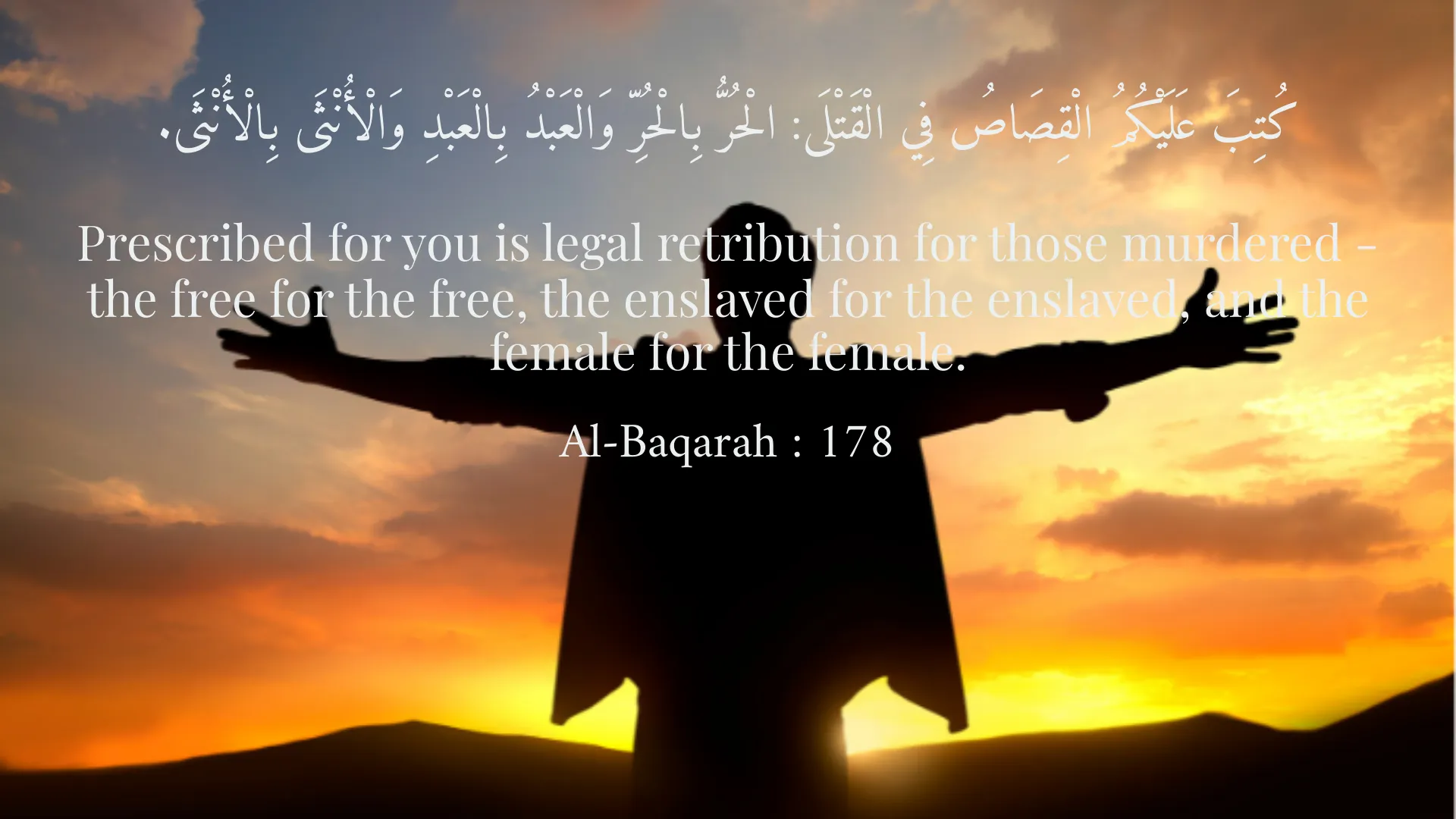
كُتِبَ عَلَيْكُمُ الْقِصَاصُ فِي الْقَتْلَى: الْحُرُّ بِالْحُرِّ وَالْعَبْدُ بِالْعَبْدِ وَالْأُنْثَى بِالْأُنْثَى.
Prescribed for you is legal retribution for those murdered - the free for the free, the enslaved for the enslaved, and the female for the female.
Al-Baqarah : 178
وَ مِنْ أَجْلِ ذَٰلِكَ كَتَبْنَا عَلَىٰ بَنِي إِسْرَائِيلَ أَنَّهُ مَن قَتَلَ نَفْسًا بِغَيْرِ نَفْسٍ أَوْ فَسَادٍ فِي الْأَرْضِ فَكَأَنَّمَا قَتَلَ النَّاسَ جَمِيعًا.
Because of that, We decreed upon the Children of Israel that whoever kills a soul unless for a soul or for corruption [done] in the land - it is as if he had slain mankind entirely.
Al-Ma'idah : 32
وَلَا تَسْتَوِي الْحَسَنَةُ وَالْسَّيِّئَةُ ۚ ادْفَعْ بِالَّتِي هِيَ أَحْسَنُ.
And not equal are the good deed and the bad. Repel [evil] by that [good] which is best.
Fussilat : 34
Short Story
One day, a girl named Samira thought about taking revenge for betrayal she suffered. However, when she studied the Quran, she realized that forgiveness and compassion hold greater value. She decided to refrain from revenge and instead respond with kindness. Samira felt a sense of peace from this decision, and over time, she noticed her life filled with love and friendship.