Quranic Answer
The Holy Quran, regarded as the ultimate source of guidance for Muslims, cajoles individuals to maintain sincerity in their intentions when performing good deeds. A central theme in Islamic teachings is the notion of sincerity, encapsulated in the notions of showing off (Riyaa) and hypocrisy (Nifaaq). Both of these terms convey the idea of insincerity in one's intentions and actions. The Quran addresses this vital issue explicitly, shedding light on the consequences and ramifications of engaging in such behavior. In this article, we will explore the essence of showing off and hypocrisy as referenced in the Quran, and the importance of carrying out good deeds with a pure heart, devoid of any ulterior motives. Showing off refers to the performance of good deeds with the intention of gaining attention or praise from others rather than purely for the sake of Allah. Allah elucidates this concept in Surah Al-Baqarah, verse 264, where He states: "O you who have believed, do not invalidate your charities with reminders or injury as one who spends his wealth only to be seen by the people." The verse presents a stark warning that good deeds can lose their value if they are obscured by one’s desire for recognition. It implies that the intrinsic value of charity is tarnished when it is intertwined with the need for social validation. Spending wealth, offering help, or engaging in acts of kindness are only commendable when they stem from the pure intention of pleasing Allah. If one undertakes these actions to exhibit a favorable image to society or to earn the admiration of others, the righteous deeds can be rendered null and void. This notion further emphasizes the importance of intention (niyyah) in Islam. The Prophet Muhammad (peace be upon him) famously stated, "Actions are judged by intentions, so each person will have what they intended." This hadith, recorded in Sahih Bukhari and Sahih Muslim, underscores that the sincerity of one’s intentions directly affects the acceptance of their actions. A charitable gesture that is colored by a desire for recognition can lead to the disapproval of Allah. Thus, individuals are urged to introspect and cultivate a sincere intention when engaging in any virtuous act. Moreover, in Surah Al-Ma'idah, verse 54, Allah warns believers of the dire consequences that come with the practice of showing off and hypocrisy. The verse states: "O you who have believed! Whoever of you should revert from his religion - Allah will bring forth for the people whom He will love and who will love Him...." This verse suggests that engaging in hypocrisy and ostentation can distance an individual from the grace of Allah, resulting in spiritual repercussions. The path that leads one to abandon their faith is often paved with acts performed without sincerity, leaving their hearts obscured by the darkness of insincerity and desire for worldly praise. In essence, the Quran categorizes showing off as one of the most abominable sins one can commit. A hadith from the Prophet Muhammad (pbuh) reinforces this perspective, warning individuals to "Beware of showing off your good deeds, for whoever shows off will not be resurrected by Allah on the Day of Judgment." This profound statement serves as a reminder of the significant implications of showing off. It captures the essence of the internal battle between seeking Allah’s pleasure versus the yearning for public acknowledgment. The Quran advocates for the cultivation of a sincere heart through the practice of humility in one’s private and public worship. It highlights that true submission to Allah involves performing good deeds independently of the influence or gaze of others. In the pursuit of goodness, individuals are reminded to maintain privacy and discretion in their acts of worship. The Quran narrates instances of righteous ancestors who carried out their charitable deeds quietly and without broadcasting their generosity to gain admiration. The practice of engaging in righteous deeds purely for the sake of Allah not only fosters a soul that remains grounded in faith but also cultivates a sense of inner peace. Additionally, showing off can lead to a cycle of hypocrisy, where individuals become trapped in a façade of piety that is ultimately devoid of sincerity. This dissonance between one's public persona and private intentions can result in alienation from true faith. Allah warns believers to assess their motives continuously to ensure that their actions align with their faith. This promotes spiritual growth and fosters a sense of accountability towards Allah and one's deeds. Addressing the issue of hypocrisy, contemporary scholars argue that showing off and insincere behaviors remain pertinent challenges faced by many Muslims today. The influence of social media and contemporary culture exacerbates this phenomenon, where individuals regularly curate their identities for public approval. This raises critical questions about the essence of good deeds and whether one's actions are performed genuinely or as part of a larger performance to gain social capital. To overcome these challenges, Muslims are encouraged to engage in self-reflection, suppression of the ego, and seek knowledge that fosters sincerity in their worship. Empowering oneself with Islamic teachings about sincerity is paramount to combating the urge to show off. Acts of worship should be rooted in sincerity and love for Allah. Moreover, nasihat (advice) from scholars and engaging in discussions about the importance of maintaining pureness in one’s actions can serve as conducive strategies to nurture sincerity in the hearts of believers. In conclusion, the Quran emphasizes the detrimental practices of showing off and hypocrisy. It delineates the importance of intention in every action, reinforcing that good deeds are honored and accepted only when performed sincerely for the sake of Allah. Believers are continually reminded to assess their intentions, promote selflessness in their acts of worship, and cultivate a heart that seeks genuine connection with their Creator. As espoused in the hadith of the Prophet Muhammad (pbuh), it is the sincerity of one's heart and the purity of intentions that ultimately dictate the worth of their deeds in the eyes of Allah. Through conscious awareness and determination to act faithfully, individuals can navigate the challenges of ostentation and hypocrisy by striving towards sincere worship and virtuous living.
Related Verses
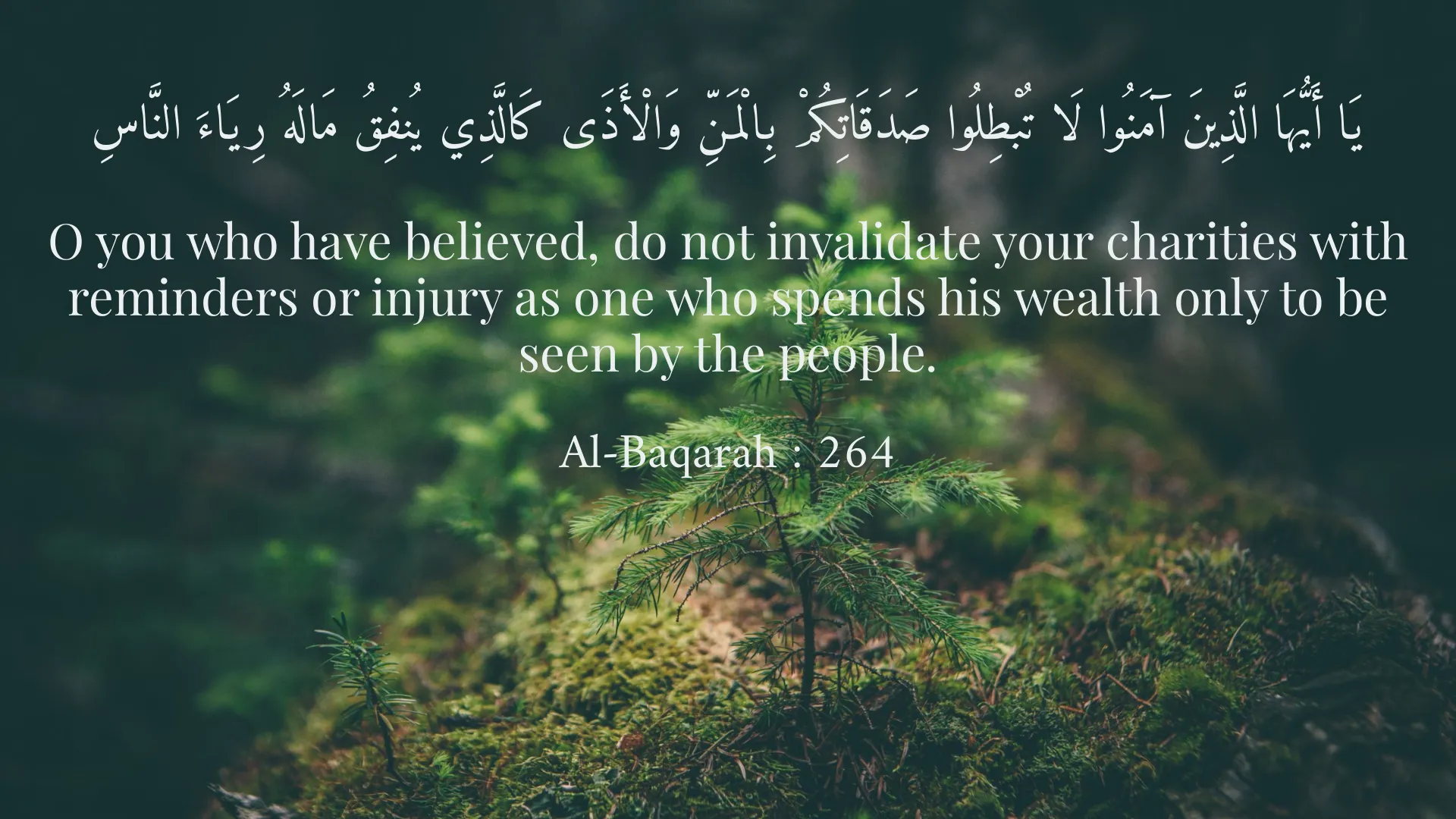
يَا أَيُّهَا الَّذِينَ آمَنُوا لَا تُبْطِلُوا صَدَقَاتِكُمْ بِالْمَنِّ وَالْأَذَى كَالَّذِي يُنفِقُ مَالَهُ رِيَاءَ النَّاسِ
O you who have believed, do not invalidate your charities with reminders or injury as one who spends his wealth only to be seen by the people.
Al-Baqarah : 264
يَا أَيُّهَا الَّذِينَ آمَنُوا مَن يَرْتَدَّ مِنكُمْ عَنْ دِينِهِ فَسَوْفَ يَأْتِي اللَّهُ بِقَوْمٍ يُحِبُّهُمْ وَيُحِبُّونَهُ
O you who have believed! Whoever of you should revert from his religion - Allah will bring forth for the people whom He will love and who will love Him.
Al-Ma'idah : 54
Short Story
One day, a man sat by the sea contemplating his deeds. He knew he should act for Allah's pleasure, yet he had doubts within. Suddenly, he realized that some of his actions had been merely to attract others' attention. He decided to purify his heart and, from that day forward, only perform deeds for Allah. With this shift in intention, he felt a greater sense of lightness and peace.