Quranic Answer
The question of whether silence signifies consent or inability is a profound and multifaceted issue in understanding human behavior, often carrying different meanings across cultures and legal systems. In seeking an answer to this question within the verses of the Holy Quran, we do not find an explicit, universal rule that always defines silence as consent or inability. Instead, the Quran, rather than relying on silence as a fixed principle, emphasizes the importance of clarity, plainness in speech, honesty, and accountability in expressing truths and acting upon intentions. Therefore, to answer this question, one must refer to the general Quranic principles and teachings that address communication, intentions, and individual responsibilities, thereby gaining a deeper understanding of the place of silence within the Quranic intellectual framework. The Holy Quran places significant importance on clear and explicit speech. Verses such as “qawlan shadeeda” (a sound and correct word) in Surah Al-Ahzab, verse 70, and “qawlan ma’rufa” (a kind word) in Surah An-Nisa, verse 5, indicate that Allah desires believers to be precise and clear in their speech. This emphasis on clarity in words implicitly suggests that relying on silence to understand consent or lack thereof, or ability and inability, can lead to ambiguity and misunderstanding. Thus, the Quran encourages explicit expression in word and deed rather than a mute interpretation of silence. Silence is inherently ambiguous and can carry various meanings, ranging from deep contemplation and reflection to an unwillingness to respond, fear, agreement, or even an inability to articulate. It is a nuanced human behavior that requires careful contextual analysis, and the Quranic teachings guide us towards seeking clarity. In instances where the Quran refers to contracts and commitments, such as marriage contracts or commercial transactions, the emphasis is on the mutual consent of the parties, which is often expressed through explicit declaration. Although in some jurisprudential branches and prophetic traditions, the silence of a virgin bride during a marriage proposal has been interpreted as consent, this is not a general Quranic rule but rather an exception within a specific social and legal context. This interpretation is often attributed to the natural shyness and modesty of a virgin in explicitly expressing consent, rather than silence itself being a universal sign of consent. Such interpretations from the prophetic tradition are based on a precise understanding of the situations and customs of the time and place and cannot be generalized to all aspects of life. In many other cases, the validity of a transaction or commitment requires explicit offer and acceptance, highlighting the Quran's general preference for clear communication. Furthermore, silence can indeed be a sign of inability. This could mean an inability to articulate the truth, an inability to confront injustice, or even a physical inability to speak. The Quran refers to conditions of weakness and inability in several verses and emphasizes supporting the weak and oppressed. For example, in Surah An-Nisa, verse 75, Allah refers to those who cry out: “Our Lord, take us out of this city whose people are oppressors, and appoint for us from Yourself a protector, and appoint for us from Yourself a helper.” These verses demonstrate that, at times, the silence of people can stem from suppression and inability, and Allah commands aid and liberation for them. Therefore, silence cannot always be interpreted as consent; in many instances, silence might be a cry of inability or a plea for help. It underscores the importance of contextual understanding rather than making sweeping generalizations based on silence alone. Additionally, silence can sometimes be a sign of wisdom and insight, such as silence in the face of ignorance or idle talk, or silence for deep contemplation and reflection. This type of silence is neither consent nor inability but a conscious and deliberate choice stemming from an individual's wisdom and foresight. The Quran encourages reflection and contemplation on divine signs and the universe, and in this journey, silence and contemplation play a key role. In Surah An-Naml, verse 82, we read: “And when the word falls upon them, We will bring forth to them a creature from the earth speaking to them, that people were not certain of Our verses.” Although this verse does not directly refer to silence, it emphasizes the importance of speech in conveying knowledge and shows that sometimes a clear and eloquent divine sign is needed for truth to become evident, and mere silence cannot be proof of belief or disbelief. Moreover, there are many verses about concealing the truth, such as in Surah Al-Baqarah, verse 42: “And do not mix truth with falsehood or conceal the truth while you know [it].” This suggests that silence, in some contexts, could be a sign of hiding the truth, rather than absolute consent or inability. Ultimately, the Holy Quran teaches us that to understand the meaning of silence, we must consider the context, the individual's intention, and the prevailing circumstances. There is no single universal rule for interpreting silence. Sometimes silence can indicate implicit acceptance (in specific cases with clear indicators), sometimes it may stem from weakness and inability, and sometimes it may arise from wisdom and prudence. What the Quran emphasizes is the discernment of truth from falsehood, clarity in communication, and accountability in word and deed. Therefore, in important matters, relying on silence to infer consent or lack thereof, or ability and inability, is incorrect, and one should seek clearer and more explicit signs, avoiding potential misunderstandings. The Quran encourages transparency and honesty and discourages ambiguity in human and social relations.
Related Verses
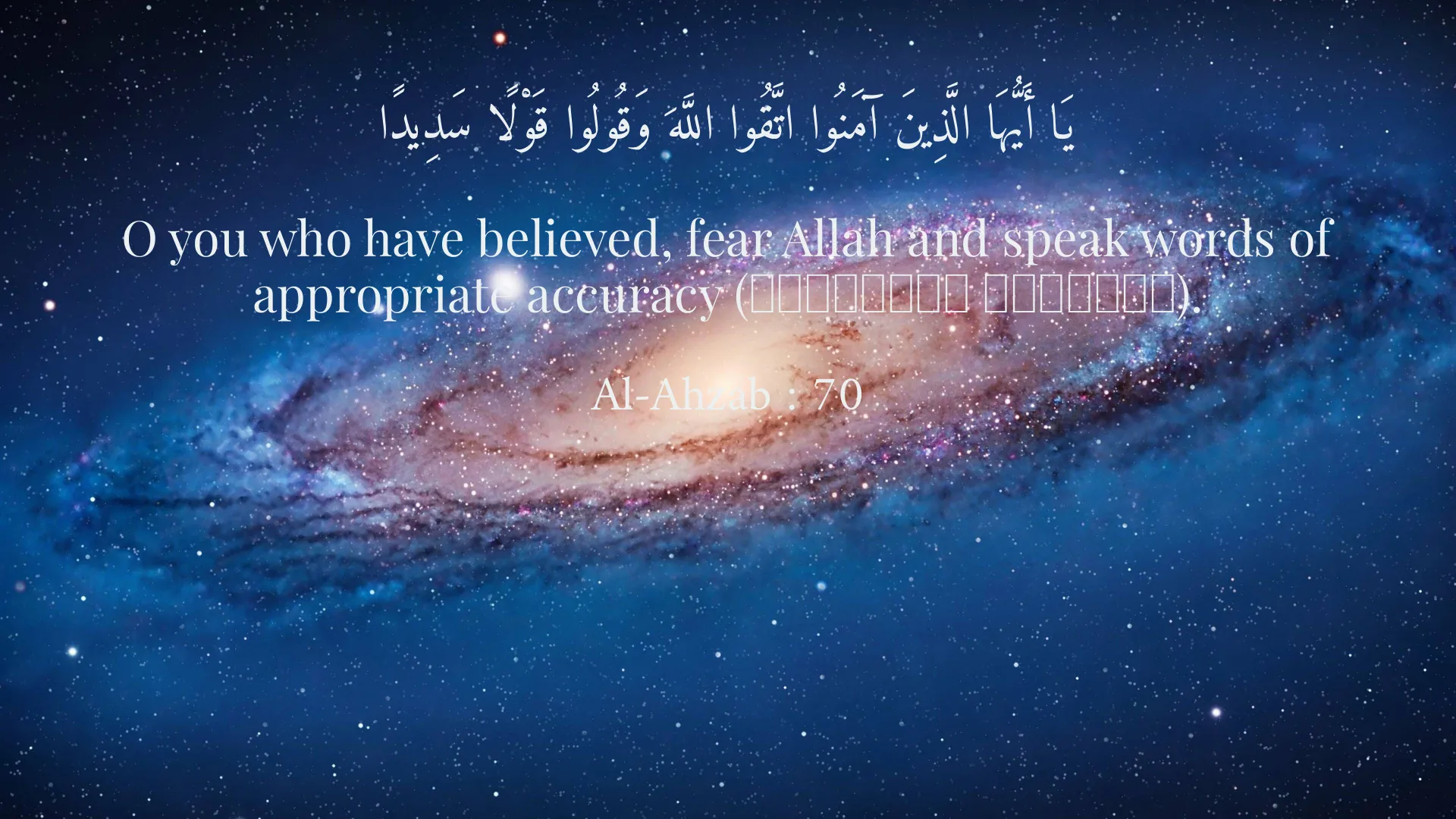
يَا أَيُّهَا الَّذِينَ آمَنُوا اتَّقُوا اللَّهَ وَقُولُوا قَوْلًا سَدِيدًا
O you who have believed, fear Allah and speak words of appropriate accuracy (قَوْلًا سَدِيدًا).
Al-Ahzab : 70
وَلَا تُؤْتُوا السُّفَهَاءَ أَمْوَالَكُمُ الَّتِي جَعَلَ اللَّهُ لَكُمْ قِيَامًا وَارْزُقُوهُمْ فِيهَا وَاكْسُوهُمْ وَقُولُوا لَهُمْ قَوْلًا مَّعْرُوفًا
And do not give the weak-minded your property, which Allah has made a means of sustenance for you, but provide for them with it and clothe them and speak to them words of appropriate kindness (قَوْلًا مَّعْرُوفًا).
An-Nisa : 5
وَلَا تَلْبِسُوا الْحَقَّ بِالْبَاطِلِ وَتَكْتُمُوا الْحَقَّ وَأَنتُمْ تَعْلَمُونَ
And do not mix the truth with falsehood or conceal the truth while you know [it].
Al-Baqarah : 42
Short Story
It is narrated in Saadi's Golestan that a wealthy man was sitting with a dervish, boasting incessantly about his wealth, possessions, and estates. The dervish remained silent throughout this entire time, uttering nothing. The wealthy man eventually asked the dervish, “Why are you silent? Do you have nothing to say?” The dervish replied with a warm smile, “My silence is a response to your words. You speak of what you possess, and I am silent about what I do not possess. I do not speak of my inner peace and contentment, for these are not things that can be expressed in words. Silence is sometimes full of meaning and sometimes empty of it, depending on whether a dervish has chosen it or a rich man.” This beautiful story teaches us that silence can have multiple meanings; sometimes it indicates wisdom and deep insight, and sometimes it may imply something else. Understanding it requires a proper grasp of the speaker's or listener's intention and circumstances.