Quranic Answer
In Islamic teachings, particularly as derived from the Holy Quran, the stance on silence in the face of injustice is unequivocally clear: it is generally considered a grave spiritual and moral failing, often tantamount to complicity, and thus can indeed be seen as a sin. The Quran emphasizes active engagement in establishing justice, upholding truth, and forbidding evil. It paints a picture of a proactive believer who is a force for good in society, not a passive observer of wrongdoing. The bedrock of this principle lies in the fundamental Quranic command of "Amr bil Ma'ruf wa Nahy anil Munkar," which translates to "enjoining what is right and forbidding what is wrong." This is not merely a recommendation but a core duty for the Muslim community and individuals within it. Allah states in Surah Ali 'Imran (3:104): "And let there be [arising] from you a nation inviting to [all that is] good, enjoining what is right and forbidding what is wrong, and those will be the successful." This verse explicitly highlights that success, both worldly and in the Hereafter, is linked to actively promoting good and preventing evil. Silence in the face of injustice directly contradicts the "Nahy anil Munkar" aspect, as it allows wrong to persist and even flourish. This divine injunction is not merely a moral guideline; it is a fundamental pillar for maintaining the health and dynamism of the Islamic society. When evil, especially injustice, remains unchecked, it not only emboldens the oppressor but also weakens the spirit of truth-seeking and responsibility among others. Furthermore, the Quran repeatedly calls believers to be "Qawwamina bil-Qist," meaning "upholders of justice" or "those who stand firmly for justice." This command is so profound that it extends even to situations where standing for justice might go against one's own interests or the interests of loved ones. In Surah An-Nisa (4:135), Allah says: "O you who have believed, be persistently [in adherence to] justice, witnesses for Allah, even if it be against yourselves or parents and relatives. Whether one is rich or poor, Allah is more worthy of both. So follow not [personal] inclination, lest you deviate. And if you distort [your testimony] or turn away, then indeed Allah is ever, with what you do, Acquainted." This powerful verse underscores that justice is an absolute principle that transcends personal bias, familial ties, or societal pressure. Silence, in this context, implies a failure to bear witness to justice, a failure to stand firm for what is right, and a failure to fulfill a divine injunction that forms the very essence of a just society. It demonstrates that the responsibility of every believer extends beyond individual self-interest towards the creation and preservation of a just social environment. The Quran also explicitly warns against inclining towards oppressors or being complicit with their wrongdoing. Surah Hud (11:113) states: "And do not incline toward those who do wrong, lest you be touched by the Fire, and you would not have other than Allah any protectors; then you would not be helped." While "inclining" might imply more than just silence (e.g., supporting or approving), remaining silent when one has the ability to speak out or act can be seen as a form of inclination or at least a failure to disassociate from the injustice. The verse carries a severe warning of divine punishment for those who, through their actions or inaction, facilitate oppression. This highlights that merely refraining from committing injustice oneself is not enough; one must also actively resist its spread. This inclination can even include weakening one's resolve to confront injustice or creating an environment where oppressors feel secure. Moreover, the Quran recounts historical narratives that serve as cautionary tales, illustrating the consequences of inaction. The story of the Sabbath-breakers in Surah Al-A'raf (7:163-166) is particularly relevant. Here, a group of people violated God's command regarding the Sabbath. The community split into three groups: those who committed the sin, those who actively forbade them, and those who remained silent, saying, "Why do you advise a people whom Allah is going to destroy or punish with a severe punishment?" Surah Al-A'raf (7:165) explicitly states: "So when they forgot that by which they had been reminded, We saved those who had forbidden evil and seized those who wronged with a wretched punishment because they were defiantly disobedient." While interpretations vary on the fate of the silent group, many scholars understand that their inaction did not absolve them entirely and that they too faced some form of divine displeasure, or at the very least, they were not among those saved. This narrative serves as a stark reminder that witnessing injustice and failing to respond, even out of a sense of futility, can have grave consequences. It implies that a believer's responsibility extends beyond personal piety to collective moral vigilance. The principle of justice (Adl) is central to the Islamic worldview. Islam seeks to establish a society founded on fairness, equity, and compassion. In such a society, oppression (Dhulm) is an anathema and must be actively confronted. Silence in the face of Dhulm allows the oppressor to continue their actions unchecked, validates their wrongdoing, and contributes to the suffering of the oppressed. It undermines the very fabric of a just society that Islam aims to build. A community where people are afraid to speak truth to power, or where they prioritize their personal comfort over standing up for the rights of others, is one that is far removed from the Quranic ideal. This silence not only helps strengthen the foundations of oppression but also causes the concept of justice in society to fade and gradually disappear. It is important to note that "speaking out" or "acting" against injustice does not always mean physical confrontation or reckless endangerment. The approach should be guided by wisdom (Hikmah) and an assessment of one's capability. The Prophetic tradition elaborates on this, stating that one should change evil with their hand (action), if not possible, then with their tongue (words), and if not possible, then with their heart (disapproval, prayer, internal resolve), and that the last is the weakest form of faith. While the Quran does not explicitly state these levels, it provides the foundational principles that underscore the importance of action. Even disapproval in the heart, when more direct action is impossible, is a form of non-silence. However, when capable, verbal or physical action is expected. This means that every believer, regardless of their position, has the responsibility to confront injustice to the best of their ability and means. In conclusion, silence in the face of injustice runs contrary to several core Quranic imperatives: the duty to enjoin good and forbid evil, the command to stand firmly for justice, and the explicit warnings against inclining towards oppressors. It can be interpreted as a form of complicity, a neglect of duty, and a failure to uphold the divine mandate of justice on Earth. While the specific degree of "sinfulness" may depend on the context, one's capacity, and the potential consequences of intervention, the general principle from the Quran is a clear call for proactive engagement against all forms of oppression. A true believer is an active participant in establishing righteousness and challenging wrong, rather than a silent bystander; for silence can mean implicit approval of tyranny, which is incompatible with the nature of faith. A society where oppressors act without resistance is not a society that God is pleased with, and its foundations will be built upon injustice.
Related Verses
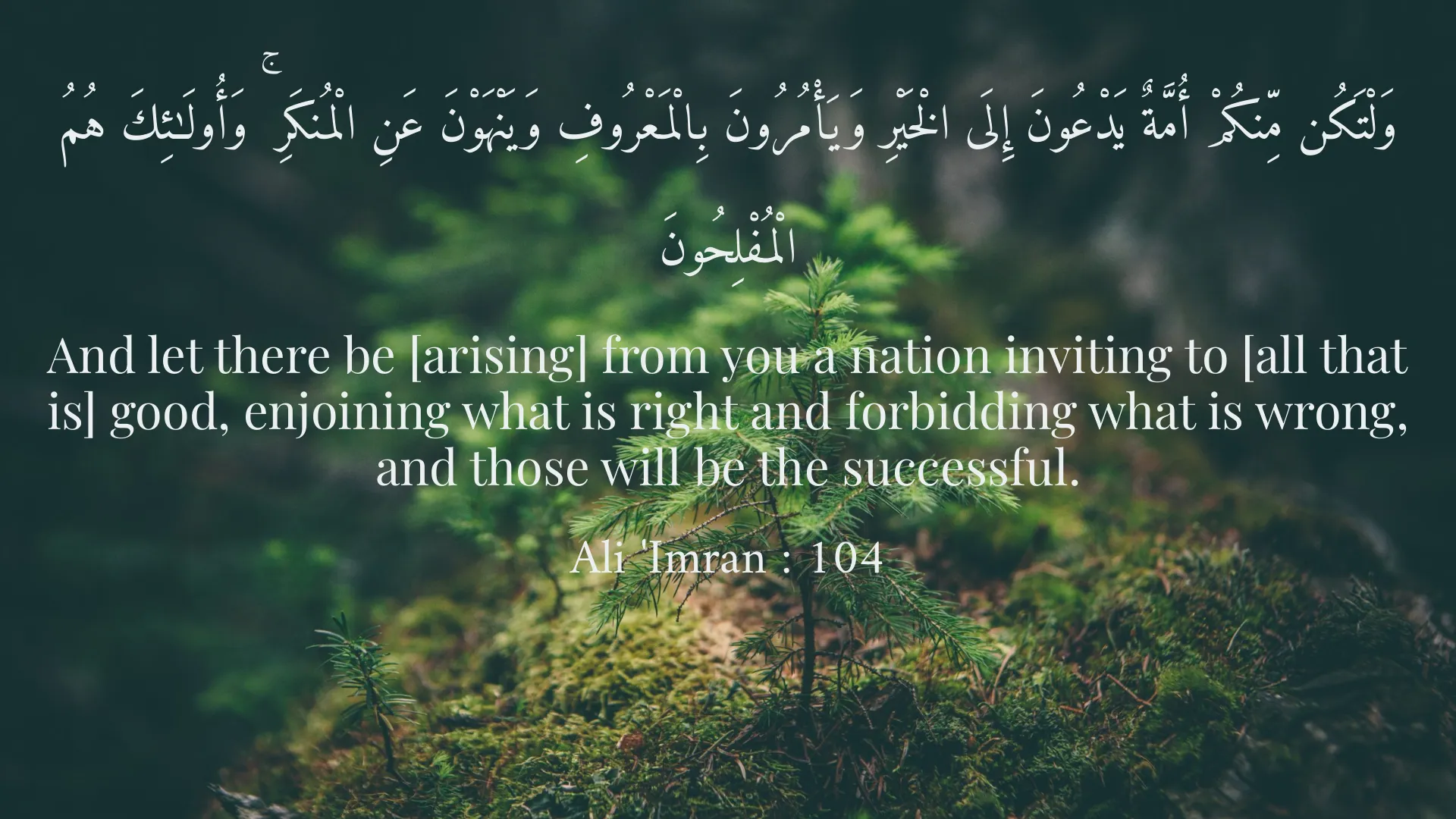
وَلْتَكُن مِّنكُمْ أُمَّةٌ يَدْعُونَ إِلَى الْخَيْرِ وَيَأْمُرُونَ بِالْمَعْرُوفِ وَيَنْهَوْنَ عَنِ الْمُنكَرِ ۚ وَأُولَٰئِكَ هُمُ الْمُفْلِحُونَ
And let there be [arising] from you a nation inviting to [all that is] good, enjoining what is right and forbidding what is wrong, and those will be the successful.
Ali 'Imran : 104
يَا أَيُّهَا الَّذِينَ آمَنُوا كُونُوا قَوَّامِينَ بِالْقِسْطِ شُهَدَاءَ لِلَّهِ وَلَوْ عَلَىٰ أَنفُسِكُمْ أَوِ الْوَالِدَيْنِ وَالْأَقْرَبِينَ ۚ إِن يَكُنْ غَنِيًّا أَوْ فَقِيرًا فَاللَّهُ أَوْلَىٰ بِهِمَا ۖ فَلَا تَتَّبِعُوا الْهَوَىٰ أَن تَعْدِلُوا ۚ وَإِن تَلْوُوا أَوْ تُعْرِضُوا فَإِنَّ اللَّهَ كَانَ بِمَا تَعْمَلُونَ خَبِيرًا
O you who have believed, be persistently [in adherence to] justice, witnesses for Allah, even if it be against yourselves or parents and relatives. Whether one is rich or poor, Allah is more worthy of both. So follow not [personal] inclination, lest you deviate. And if you distort [your testimony] or turn away, then indeed Allah is ever, with what you do, Acquainted.
An-Nisa : 135
وَلَا تَرْكَنُوا إِلَى الَّذِينَ ظَلَمُوا فَتَمَسَّكُمُ النَّارُ وَمَا لَكُم مِّن دُونِ اللَّهِ مِنْ أَوْلِيَاءَ ثُمَّ لَا تُنصَرُونَ
And do not incline toward those who do wrong, lest you be touched by the Fire, and you would not have other than Allah any protectors; then you would not be helped.
Hud : 113
فَلَمَّا نَسُوا مَا ذُكِّرُوا بِهِ أَنجَيْنَا الَّذِينَ يَنْهَوْنَ عَنِ السُّوءِ وَأَخَذْنَا الَّذِينَ ظَلَمُوا بِعَذَابٍ بَئِيسٍ بِمَا كَانُوا يَفْسُقُونَ
So when they forgot that by which they had been reminded, We saved those who had forbidden evil and seized those who wronged with a wretched punishment because they were defiantly disobedient.
Al-A'raf : 165
Short Story
It is narrated that in ancient times, a powerful king ruled who at times committed injustices, yet none of his courtiers dared to speak out for fear of his wrath. Only one wise old minister, whose beard had grown white in service, had the courage to utter the truth. One day, the king decided to seize a poor farmer's land for his hunting grounds without compensation. All advisors kept their peace. But the old minister, with a trembling voice yet resolute heart, stepped forward and said: "O King, the foundation of your kingdom is justice. When the people suffer injustice in silence, their hidden laments rise to the heavens, and the walls of tyranny, however grand, will crumble." The king, initially angered, paused. The minister continued, "Silence in the face of wrong is like building a wall with rotten bricks; it may stand for a while, but it will surely collapse." The king, struck by the truth and the minister's courage, rescinded his order and compensated the farmer generously. From that day, he listened more to honest counsel, understanding that true strength lies not in unchallenged power, but in justice, and that the silence of the wise is more perilous than the clamor of a thousand enemies.