Quranic Answer
The question of whether the Quran aligns with a minimalist lifestyle is a fascinating one, and upon closer examination, it becomes clear that there is a profound harmony between the core principles of both. While the term "minimalism" itself is a modern concept, the spiritual and ethical framework provided by the Quran inherently promotes a life of moderation, detachment from excessive materialism, and a focus on purpose and higher values, which are all hallmarks of a minimalist approach to living. At its heart, minimalism is about consciously choosing to live with less—less clutter, less distraction, and less attachment to material possessions—in order to make room for what truly matters, whether that be experiences, relationships, personal growth, or spiritual pursuits. This philosophy finds a strong echo in the Quran's teachings. One of the most prominent Quranic principles that resonates with minimalism is moderation (wasatiyyah). Islam is often described as the middle path, advocating for balance in all aspects of life. The Quran repeatedly encourages believers to avoid extremes, whether it's excessive indulgence or extreme asceticism. For instance, in Surah Al-Furqan (25:67), Allah describes the true servants of the Most Gracious as those who, when they spend, are neither extravagant nor miserly, but maintain a just balance between the two. This concept of balance directly contradicts the consumerist drive to constantly acquire more, pushing individuals towards a more measured and conscious approach to consumption. It's not about abstaining from the permissible enjoyments of life, but about enjoying them within limits, without falling into the trap of insatiable desire. This lifestyle teaches us to appreciate what we have and to make the best use of our possessions for our spiritual growth and elevation, instead of endlessly pursuing new things. Furthermore, the Quran explicitly condemns extravagance (israf) and waste (tabdhir). These terms are frequently used in the Quran to warn against excessive consumption and misuse of resources. In Surah Al-A'raf (7:31), Allah states: "O children of Adam, take your adornment at every place of prayer, and eat and drink, but be not excessive. Indeed, He likes not those who commit excess." Similarly, in Surah Al-Isra (17:26-27), those who are extravagant are described as "brothers of the devils." This prohibition extends beyond mere financial waste; it encompasses wasting time, talent, and natural resources. A minimalist mindset, which seeks to reduce waste, reuse, and be mindful of consumption, is therefore perfectly aligned with these Quranic injunctions. It encourages individuals to be stewards of the earth's resources, not their heedless exploiters. The idea is to recognize that everything we possess is a trust (amanah) from God, and we will be accountable for how we used it. This awareness naturally leads to more deliberate and less wasteful choices, ultimately contributing to environmental preservation and ecological balance. Another crucial aspect is spiritual detachment (zuhd). While Islam does not prescribe monasticism or absolute renunciation of the world, it strongly encourages believers to have a detachment from the love of worldly possessions. The Quran reminds us that this life is temporary and fleeting, a mere "play and amusement" compared to the eternal abode of the Hereafter (Surah Al-Hadid, 57:20). This perspective shifts one's priorities from accumulating material wealth and comforts to investing in spiritual growth, good deeds, and preparing for the ultimate return to God. When one's heart is not enslaved by possessions, the desire for "more" diminishes, paving the way for contentment with "enough." This detachment is not about living in destitution but about living with freedom from material bondage, recognizing that true richness lies in faith and good character, not in bank accounts or vast collections of goods. This teaching guides individuals towards a conscious life where the value of everything is measured by its impact on one's spiritual and moral growth, not merely by its material worth. The Quran's repeated calls for charity (infaq) and spending in the way of Allah further reinforce the idea of not hoarding wealth. If a significant portion of one's wealth is meant to be shared with the less fortunate, given as Zakat (obligatory charity), or used for communal good, it naturally limits personal accumulation. This encourages a dynamic flow of resources rather than stagnant hoarding, promoting economic justice and empathy, which are values that often accompany the minimalist desire to live responsibly and contribute positively to society. Giving away what is superfluous, or even what one cherishes, cultivates a spirit of generosity and reduces attachment to worldly goods, aligning seamlessly with the minimalist ethos of conscious consumption and giving. This approach also helps to distribute wealth more fairly in society and prevents its concentration in the hands of a few. Furthermore, the example of Prophet Muhammad (peace be upon him) and his companions vividly illustrates a life of simplicity and moderation. Despite being the leader of a burgeoning community and having access to resources, the Prophet often lived humbly, preferring a life free from excess. His dwelling was simple, his possessions few, and his focus was consistently on his mission and connection with God. This prophetic sunnah serves as a powerful practical guide for Muslims seeking to live a life unburdened by materialism, offering a living blueprint for minimalist principles centuries before the term was coined. This lifestyle of the Prophet is not only a model for individual living but also demonstrates a comprehensive approach to resource management and prioritizing spiritual values over material ones. In conclusion, while the Quran doesn't explicitly use the word "minimalism," its profound teachings on moderation, avoiding extravagance, spiritual detachment from worldly allurements, prioritizing the Hereafter, and the importance of charity, all converge to foster a lifestyle that is remarkably consonant with minimalist values. It encourages believers to be conscious consumers, responsible stewards of resources, and individuals whose hearts are not enslaved by material possessions. This leads not to deprivation, but to a richer, more purposeful, and ultimately more peaceful existence, free from the burdens of endless acquisition and the anxiety of consumerism, aligning a Muslim's worldly actions with their spiritual aspirations. This alignment indicates that minimalism can be a path to deepening faith and achieving ultimate happiness, not just a modern lifestyle trend.
Related Verses
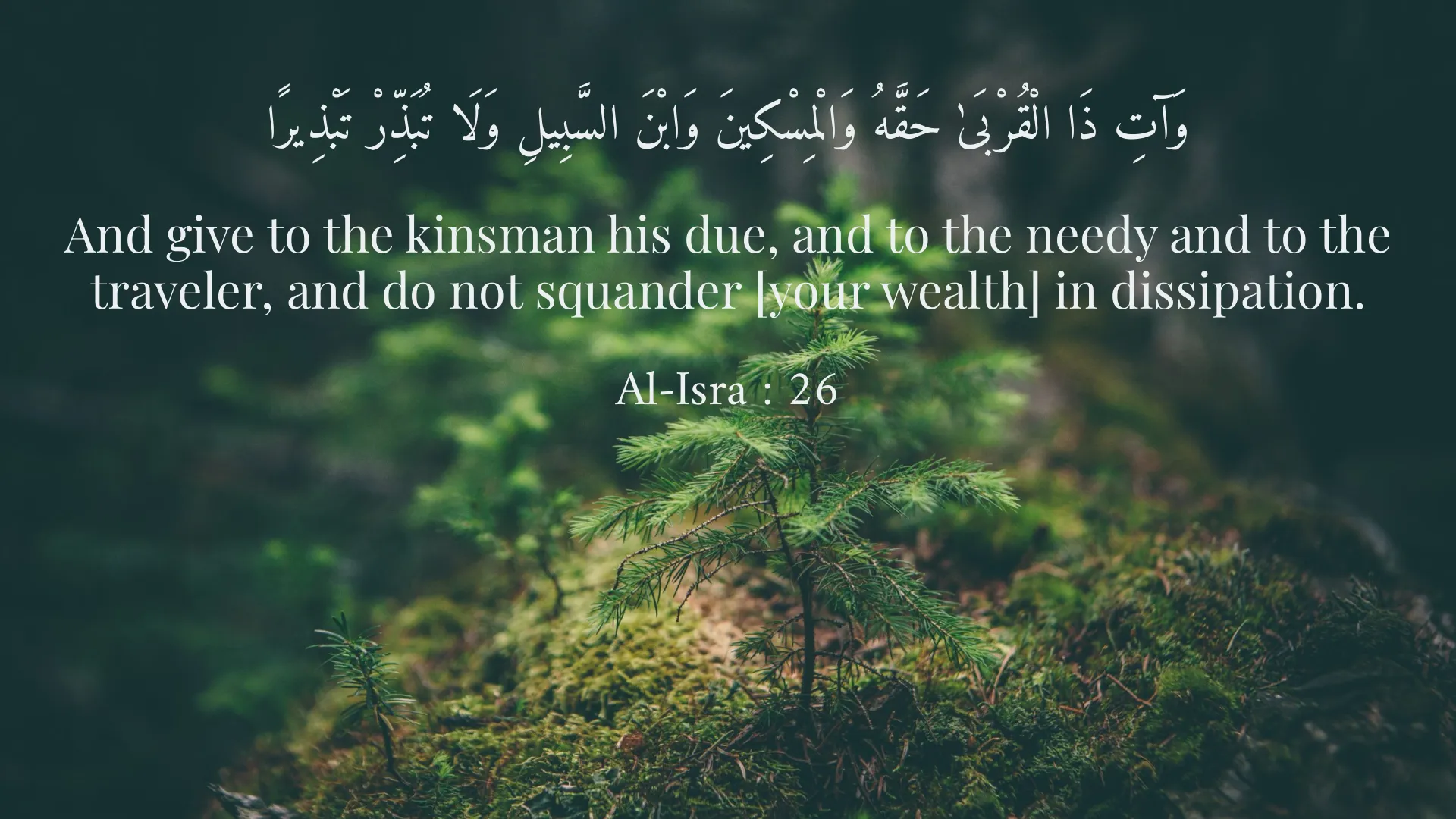
وَآتِ ذَا الْقُرْبَىٰ حَقَّهُ وَالْمِسْكِينَ وَابْنَ السَّبِيلِ وَلَا تُبَذِّرْ تَبْذِيرًا
And give to the kinsman his due, and to the needy and to the traveler, and do not squander [your wealth] in dissipation.
Al-Isra : 26
إِنَّ الْمُبَذِّرِينَ كَانُوا إِخْوَانَ الشَّيَاطِينِ ۖ وَكَانَ الشَّيْطَانُ لِرَبِّهِ كَفُورًا
Indeed, the squanderers are brothers of the devils, and ever has Satan been to his Lord ungrateful.
Al-Isra : 27
يَا بَنِي آدَمَ خُذُوا زِينَتَكُمْ عِندَ كُلِّ مَسْجِدٍ وَكُلُوا وَاشْرَبُوا وَلَا تُسْرِفُوا ۚ إِنَّهُ لَا يُحِبُّ الْمُسْرِفِينَ
O children of Adam, take your adornment at every place of prayer, and eat and drink, but be not excessive. Indeed, He likes not those who commit excess.
Al-A'raf : 31
وَالَّذِينَ إِذَا أَنفَقُوا لَمْ يُسْرِفُوا وَلَمْ يَقْتُرُوا وَكَانَ بَيْنَ ذَٰلِكَ قَوَامًا
And [they are] those who, when they spend, do not spend excessively or stingily but are moderate in between.
Al-Furqan : 67
Short Story
One day, a king was speaking with a dervish and asked him, 'I, who possess so much wealth and power, why do I never find peace, while you, who have nothing, are so at ease?' The dervish, with a gentle smile, replied, 'O King, you are constantly worried about maintaining what you have, and I am at ease because I am not worried about anything I don't need.' This beautiful story reminds us that sometimes, a great burden in our lives comes not from scarcity, but from wanting too much and being attached to possessions; much like minimalism teaches us that freedom lies in letting go of extra burdens.