Quranic Answer
In the noble Quran, the concept of success is explored with a profundity that extends far beyond mere material and worldly achievements. To directly answer the question of whether worldly success is always a good sign, the answer is no. The Quran explicitly states that worldly accomplishments, including wealth, power, social status, and children, are neither definitive indicators of divine pleasure nor guarantees of ultimate felicity in the Hereafter. Instead, these successes are frequently presented as a “test” or “fitna” from Allah, designed to gauge a person's gratitude, piety, and steadfastness on the path of truth. Allah describes the life of this world as a fleeting and transient provision, warning that attachment to it can divert humanity from its primary purpose of creation: servitude to and proximity with Allah. In Surah Al-Hadid, verse 20, Allah Almighty says: “Know that the life of this world is but amusement and diversion and adornment and boasting to one another and competition in increase of wealth and children - like the example of a rain whose [resulting] plant growth pleases the disbelievers; then it dries and you see it turned yellow; then it becomes [scattered] debris. And in the Hereafter is severe punishment and forgiveness from Allah and approval. And what is the life of this world except the enjoyment of delusion.” This verse clearly illustrates that the nature of worldly life is ephemeral and deceptive, and therefore, success within it cannot be considered the ultimate measure of goodness or well-being. One of the key concepts in this regard is "Istidraj." Istidraj refers to Allah gradually bestowing more worldly blessings and successes upon sinful or disbelieving individuals, thereby leading them step by step towards punishment and destruction. This happens so that they may sink deeper into their heedlessness and rebellion, eventually becoming deserving of a more severe retribution. Thus, for some individuals, an increase in apparent blessings and worldly successes is not a good sign at all; rather, it can be an indication of their deviation from the divine path and their immersion in sin. A prominent example of this state is Pharaoh, who, despite his immense power and wealth, engaged in rebellion and was ultimately annihilated. The story of Qarun in Surah Al-Qasas is also a clear illustration of this concept. Qarun became arrogant and rebellious due to his boundless wealth, attributing it to his own knowledge rather than divine favor. In Surah Al-Qasas, verse 81, Allah states: “So We caused the earth to swallow him and his home. And there was no party to protect him from Allah, nor was he of those who could defend themselves.” This outcome demonstrates that wealth and worldly success, when accompanied by disbelief and rebellion, are not only not a sign of goodness but a precursor to destruction. The Quran emphasizes that the true criteria for evaluating a human being are piety (taqwa), righteous deeds, and striving for the Hereafter. True success (falah) in the Quran is defined as salvation in this world and the Hereafter, achieved through faith, righteousness, fulfilling obligations, refraining from prohibitions, spending in Allah's cause, and patience in the face of adversities. Surah Al-Mu'minun begins with verses describing the characteristics of the successful believers: “Certainly will the believers prosper: Those who are during their prayer humbly submissive; And those who turn away from ill speech; And those who are actively for [discharging] zakah; And those who guard their private parts...” These verses define success not in the accumulation of wealth but in the quality of one's relationship with Allah and one's ethical conduct. However, this does not mean that having worldly wealth or status is inherently bad. If worldly success is acquired through lawful means and used for the pleasure of Allah, for serving humanity, and for building a righteous world, it can be extremely blessed and lead to divine reward in this world and the Hereafter. Prophets and righteous individuals sometimes utilized their worldly positions to spread truth and serve people. The fundamental difference lies in the intention and the manner in which these blessings are used. Do these successes lead to arrogance and heedlessness, or do they become tools for greater gratitude and closeness to Allah? Therefore, the Quranic perspective is that worldly success is a test. While it can be a blessing from Allah through which good deeds can be performed, it should never be considered the sole criterion of worth or a definitive sign of divine pleasure. Instead, it must always be viewed with humility, gratitude, and an awareness of one's obligations in the Hereafter. The true sign of goodness and well-being is the quality of one's faith, piety, and steadfastness on Allah's path, not the extent of one's possessions or worldly positions. Ultimately, for a Muslim, true success hinges on gaining Allah's pleasure and attaining felicity in the Hereafter. The worldly life is the cultivation ground for the Hereafter, and whatever is sown in it will be reaped in the next world. Therefore, any success that brings a person closer to Allah and increases their faith and righteous deeds is a good sign. However, any success that makes one oblivious to Allah and leads to rebellion and arrogance, no matter how outwardly glamorous, is not a good sign at all; rather, it can be the beginning of downfall and destruction. The ultimate criterion is piety and righteous deeds, for Allah says in Surah Al-Hujurat, verse 13: “Indeed, the most noble of you in the sight of Allah is the most righteous of you.”
Related Verses
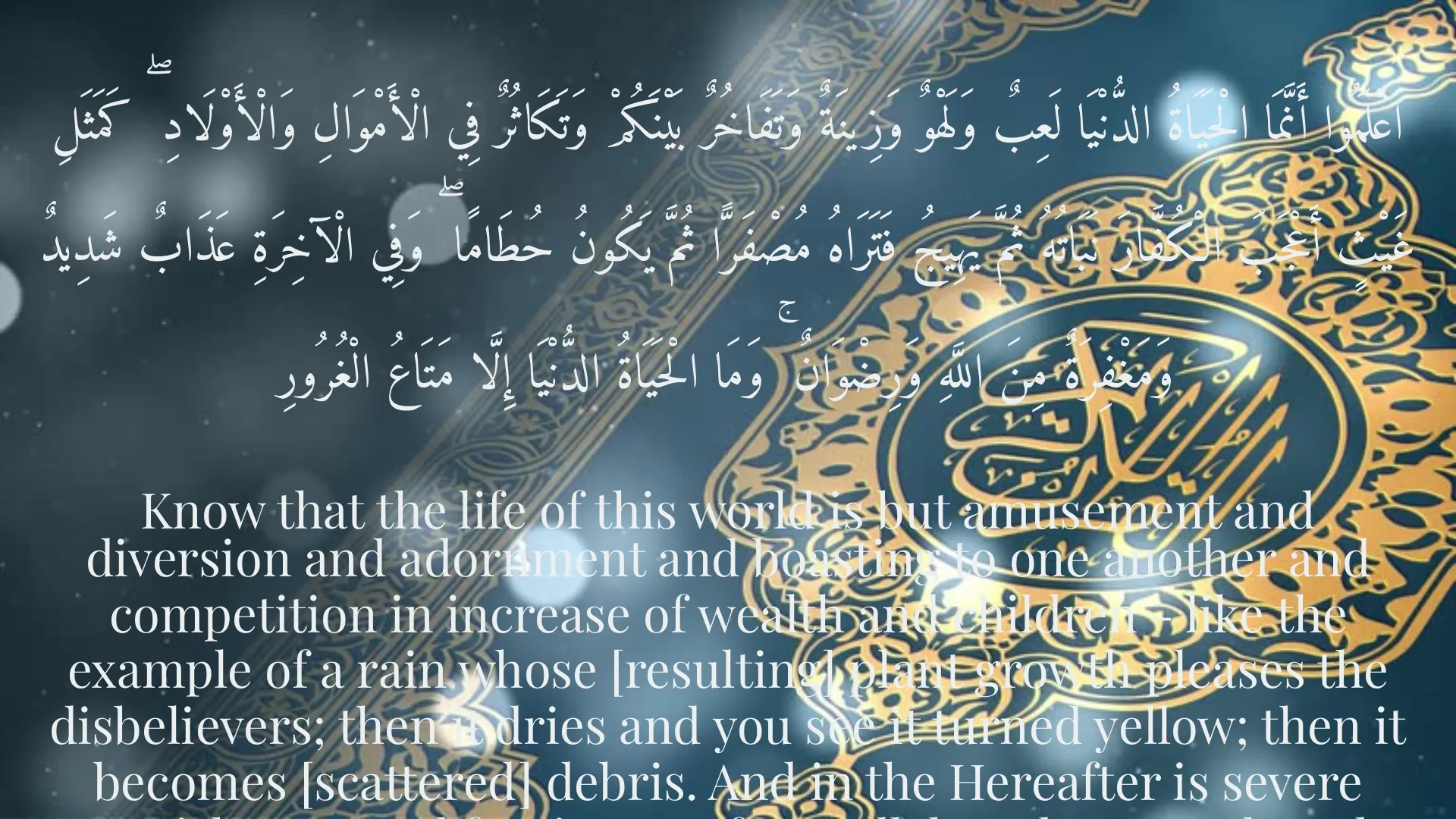
اعْلَمُوا أَنَّمَا الْحَيَاةُ الدُّنْيَا لَعِبٌ وَلَهْوٌ وَزِينَةٌ وَتَفَاخُرٌ بَيْنَكُمْ وَتَكَاثُرٌ فِي الْأَمْوَالِ وَالْأَوْلَادِ ۖ كَمَثَلِ غَيْثٍ أَعْجَبَ الْكُفَّارَ نَبَاتُهُ ثُمَّ يَهِيجُ فَتَرَاهُ مُصْفَرًّا ثُمَّ يَكُونُ حُطَامًا ۖ وَفِي الْآخِرَةِ عَذَابٌ شَدِيدٌ وَمَغْفِرَةٌ مِنَ اللَّهِ وَرِضْوَانٌ ۚ وَمَا الْحَيَاةُ الدُّنْيَا إِلَّا مَتَاعُ الْغُرُورِ
Know that the life of this world is but amusement and diversion and adornment and boasting to one another and competition in increase of wealth and children - like the example of a rain whose [resulting] plant growth pleases the disbelievers; then it dries and you see it turned yellow; then it becomes [scattered] debris. And in the Hereafter is severe punishment and forgiveness from Allah and approval. And what is the life of this world except the enjoyment of delusion.
Al-Hadid : 20
فَخَسَفْنَا بِهِ وَبِدَارِهِ الْأَرْضَ فَمَا كَانَ لَهُ مِنْ فِئَةٍ يَنْصُرُونَهُ مِنْ دُونِ اللَّهِ وَمَا كَانَ مِنَ الْمُنْتَصِرِينَ
So We caused the earth to swallow him and his home. And there was no party to protect him from Allah, nor was he of those who could defend themselves.
Al-Qasas : 81
قَدْ أَفْلَحَ الْمُؤْمِنُونَ
Certainly will the believers prosper:
Al-Mu'minun : 1
أُولَٰئِكَ هُمُ الْوَارِثُونَ * الَّذِينَ يَرِثُونَ الْفِرْدَوْسَ هُمْ فِيهَا خَالِدُونَ
Those are the inheritors * who will inherit Paradise. They will abide therein eternally.
Al-Mu'minun : 11
Short Story
Once upon a time, there lived a very wealthy and arrogant merchant who attributed all his successes to his own cleverness and never remembered God. He owned a luxurious mansion and his riches grew daily. In the same city, there was a humble dervish who focused solely on remembering God and seeking His pleasure. People considered the merchant successful but the dervish poor. One day, the dervish said to the merchant, “My friend, these treasures that have made you arrogant are like flowing water that cannot be held in a fist. A day will come when neither the treasure nor the arrogance will remain.” The merchant scoffed and paid no heed to the dervish's advice. Time passed, and suddenly a great misfortune struck; the merchant's wealth vanished, and he lost everything. He was left alone and regretful, while the dervish, with his contentment and remembrance of God, had found true peace. It was on that day that the merchant understood that outward success is only valuable if it brings the heart closer to God, not if it makes one forget Him.