Quranic Answer
In the rich and profound teachings of the Holy Quran, worship is defined not merely as a set of physical actions and outward rituals, but as a vital and conscious connection between humanity and its Creator. Therefore, the answer to the question of whether worship without thought is beneficial unequivocally indicates that the true value and impact of worship depend on the extent of one's presence of heart and deep contemplation within it. The Quran repeatedly invites humans to reflect, ponder, and use their intellect concerning divine verses, creation, and the phenomena of the universe; these invitations demonstrate that Islam is a religion of rationality and insight, not merely confined to outward appearances. Although performing acts of worship even without full mental presence might fulfill one's duty in some respects and instill a habit of worship, its true and transformative benefit is achieved only when the spirit of worship, namely thought and presence of heart, is breathed into it. Several verses in the Holy Quran emphasize the importance of reflection and contemplation. For instance, in Surah Al-Baqarah, verse 164, it states: “Indeed, in the creation of the heavens and the earth, and the alternation of night and day, and the [great] ships which sail through the sea with that which benefits people, and what Allah has sent down from the heavens of rain and revived thereby the earth after its lifelessness and dispersed therein every [kind of] moving creature, and [in] the dispersal of winds and clouds subjugated between the heaven and the earth are signs for a people who use reason.” This verse and similar ones not only encourage contemplation of creation but also reflection on divine verses and the revealed word. In Surah Muhammad, verse 24, it asks: “Do they not then contemplate the Quran, or are there locks upon [their] hearts?” This question underscores that the Quran is not merely for recitation, but for understanding and acting upon, and understanding is impossible without contemplation. Worship is no exception to this rule. The concept of 'khushu'' (humility and devotion) in prayer and other acts of worship is closely linked to the presence of heart and thought. Khushu' signifies humility, both internal and external, which stems from understanding the Creator's grandeur and the servant's insignificance. When an individual performs prayer without mental presence, relying solely on physical movements, true khushu' is not achieved. Such a prayer might be valid from a jurisprudential perspective, but it will lack profound spiritual and educational effects. Imam Ali (peace be upon him) said: “There is no good in a recitation that lacks contemplation.” This precious saying applies not only to reciting the Quran but also to performing any act of worship. The primary goal of worship is self-purification and spiritual nurturing so that humanity may attain 'taqwa' (piety), and this piety is the product of conscious thinking and action, not merely performing outward rituals. The effects of worship with and without thought are entirely different. Worship accompanied by thought leads to spiritual tranquility, strengthening of faith, self-improvement, avoidance of sin, and increased insight. When we reflect in prayer on the meanings of 'Allahu Akbar' (God is the Greatest), 'Subhana Rabbiyal 'Azimi wa Bihamdih' (Glory to my Lord, the Most Great, and praise be to Him), or 'Iyyaka na'budu wa iyyaka nasta'in' (You alone we worship, and You alone we ask for help), these meanings settle in our hearts and minds and influence our lives. The feeling of servitude and insignificance before God prevents us from arrogance; understanding His grandeur increases our hope and reliance, and knowing that we seek help only from Him frees us from worldly attachments. Similarly, fasting, when accompanied by contemplation of its wisdom – including understanding the plight of the hungry, strengthening willpower, and controlling desires – transforms into a school of spiritual training. Hajj, a journey and ritual full of symbols and allusions, will turn into a mere tourist trip without contemplation of its philosophy. Charity (Zakat and Sadaqah), if performed with the intention of seeking divine proximity and helping the needy, and with awareness of its worldly and spiritual benefits, will be blessed for both the giver and the recipient. In contrast, worship performed without thought is like a body without a soul; it may have an outward form, but it lacks energy, impact, and inner life. Such worship might be done out of habit, compulsion, or merely to fulfill a duty, and it brings no spiritual growth; it can even lead to indifference and hypocrisy. Therefore, for our acts of worship to be fruitful and beneficial and to draw us closer to the sublime divine goals, it is essential that we always strive to have presence of heart while performing them, to reflect on their meanings and philosophy, and to ask ourselves why we are doing this and what goal we are pursuing. It is this continuous attention and contemplation that transforms worship from a daily habit into a profound and transformative spiritual experience, and it is here that one tastes the true flavor of divine proximity and inner peace. As the Quran states, the remembrance of God is not only with the tongue but with the heart and presence of mind that brings tranquility to hearts: “Unquestionably, by the remembrance of Allah hearts are assured” (Ar-Ra'd, verse 28). And true remembrance of God is conscious and contemplative remembrance.
Related Verses
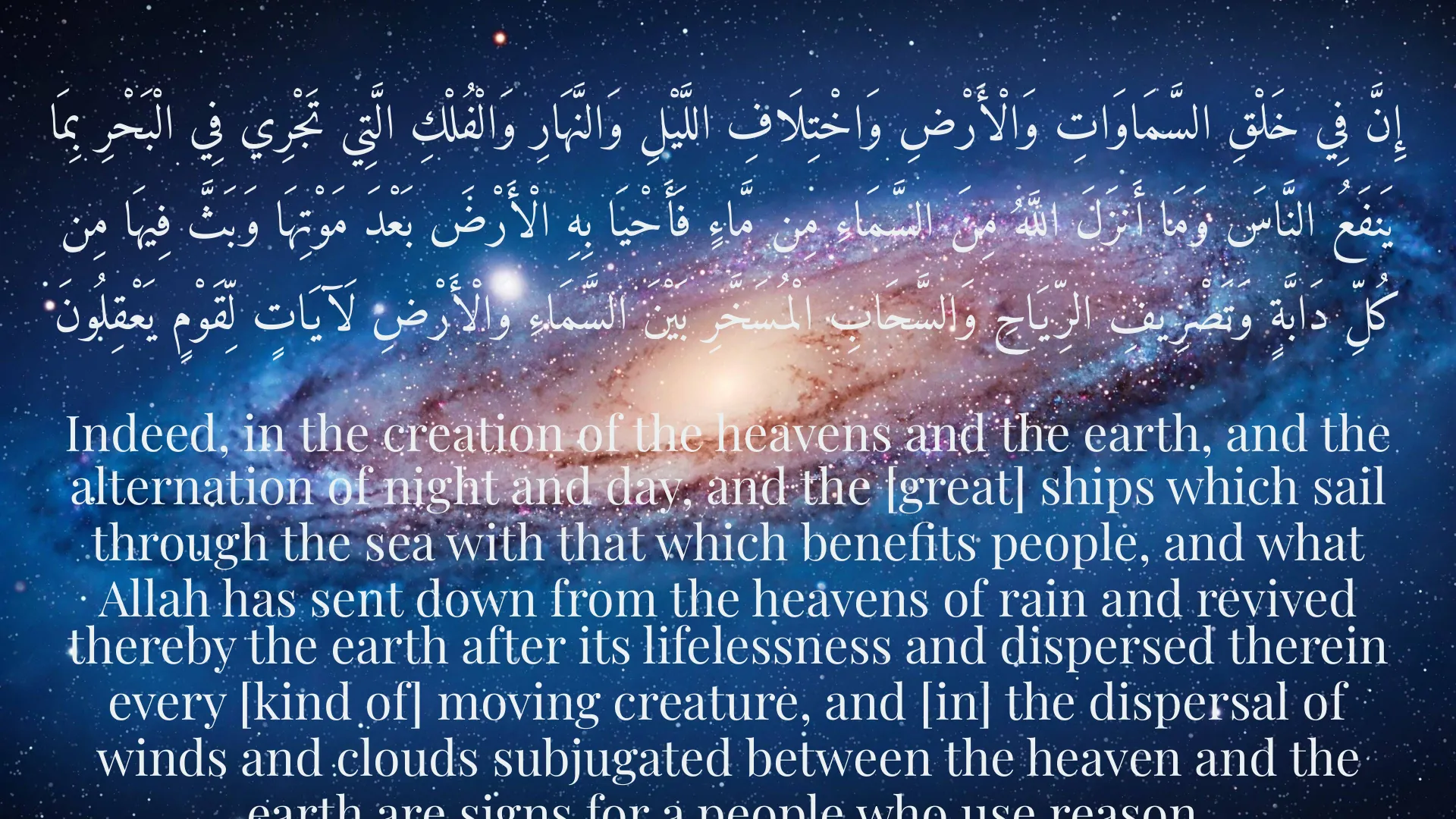
إِنَّ فِي خَلْقِ السَّمَاوَاتِ وَالْأَرْضِ وَاخْتِلَافِ اللَّيْلِ وَالنَّهَارِ وَالْفُلْكِ الَّتِي تَجْرِي فِي الْبَحْرِ بِمَا يَنفَعُ النَّاسَ وَمَا أَنزَلَ اللَّهُ مِنَ السَّمَاءِ مِن مَّاءٍ فَأَحْيَا بِهِ الْأَرْضَ بَعْدَ مَوْتِهَا وَبَثَّ فِيهَا مِن كُلِّ دَابَّةٍ وَتَصْرِيفِ الرِّيَاحِ وَالسَّحَابِ الْمُسَخَّرِ بَيْنَ السَّمَاءِ وَالْأَرْضِ لَآيَاتٍ لِّقَوْمٍ يَعْقِلُونَ
Indeed, in the creation of the heavens and the earth, and the alternation of night and day, and the [great] ships which sail through the sea with that which benefits people, and what Allah has sent down from the heavens of rain and revived thereby the earth after its lifelessness and dispersed therein every [kind of] moving creature, and [in] the dispersal of winds and clouds subjugated between the heaven and the earth are signs for a people who use reason.
Al-Baqarah : 164
أَفَلَا يَتَدَبَّرُونَ الْقُرْآنَ أَمْ عَلَىٰ قُلُوبٍ أَقْفَالُهَا
Do they not then contemplate the Quran, or are there locks upon [their] hearts?
Muhammad : 24
الَّذِينَ آمَنُوا وَتَطْمَئِنُّ قُلُوبُهُم بِذِكْرِ اللَّهِ ۗ أَلَا بِذِكْرِ اللَّهِ تَطْمَئِنُّ الْقُلُوبُ
Those who have believed and whose hearts are assured by the remembrance of Allah. Unquestionably, by the remembrance of Allah hearts are assured.
Ar-Ra'd : 28
Short Story
It is narrated that a wealthy but perpetually anxious merchant decided to build a magnificent mosque. He spent a vast fortune on its architecture, marble, and decorations. Proud of his deed, he would often stand at the mosque's entrance, observing the worshippers. Yet, his heart remained hardened, full of worldly anxieties and devoid of true peace. One day, a wise dervish passed by and witnessed the merchant's pride. He said, 'O merchant, your mosque is magnificent, but where is the mosque of your heart? For true worship begins not with stone and gold, but with a present mind and a humbled heart. A single moment of sincere intention in a humble prayer is worth more than a thousand prayers performed mindlessly in the grandest edifice.' The merchant pondered these words and began to reflect on his own worship, finding peace only when his thought accompanied his deeds.