Quranic Answer
In the rich and comprehensive teachings of the Holy Quran, which outlines the path for believers, the subject of supplication (du'a) holds a special place. Du'a is the only direct and unmediated connection between a servant and the Lord of the worlds; an opportunity to express needs, offer gratitude, repent, and seek help. However, a crucial question arises: Should this deep and blessed connection be limited solely to individual desires and needs? The answer from the Quran and the Sunnah of the Prophet Muhammad (PBUH) is unequivocally 'no.' Du'a in Islam is never a purely individualistic activity; rather, it possesses a vast social dimension, symbolizing solidarity, mercy, and empathy among believers. From the Quranic perspective, the scope of du'a should extend far beyond our personal needs, encompassing parents, family, friends, all believers, and even humanity at large. This broad view of du'a is not only rooted in numerous Quranic verses but also embodies the concept of the unified Ummah and Islamic brotherhood, which Allah Almighty strongly emphasizes. The Holy Quran repeatedly narrates the supplications of great prophets, all of which included requests for others. For instance, Prophet Noah (Nuh), in Surah Nuh, verse 28, supplicates: “My Lord, forgive me and my parents and whoever enters my house a believer and the believing men and believing women.” This verse clearly demonstrates that even in difficult and solitary circumstances, a prophet’s prayer transcends his own circle to include his parents, his believing household, and all believers. This serves not only as a model for us but also as an affirmation that collective prayer and prayer for the community hold special esteem with Allah. Similarly, Prophet Abraham (Ibrahim), in Surah Ibrahim, verse 41, prays: “Our Lord, forgive me and my parents and the believers on the Day the account is established.” This comprehensive prayer includes not only forgiveness for himself and his parents but also encompasses all believers, even those who have not yet been born until the Day of Judgment. Furthermore, the Quran encourages believers to pray for their brothers and sisters in faith who preceded them. In Surah Al-Hashr, verse 10, we read: “And those who came after them say, ‘Our Lord, forgive us and our brethren who preceded us in faith and put not in our hearts [any] resentment toward those who have believed. Our Lord, indeed You are Kind and Merciful.’” This verse shows that the prayer of later generations for their predecessors creates a spiritual bond and a sense of shared responsibility. This act purifies hearts from malice and envy, fostering affection and love. Praying for others is a sign of ultimate selflessness and sacrifice, demonstrating that a believer considers themselves part of a single body, where each limb feels the pain and needs of the other. The philosophy behind this emphasis on collective du'a lies in the spirit of Islam, which stresses unity, empathy, and social responsibility. When we pray for another, we are, in fact, acting for our own benefit as well. According to Islamic narrations, angels also say to one who prays for their absent sibling in faith: “Ameen, and for you too.” This itself is a double reward and a powerful incentive to expand the scope of our supplications. Praying for others not only leads to blessings and the acceptance of our own prayers but also purifies our hearts and brings us closer to divine attributes, such as Allah’s boundless Mercy and Compassion. This act is a sign of the perfection of faith and selflessness, leading to an increase in divine mercy upon the community of believers. In essence, du'a in Islam transcends a personal request; it is a comprehensive act of worship, a bridge to strengthen social solidarity, and a powerful tool to attract Allah’s vast mercy for both the individual and society. Therefore, let us never limit our prayers solely to personal needs, but open our hearts to all of Allah's creation, especially believers, and benefit from the countless blessings of collective prayer.
Related Verses
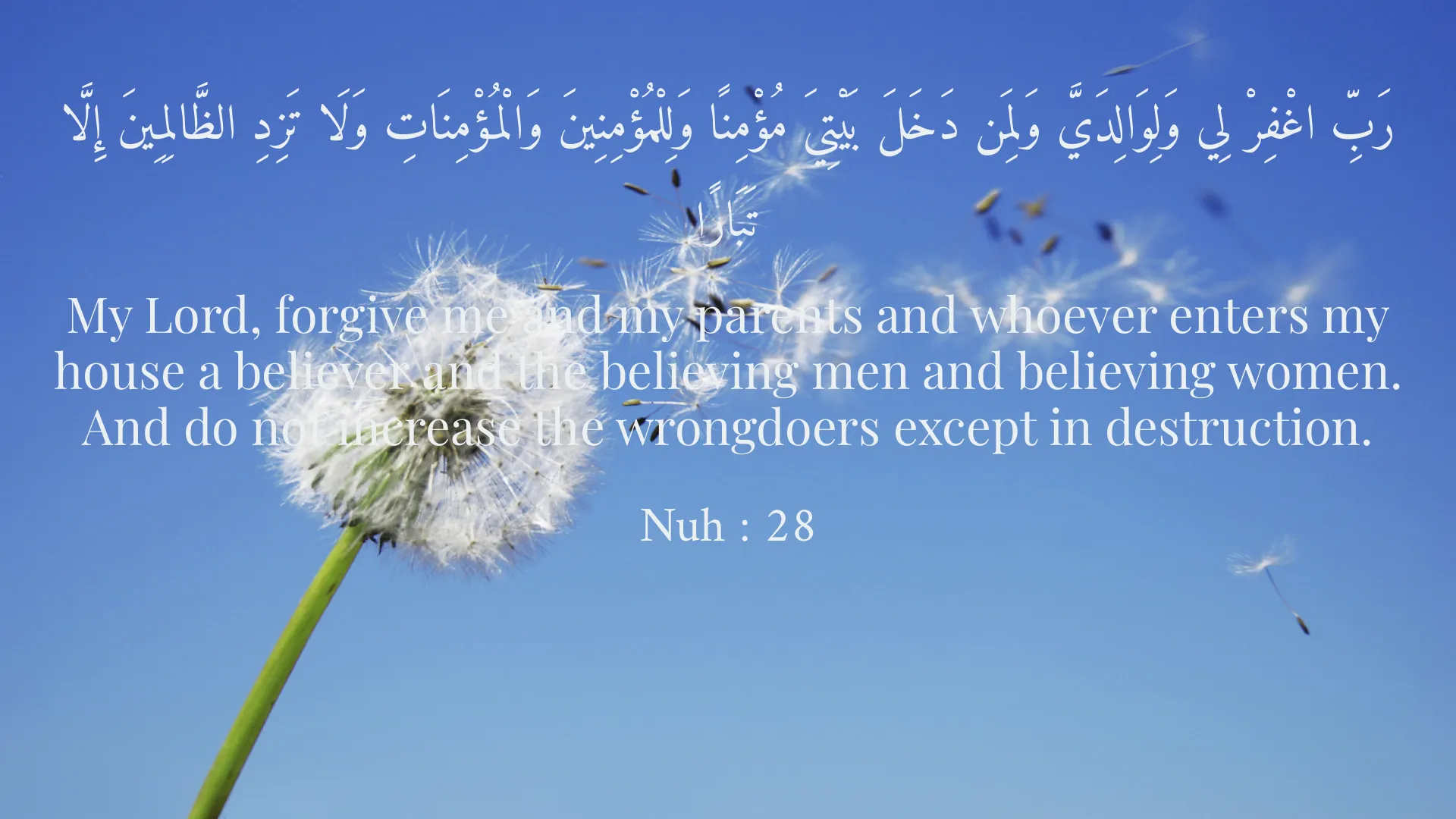
رَبِّ اغْفِرْ لِي وَلِوَالِدَيَّ وَلِمَن دَخَلَ بَيْتِيَ مُؤْمِنًا وَلِلْمُؤْمِنِينَ وَالْمُؤْمِنَاتِ وَلَا تَزِدِ الظَّالِمِينَ إِلَّا تَبَارًا
My Lord, forgive me and my parents and whoever enters my house a believer and the believing men and believing women. And do not increase the wrongdoers except in destruction.
Nuh : 28
رَبَّنَا اغْفِرْ لِي وَلِوَالِدَيَّ وَلِلْمُؤْمِنِينَ يَوْمَ يَقُومُ الْحِسَابُ
Our Lord, forgive me and my parents and the believers on the Day the account is established.
Ibrahim : 41
وَالَّذِينَ جَاءُوا مِن بَعْدِهِمْ يَقُولُونَ رَبَّنَا اغْفِرْ لَنَا وَلِإِخْوَانِنَا الَّذِينَ سَبَقُونَا بِالْإِيمَانِ وَلَا تَجْعَلْ فِي قُلُوبِنَا غِلًّا لِّلَّذِينَ آمَنُوا رَبَّنَا إِنَّكَ رَءُوفٌ رَّحِيمٌ
And those who came after them say, 'Our Lord, forgive us and our brethren who preceded us in faith and put not in our hearts [any] resentment toward those who have believed. Our Lord, indeed You are Kind and Merciful.'
Al-Hashr : 10
Short Story
Once upon a time, in a bustling city, lived a wealthy merchant whose prayers were solely for the increase of his own wealth and the preservation of his health. Every morning and evening, he would implore God to multiply his possessions and protect him from harm. Next door to him lived a simple-hearted dervish, who possessed no worldly goods but whose heart overflowed with kindness. The dervish's prayers were never just for himself; he prayed wholeheartedly for his neighbors, for the sick, for orphaned children, and for anyone in need. The townspeople were puzzled by the dervish's actions and would ask him, 'You are a dervish yourself and have many needs, why don't you pray only for yourself?' The dervish replied with a gentle smile: 'I have learned from Saadi that whoever looks only to himself is selfish, but whoever looks to others is generous. God is Merciful, and when I wish good for others, the angels say: 'Ameen, and for you too!' This way, my prayers are answered doubly, and my heart finds greater peace.' As time passed, the wealthy merchant, though rich, was always worried and restless. But the dervish, despite his simple life, had a tranquil and joyful heart, because his prayers brought blessings not only to himself but also to hundreds of others, and this filled his heart with light.