Quranic Answer
In the Holy Quran, forgiveness is established as one of the noble traits of the believers. This essential value not only enriches interpersonal relationships but also contributes to personal peace and societal harmony. As one of the core attributes that exemplifies a true believer, forgiveness is emphasized in multiple verses of the Quran, particularly in Surah An-Nur, verse 22, where Allah conveys profound guidance on treating others with kindness and compassion, even in the face of injustice. The verse states: 'And let not those of virtue among you and wealth swear not to give to their relatives and the needy and those who have emigrated for the cause of Allah. And let them pardon and overlook. Would you not like that Allah should forgive you? And Allah is Forgiving and Merciful.' This instruction does not merely advocate for forgiveness but challenges believers to cultivate patience and empathy in their interactions with others. One remarkable facet of the Quranic approach to forgiveness is the emphasis on the collective responsibility of the community. Allah commands believers with viable traits such as patience, forgiveness, and generosity. This presents forgiveness not as an isolated act but as an integral component of a broader moral framework that encourages individuals to support one another. The verse invites readers to reflect on their own need for forgiveness from Allah, thereby fostering a sense of humility and gratitude within the community. By acknowledging our own imperfections, we become more inclined to forgive the shortcomings of others. Further reinforcing this message, Surah Al-Imran, verse 134 highlights the character traits of the righteous: 'Who are patient and forgiving and who are steadfast in hardship.' This sequence of virtues—patience, forgiveness, and steadfastness—presents a comprehensive model for believers to aspire to. Each quality builds upon the other, illustrating that genuine forgiveness often requires significant inner strength and resilience. In practicing forgiveness, believers not only promote healing and understanding but also strengthen their own ability to persevere in times of adversity. Contrary to some misconceptions, the Quranic perspective on forgiveness does not imply that one should tolerate abusive behavior or unjust treatment. Instead, it advocates for a conscious choice to release anger and resentment—a powerful act that liberates the soul. Forgiveness is a form of emotional and spiritual freedom, empowering individuals to move beyond pain and betrayal, allowing them to engage in healthier relationships characterized by love and mutual respect. Research on the psychological impacts of forgiveness supports the Quranic perspectives, indicating that forgiving others can lead to significant improvements in mental health. Individuals who practice forgiveness often report lower levels of anxiety, depression, and stress. They also experience enhanced emotional well-being and life satisfaction. In essence, the act of forgiving not only benefits the person being forgiven but serves as a healing balm for the forgiver, nurturing their emotional and spiritual health. This aligns seamlessly with the Quranic principle that advocating for forgiveness is indeed an act of self-care and compassion. The act of forgiveness can also be viewed as an essential social mechanism. Within communities, a culture of forgiveness lays the groundwork for unity and collaboration among individuals. By setting aside grievances and choosing understanding instead, communities can work towards goals that promote mutual interests and shared values. This collective healing process fosters stronger bonds and enhances communication, allowing individuals to support one another in a spirit of cooperation rather than division. In the world today, where conflicts and tensions abound, the Quranic message of forgiveness remains as relevant as ever. It urges individuals to rise above discord and animosity, fostering an environment in which love and friendship thrive. By prioritizing forgiveness, believers can actively combat negativity, promote peace, and contribute to a more harmonious society. Engaging in acts of forgiveness, especially in challenging times, serves as a testament to one’s faith and commitment to bettering oneself and those around them. Moreover, forgiveness has far-reaching implications in the context of justice and accountability. While it is important to uphold justice, the Quranic message encourages believers to consider forgiveness as a path to healing in situations where punitive measures might create further animosity. The balance between justice and forgiveness can lead societies toward rehabilitation rather than mere punishment, fostering an environment where individuals can learn from their mistakes and contribute positively to society in the future. In light of these insights, believers are encouraged to engage in regular self-reflection and strive towards embodying the principle of forgiveness in their daily lives. Implementing this practice requires conscious effort; it is not always an easy task, especially when faced with wrongdoing. However, the rewards of long-term emotional health, stronger relationships, and enhanced community bonds are well worth the endeavor. In conclusion, the concept of forgiveness in the Holy Quran is a multi-faceted virtue that transcends mere words. It encapsulates a divine principle that binds individuals and communities, bridging the gaps created by misunderstandings and wrongdoings. The teachings within Surah An-Nur and Surah Al-Imran demonstrate that forgiveness is a powerful tool that not only benefits the individual but also fosters communal strength, healing, and growth. In the face of adversity, the believer is reminded to embody patience and forgiveness, transforming grievances into opportunities for love and understanding. By choosing forgiveness, we not only align ourselves with divine attributes but also enhance our overall well-being, paving the way for a more compassionate and forgiving world.
Related Verses
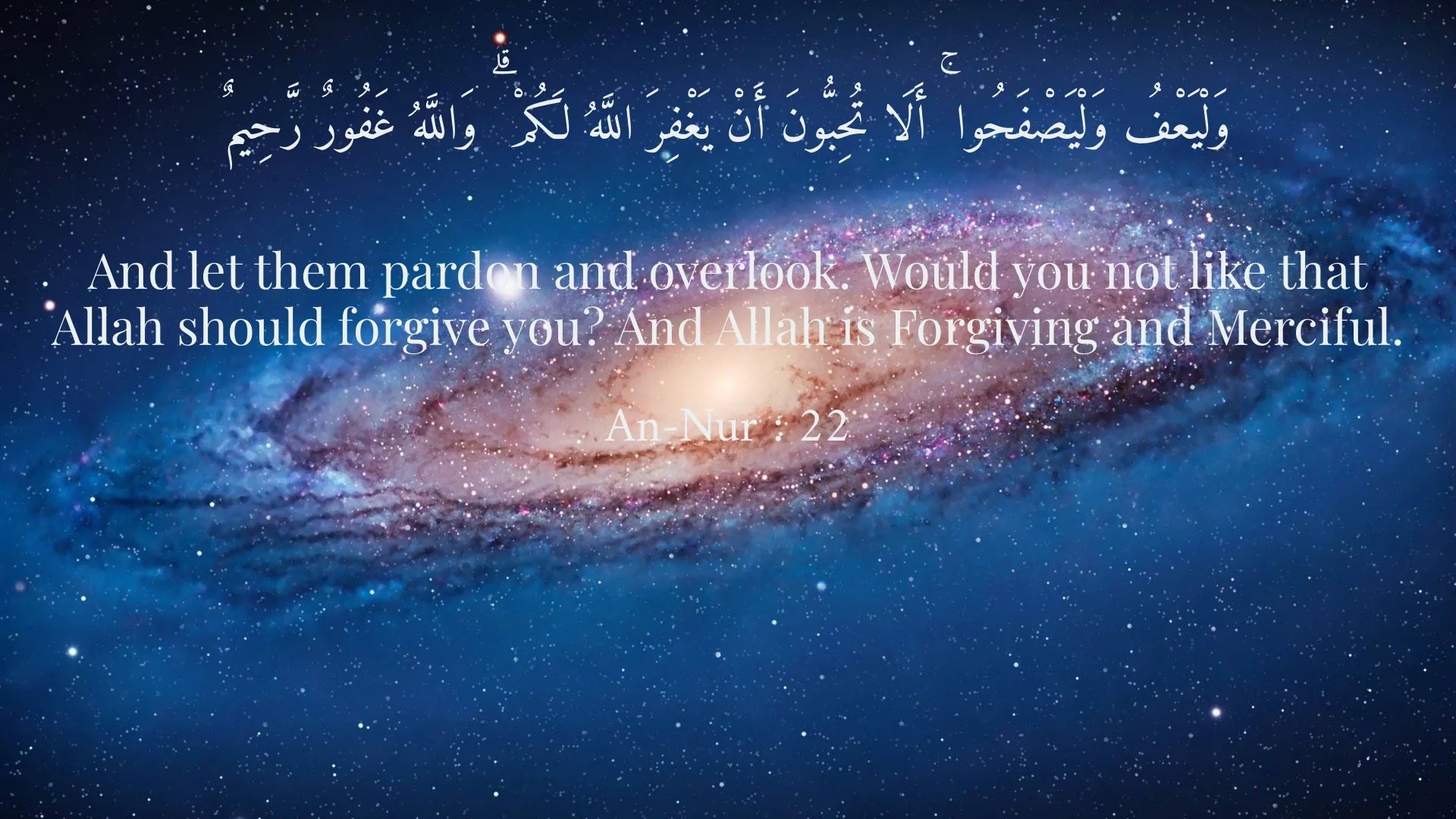
وَلْيَعْفُ وَلْيَصْفَحُوا ۚ أَلَا تُحِبُّونَ أَنْ يَغْفِرَ اللَّهُ لَكُمْ ۗ وَاللَّهُ غَفُورٌ رَّحِيمٌ
And let them pardon and overlook. Would you not like that Allah should forgive you? And Allah is Forgiving and Merciful.
An-Nur : 22
الَّذِينَ يُنفِقُونَ فِي السَّرَّاءَاتِ وَالضَّرَّاتِ وَالْكَاظِمِينَ الْغَيْظَ وَالْعَافِينَ عَنِ النَّاسِ ۗ وَاللَّهُ يُحِبُّ الْمُحْسِنِينَ
Who spend in ease and in hardship and who restrain anger and who pardon the people; and Allah loves the doers of good.
Al-Imran : 134
Short Story
One day, a woman went to consult a sage about the anger and resentment she felt towards her neighbor. The sage told her, 'If you want to bring peace into your home, you must let go of your grudges and forgive.' After some reflection, she decided to forgive her neighbor. Once she did, she felt a weight lift from her heart, and a new friendship blossomed between them.