Quranic Answer
In the luminous teachings of the Holy Quran, wealth holds a special place and plays a vital role in both individual and societal life. The Quran views wealth not merely as a means for worldly comfort and prosperity, but as a trust (amanah) from Allah and a means of testing His servants. Quranic recommendations for the proper use of wealth are comprehensive and encompassing, covering various aspects of its acquisition, preservation, expenditure, and utilization. These guidelines serve as a complete roadmap for achieving economic balance and justice in an Islamic society. One of the most fundamental and crucial principles in this regard is the emphasis on transparency and legitimacy in the source of wealth. The Holy Quran strongly emphasizes earning wealth through lawful (halal) and legitimate means, condemning any income obtained through falsehood, oppression, usury (riba), bribery, deceit, or fraud. In Surah Al-Baqarah, verse 275, Allah severely prohibits usury, stating: "Those who consume interest will not stand [on the Day of Resurrection] except as one stands who has been struck by Satan into madness. That is because they say, 'Trade is [just] like interest.' But Allah has permitted trade and forbidden interest..." This emphasis on lawful earning forms the basis for the economic well-being of individuals and society. Unlawful wealth not only lacks blessings but also leads to corruption and ruin, jeopardizing one's worldly and afterlife well-being. The Quran considers earning a lawful livelihood as a struggle in the way of Allah (jihad fi sabilillah) and commands believers to partake of what is good and pure. This not only contributes to physical health but also purifies the soul and mind from impurities, bringing a sense of satisfaction and peace. Therefore, every Muslim is obligated to exercise utmost care in choosing their profession and means of livelihood, ensuring they do not deviate from the lawful and legitimate path. The second core of Quranic recommendations concerns the manner of spending and giving wealth. The Quran encourages Muslims to practice moderation and temperance in consumption. It disapproves of both extravagance (israf) and miserliness (bukhl). In Surah Al-Furqan, verse 67, Allah describes the characteristics of the servants of the Most Merciful: "And [they are] those who, when they spend, do so not excessively or stingily but are ever, between that, [justly] balanced." Extravagance refers to overspending and wasting blessings, leading to resource depletion, harm to the environment and society, and creating economic pressures on others. This act is not only economically reprehensible but also a significant moral flaw. Conversely, miserliness and hoarding stifle economic circulation, prevent aid to the needy, and ultimately result in poverty and deprivation in society. The Quran refers to the extravagant as "brothers of devils" (Al-Isra: 27) and severely censures the stingy, considering them far from divine mercy. Therefore, a true Muslim must observe moderation in their life, whether in personal or public affairs, and avoid excessive consumerism and ostentatious luxury. This moderation should apply not only to the quantity consumed but also to its quality and type, so that it neither leads to ruin nor to deprivation. The third significant recommendation relates to charity and spending in the way of Allah (infaq fi sabilillah). The Quran strongly encourages giving charity to the needy, orphans, the poor, and travelers. It views charity not only as a means of purifying wealth but also as a means for its growth and increase in blessings. In Surah Al-Baqarah, verse 261, Allah describes the reward for those who spend in His way: "The example of those who spend their wealth in the way of Allah is like a seed [of grain] which grows seven spikes; in each spike is a hundred grains. And Allah multiplies [His reward] for whom He wills. And Allah is all-Encompassing and Knowing." This beautiful analogy illustrates the boundless blessings and rewards from Allah for those who spend from what they possess in His path. Zakat, as one of the pillars of Islam, is a clear example of obligatory charity, representing a specified right of the poor in the wealth of the rich. In addition to Zakat, voluntary charity (sadaqat) and aid are also highly emphasized. Charity not only alleviates poverty from society but also strengthens the spirit of cooperation and solidarity among Muslims, reducing social inequality and fostering unity. The Quran stresses that charity must be given from pure wealth, with sincere intentions, and without any boastfulness or harm, so that its reward may be complete, as any form of showing off or causing harm nullifies the reward of charity. The fourth crucial point is the prohibition of hoarding and accumulating wealth without spending it for good. The Quran severely condemns those who accumulate wealth and refuse to spend it in the way of Allah. In Surah At-Tawbah, verse 34, the painful consequence for those who hoard gold and silver and do not spend it in Allah's cause is described: "And those who hoard gold and silver and do not spend it in the way of Allah - give them tidings of a painful punishment." These verses clearly demonstrate that wealth must circulate within the society's economy, and its stagnation is considered a grave sin, as it leads to economic stagnation, concentration of wealth in the hands of a few, and ultimately inequality and poverty in society. The Quran's aim in this prohibition is to ensure the circulation of wealth and prevent its concentration in the hands of a few, so that all members of society can benefit from it and economic justice is established. Finally, the Quran addresses the importance of investing and developing wealth for the benefit of society and the cultivation of the earth. Wealth should not be solely for personal consumption and pleasure; rather, it should be utilized in a way that contributes to the growth and development of society. This includes creating job opportunities, producing essential goods and services, and participating in public welfare projects that lead to the betterment of people's lives. The Quran advises believers to use their wealth for their own benefit and the benefit of society, making it a means for achieving divine objectives and cultivating the earth, which itself is a form of worship and struggle. Furthermore, upholding the rights of others in wealth, including the rights of orphans, the poor, laborers, and those in need of support, is another key Quranic recommendation that leads to social and economic justice. The Holy Quran repeatedly emphasizes respecting the rights of others and fulfilling their due, considering this an inseparable part of faith. Therefore, the proper use of wealth from a Quranic perspective is a comprehensive and responsible approach that encompasses both individual and societal dimensions, contributing to human well-being in this life and the hereafter. These recommendations not only guide Muslims in financial matters but also serve as a model for any society seeking justice, equality, and sustainable prosperity, aiming to advance based on human and divine values.
Related Verses
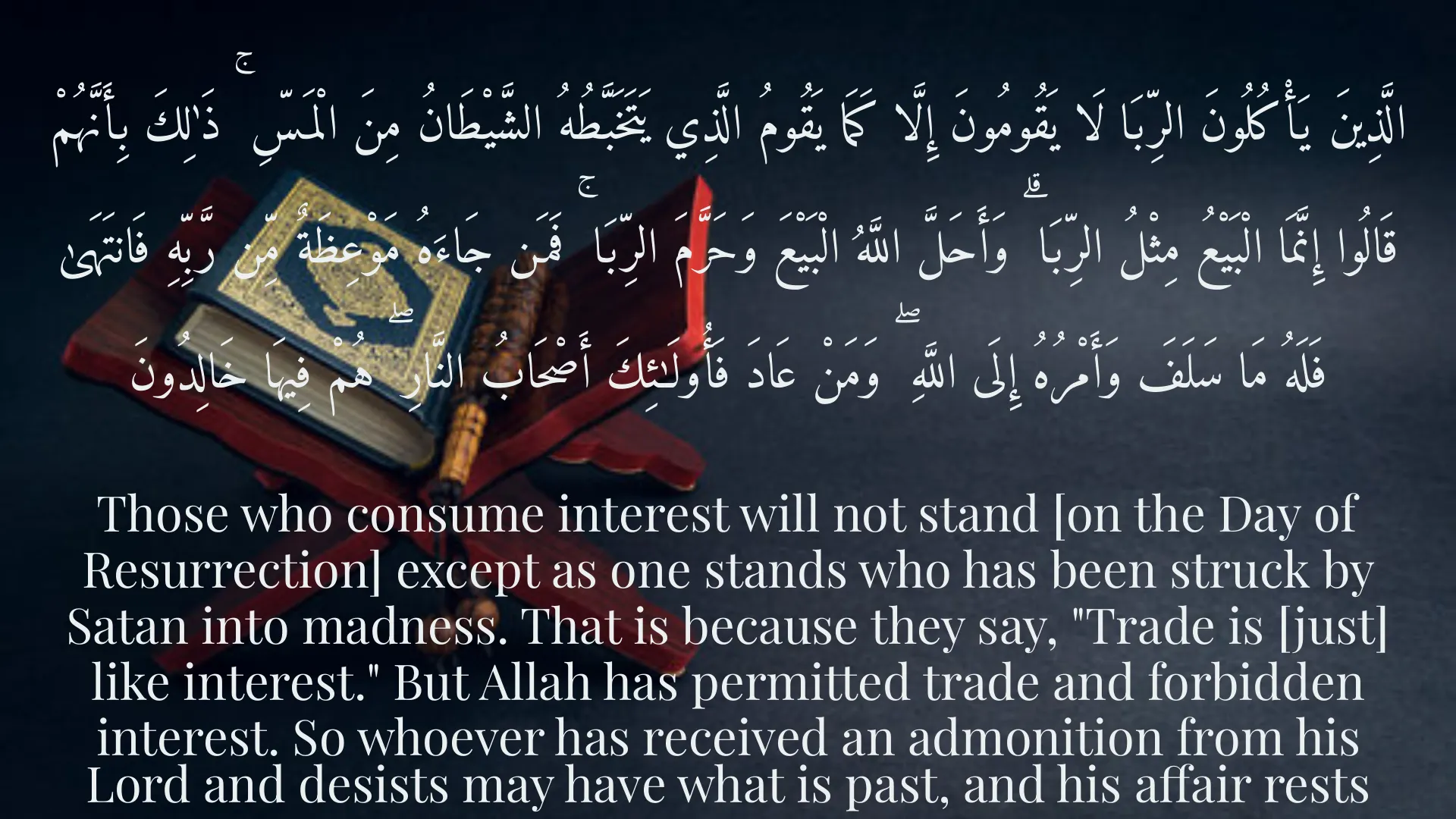
الَّذِينَ يَأْكُلُونَ الرِّبَا لَا يَقُومُونَ إِلَّا كَمَا يَقُومُ الَّذِي يَتَخَبَّطُهُ الشَّيْطَانُ مِنَ الْمَسِّ ۚ ذَٰلِكَ بِأَنَّهُمْ قَالُوا إِنَّمَا الْبَيْعُ مِثْلُ الرِّبَا ۗ وَأَحَلَّ اللَّهُ الْبَيْعَ وَحَرَّمَ الرِّبَا ۚ فَمَن جَاءَهُ مَوْعِظَةٌ مِّن رَّبِّهِ فَانتَهَىٰ فَلَهُ مَا سَلَفَ وَأَمْرُهُ إِلَى اللَّهِ ۖ وَمَنْ عَادَ فَأُولَٰئِكَ أَصْحَابُ النَّارِ ۖ هُمْ فِيهَا خَالِدُونَ
Those who consume interest will not stand [on the Day of Resurrection] except as one stands who has been struck by Satan into madness. That is because they say, "Trade is [just] like interest." But Allah has permitted trade and forbidden interest. So whoever has received an admonition from his Lord and desists may have what is past, and his affair rests with Allah. But whoever returns [to dealing in interest] - those are the companions of the Fire; they will abide eternally therein.
Al-Baqarah : 275
وَالَّذِينَ إِذَا أَنفَقُوا لَمْ يُسْرِفُوا وَلَمْ يَقْتُرُوا وَكَانَ بَيْنَ ذَٰلِكَ قَوَامًا
And [they are] those who, when they spend, do so not excessively or stingily but are ever, between that, [justly] balanced.
Al-Furqan : 67
مَّثَلُ الَّذِينَ يُنفِقُونَ أَمْوَالَهُمْ فِي سَبِيلِ اللَّهِ كَمَثَلِ حَبَّةٍ أَنبَتَتْ سَبْعَ سَنَابِلَ فِي كُلِّ سُنبُلَةٍ مِّائَةُ حَبَّةٍ ۗ وَاللَّهُ يُضَاعِفُ لِمَن يَشَاءُ ۗ وَاللَّهُ وَاسِعٌ عَلِيمٌ
The example of those who spend their wealth in the way of Allah is like a seed [of grain] which grows seven spikes; in each spike is a hundred grains. And Allah multiplies [His reward] for whom He wills. And Allah is all-Encompassing and Knowing.
Al-Baqarah : 261
وَالَّذِينَ يَكْنِزُونَ الذَّهَبَ وَالْفِضَّةَ وَلَا يُنفِقُونَهَا فِي سَبِيلِ اللَّهِ فَبَشِّرْهُم بِعَذَابٍ أَلِيمٍ
And those who hoard gold and silver and do not spend it in the way of Allah - give them tidings of a painful punishment.
At-Tawbah : 34
Short Story
It is narrated that in the land of Khorasan there lived a merchant renowned for his wealth, yet burdened by the sheer volume of his possessions and the constant anxiety of preserving them. At night, he feared thieves, and by day, the rulers, finding no peace. One day, he sat in the gathering of a dervish who spoke of generosity and giving. The merchant sighed deeply and said, "O Sheikh, this wealth is nothing but a burden upon my soul. Would that I had only enough for sustenance and could live in peace." The dervish smiled and said, "My brother, wealth was not brought to be hoarded and stored, but rather to facilitate the affairs of people and bring comfort to the heart. If you view wealth like a spring from which water gushes forth and reaches the fields, and not like a stagnant pool that holds water and makes it putrid, then you will see that your wealth is not a burden, but rather a remover of burdens and a source of inner peace. Giving, like water, extinguishes the fire of greed and brings forth blessings." The merchant took heed of this advice, and from that day forward, not only did he strive to earn lawfully, but he also spent from his wealth for the needy and for the development of his city. He found that his heart became serene, and his wealth more blessed. He understood that true richness lies in giving, not in accumulating.