Quranic Answer
The Holy Quran, as a divine guide, offers a profound and comprehensive set of teachings regarding peace and war. These teachings, contrary to some misconceptions, consider peace as the fundamental principle governing human and international relations, while war is only permitted as a last resort, under very specific conditions, and with strict adherence to ethical and moral guidelines. Indeed, the very name Islam, derived from the root 'Salam' meaning peace and submission to God, inherently signifies a religion of peace and reconciliation. Its ultimate goal is to establish justice, tranquility, and peaceful coexistence worldwide. The Quran consistently advises believers to move towards peace and harmonious coexistence, and to avoid any form of aggression or oppression. In Surah Al-Baqarah, verse 208, Allah calls upon believers to enter into peace (Islam) completely, stating: "O you who have believed, enter into peace (Islam) completely and do not follow the footsteps of Satan. Indeed, he is to you a clear enemy." This verse indicates that peace and security are not merely an option, but a vital principle in a believer's life, upon which the Islamic society should be built. Encouragement for forgiveness, pardon, reconciliation, and mending of relations are among other Quranic teachings aimed at solidifying peace. For instance, Surah Fussilat, verse 34, states: "And not equal are the good deed and the bad. Repel [evil] by that which is better; then suddenly, the one whom between you and him is enmity will become as though he was a devoted friend." These verses demonstrate that the Quran seeks to eradicate malice and enmity through mercy and affection. However, the Quran does not ignore the reality of oppression, aggression, and transgression. Under specific circumstances, it permits war as an unavoidable necessity for self-defense, repelling injustice, and establishing justice. This type of war, referred to in Islam as 'defensive jihad' or 'qital,' differs from 'jihad' in its broader sense, which means striving in the path of Allah. Jihad in its general meaning includes any effort to uphold truth, struggle against one's inner desires, acquire knowledge, and spread virtues, with only a small portion of it limited to physical combat. War in the Quran is never for aggression, territorial occupation, forced conversion, or coerced spread of religion. Its objectives are clearly defined and limited: 1. Self-defense and protecting one's land against enemy aggression: Surah Al-Baqarah, verse 190, states: "And fight in the way of Allah those who fight you, but do not transgress. Indeed. Allah does not like transgressors." This verse clearly sets the boundaries for war: it is only against aggressors, and one must not transgress limits. 2. Repelling oppression and aiding the oppressed: The Quran calls upon believers to assist those who are oppressed and cry out for help. Surah An-Nisa, verse 75, clearly articulates this responsibility. 3. Defending freedom of belief and preventing mischief (fitna): War in the Quran is for confronting mischief that hinders the freedom of expressing beliefs and performing religious rites. This does not mean war to impose religion, but to guarantee the right to choose and express belief. Not only does the Quran specify the conditions for initiating war, but it also lays down stringent ethical rules for conduct during warfare. These rules reflect divine mercy and justice even in the harshest conditions: 1. No attacking non-combatants: Women, children, the elderly, religious figures, and the disabled are among those who should never be targeted. 2. No wanton destruction: Destruction of farms, trees, homes, and places of worship is prohibited except in extremely necessary tactical situations. 3. Humane treatment of prisoners of war: The Quran emphasizes kind and humane treatment of prisoners, even recommending their release for ransom or freely. (Surah Muhammad, verse 4) 4. Inclination to peace if the enemy inclines to it: If enemies show an inclination towards peace, believers must also incline towards it and trust in Allah. Surah Al-Anfal, verse 61, states: "And if they incline to peace, then incline to it also and rely upon Allah. Indeed, it is He who is the Hearing, the Knowing." This verse indicates that the ultimate goal of war is the re-establishment of peace and security, not the continuation of enmity and destruction. Ultimately, the Quranic teachings on peace and war emphasize principles such as justice, mercy, self-restraint, and respect for human rights. These teachings consider war an exception and a last resort for defending divine and human values, consistently inviting towards peace and brotherhood. This comprehensive perspective portrays Islam as a religion of justice and peace that, even in the battlefield, adheres to human dignity and ethical principles, always leaving the door open for return to peace and reconciliation. The ultimate objective is to establish a just and peaceful society where the rights of all individuals, regardless of their religion or race, are respected, and peaceful coexistence is maintained. This Quranic vision serves as a model for conflict resolution in today's world as well.
Related Verses
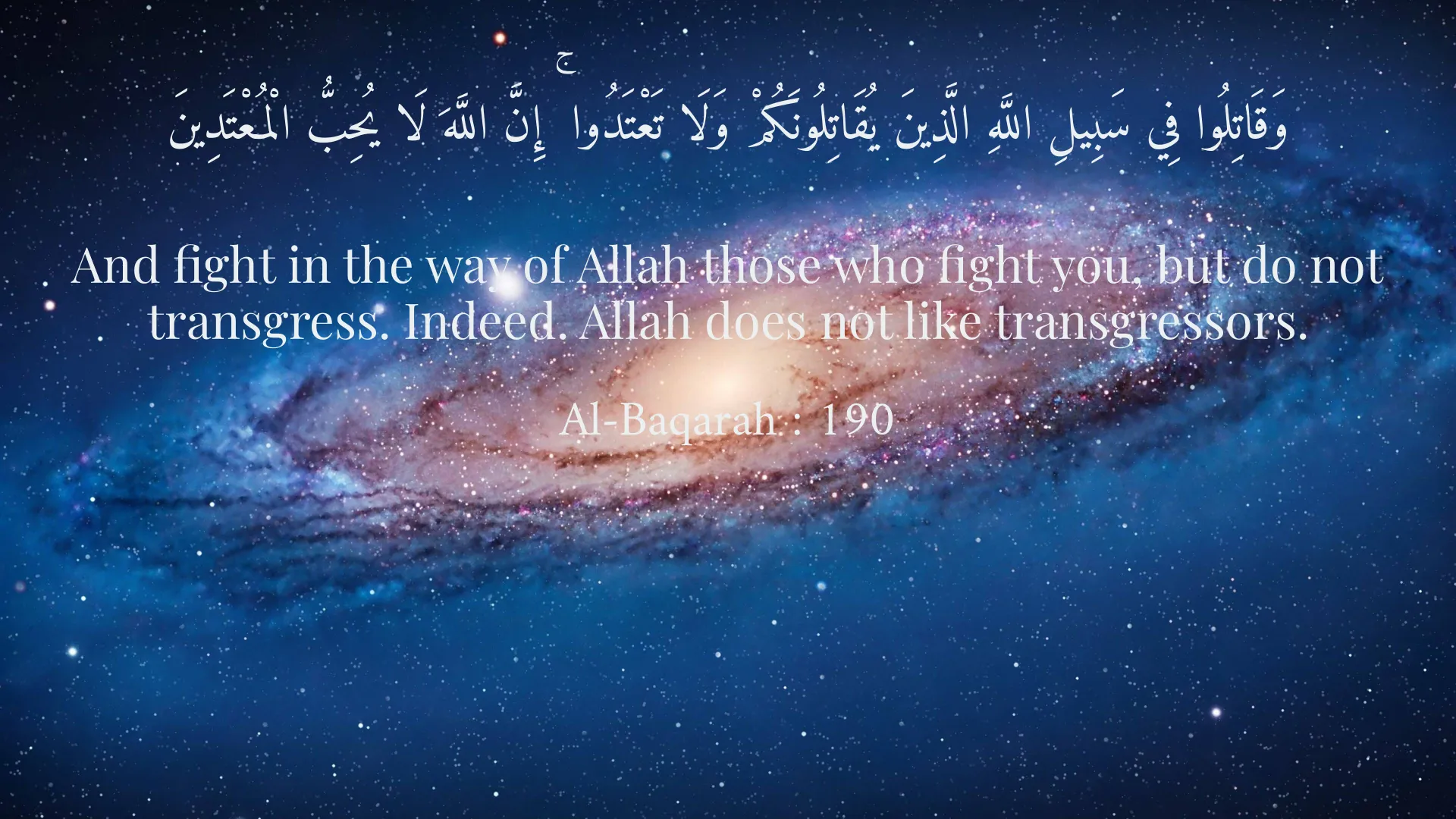
وَقَاتِلُوا فِي سَبِيلِ اللَّهِ الَّذِينَ يُقَاتِلُونَكُمْ وَلَا تَعْتَدُوا ۚ إِنَّ اللَّهَ لَا يُحِبُّ الْمُعْتَدِينَ
And fight in the way of Allah those who fight you, but do not transgress. Indeed. Allah does not like transgressors.
Al-Baqarah : 190
وَإِن جَنَحُوا لِلسَّلْمِ فَاجْنَحْ لَهَا وَتَوَكَّلْ عَلَى اللَّهِ ۚ إِنَّهُ هُوَ السَّمِيعُ الْعَلِيمُ
And if they incline to peace, then incline to it also and rely upon Allah. Indeed, it is He who is the Hearing, the Knowing.
Al-Anfal : 61
يَا أَيُّهَا الَّذِينَ آمَنُوا ادْخُلُوا فِي السِّلْمِ كَافَّةً وَلَا تَتَّبِعُوا خُطُوَاتِ الشَّيْطَانِ ۚ إِنَّهُ لَكُمْ عَدُوٌّ مُّبِينٌ
O you who have believed, enter into peace (Islam) completely and do not follow the footsteps of Satan. Indeed, he is to you a clear enemy.
Al-Baqarah : 208
Short Story
Once upon a time, in a city teeming with sages and scholars, two tribes had been in conflict for years over water and land. Every day, fresh blood was spilled, and more hearts filled with animosity. Weary of these endless disputes, the elders of both tribes approached a wise sage, renowned for his Saadi-like wisdom and knowledge. The sage, with a kind smile and eyes full of light, invited them to peace and said: "My dear ones, you are like two brothers who have lost their way home in the dark night and, instead of helping each other, have turned to conflict. The Quran teaches you that peace is the guiding light, and war is a consuming fire. Is it not true that if one of you extends a hand in peace, the other should also grasp it?" He spoke of stories where forgiveness and pardon had demolished the fortresses of malice and rebuilt friendships. The sage's words, like rain on their parched hearts, gradually brought them closer. Then, they made a pact of peace and justly divided the water and land. From then on, not only did the conflicts cease, but their city also became a model of peace and coexistence, and the name of the wise sage became celebrated, for he had, with the light of the Quran, dispelled the darkness of enmity.