Quranic Answer
In the Holy Quran, peaceful coexistence and its principles are among the most paramount teachings, repeatedly emphasized in various ways. Islam, as a divine religion, considers peace and security to be fundamental human needs and invites believers to a life based on mutual respect, justice, and understanding. This comprehensive concept not only encompasses relations among Muslims but also extends to their interactions with followers of other religions and even those with differing ideologies or beliefs. The Quran clearly stresses that the differences and diversity among humans are in themselves signs of God's immense power and profound wisdom. Therefore, these variations should by no means transform into causes for conflict and strife; instead, they ought to serve as invaluable opportunities for mutual acquaintance, learning, and profound understanding. This contributes significantly to the cultural and social richness of human society, which is a cornerstone of peace and stability. One of the most prominent verses referring to the principle of peaceful coexistence is verse 256 of Surah Al-Baqarah, which unequivocally states: “There shall be no compulsion in [acceptance of] the religion; the right course has become clear from the wrong.” This noble verse stands as the veritable cornerstone of freedom of belief and religion in Islam. The Quran explicitly stipulates that faith must originate from free will and a conscious, uncoerced choice, thereby affirming that compelling anyone to accept a religion is entirely impermissible. This is because faith coerced lacks genuine spiritual value and inherent stability. This principle not only proactively prevents any form of compulsion in accepting Islam but also profoundly guarantees respect for the religious choices of others, emphasizing the inherent right of individuals to choose their own spiritual path. Consequently, an environment is meticulously fostered where individuals of all beliefs and convictions can live harmoniously side by side, engaging in mutual respect for each other's beliefs, without any fear of pressure or imposition. This enlightened approach signifies the explicit recognition of others' inherent right to hold diverse beliefs and meticulously lays the foundational principles for a truly pluralistic and coexistent society, where peaceful coexistence is realized through an unwavering commitment to peace and justice. Beyond the profound emphasis on freedom of belief, the Quran vigorously stresses the paramount importance of upholding justice and fairness in dealing with everyone, without exception, including those who may be considered adversaries. In verse 8 of Surah Al-Ma'idah, we are admonished: “O you who have believed, be persistently Qawwameen for Allah, witnesses in justice, and let not the hatred of a people prevent you from being just. Be just; that is nearer to righteousness. And fear Allah; indeed, Allah is Acquainted with what you do.” This powerful verse clearly indicates that negative feelings, resentment, or animosity towards a particular group or people should never, under any circumstances, hinder or prevent the impartial execution of justice, even if that group or people harbors hostility towards you. This is a truly fundamental principle for fostering coexistence, as injustice itself is demonstrably the root cause of countless disputes, resentments, and conflicts, inevitably eroding the very fabric of peace. When a society, even amidst conditions of animosity, remains steadfastly committed to the principles of justice, mutual trust is significantly enhanced, and viable pathways to peace and reconciliation are effectively opened. This verse provides a robust and comprehensive ethical framework for both international and inter-group relations, firmly anchored in fairness and impartiality, even when confronted with stark differences and outright hostilities. It brilliantly illustrates that the pursuit of justice is itself a means of drawing closer to God, embodying a higher moral standard. Furthermore, the Quran powerfully emphasizes the critical importance of constructive dialogue and the invitation to the path of truth with profound wisdom and gentle admonition. In verse 125 of Surah An-Nahl, it declares: “Invite to the way of your Lord with wisdom and good instruction, and argue with them in a way that is best.” This verse masterfully offers a clear and compassionate strategy for peaceful interaction with others, particularly in matters of faith and intellectual discourse. Instead of advocating for the imposition of beliefs or resorting to force, the Quran wholeheartedly recommends dialogue and the respectful exchange of ideas, grounded in mutual respect, sound logic, and the most excellent argumentation. This enlightened approach inherently implies the acceptance of others' right to hold diverse viewpoints and meticulously cultivates an environment permeated with mutual respect and profound understanding. This actively facilitates the peaceful exchange of ideas and effectively prevents intellectual differences from dangerously escalating into overt conflict. The Quranic methodology places a strong emphasis on persuasion achieved through reasoned discourse and gentle demeanor, rather than through coercion or aggression, thereby proactively promoting a vibrant culture of dialogue and reconciliation—an absolute imperative for fostering coexistence in a diverse society. Human diversity and variety are also eloquently presented in the Quran as a divine and purposeful reality. Verse 13 of Surah Al-Hujurat states: “O mankind, indeed We have created you from male and female and made you peoples and tribes that you may know one another. Indeed, the most noble of you in the sight of Allah is the most righteous of you. Indeed, Allah is Knowing and Acquainted.” This verse beautifully explains that the fundamental purpose of creating humans as diverse peoples and tribes is for mutual acquaintance, recognition, and understanding, not for self-aggrandizement, boasting, or fostering conflict and superiority complexes. This profound recognition entails understanding different cultures, customs, and ideas, which immeasurably enriches human society and lays the groundwork for respecting each other's inherent rights. This verse explicitly and unequivocally rejects any form of racial, ethnic, or tribal superiority, unequivocally declaring that piety (taqwa) and righteous deeds are the sole criteria for nobility in the sight of Allah. This overarching perspective decisively dismantles the very foundations of discrimination and meticulously creates an environment conducive to peaceful coexistence, firmly rooted in principles of equality, profound human dignity, and unwavering mutual respect. Finally, the Holy Quran views peace and reconciliation as not merely an option, but as a highly desirable and superior choice when confronting conflicts. Verse 61 of Surah Al-Anfal states: “And if they incline to peace, then incline to it also and rely upon Allah. Indeed, it is He who is the Hearing, the Knowing.” This verse provides clear and unambiguous instructions for Muslim leaders: if the opposing party shows a genuine inclination towards peace, they too should readily lean towards it and warmly welcome it. This powerfully demonstrates the inherent prioritization of peace over war and Islam's intrinsic readiness to bring an end to conflicts through constructive negotiation and amicable agreement. This fundamental principle provides a robust framework for the peaceful resolution of disputes and actively seeks peaceful solutions rather than the continuation of hostility. This proactive readiness for peace not only means refraining from initiating war but also embraces the acceptance of peaceful opportunities whenever the opposing party is willing, unequivocally demonstrating that Islam is a religion fundamentally built on peace and positive interaction. In summary, the Holy Quran, by profoundly emphasizing freedom of belief, comprehensive justice, wise and respectful dialogue, and the cherished respect for human diversity, provides a truly comprehensive roadmap for achieving peaceful coexistence. These timeless teachings are not exclusively for Muslims; rather, they carry a universal message of peace, profound understanding, and unwavering mutual respect for all humanity, actively striving to create a world where differences, instead of being a source of division, become an invaluable source of richness and synergy, allowing everyone to live together in profound tranquility and security.
Related Verses
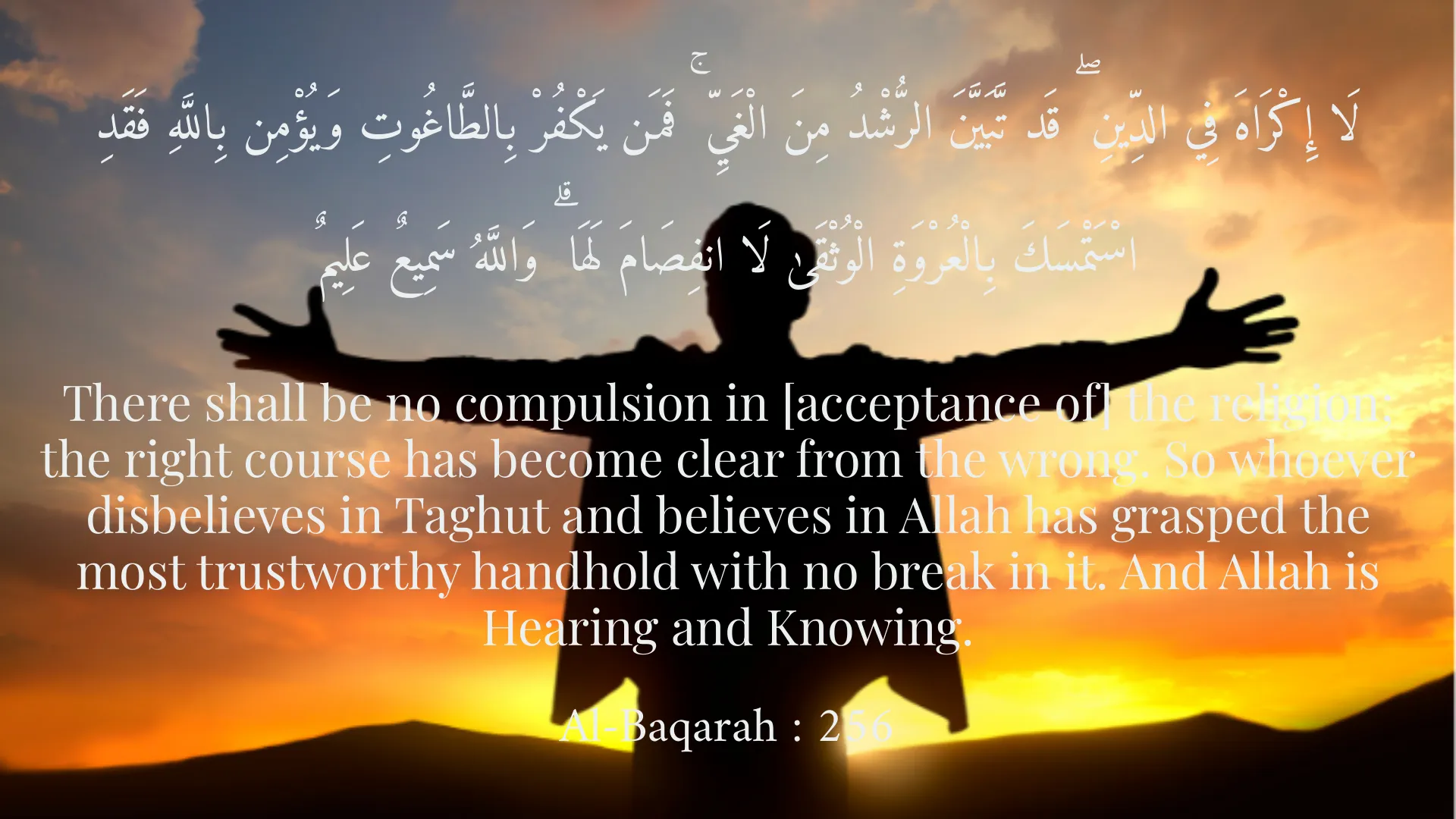
لَا إِكْرَاهَ فِي الدِّينِ ۖ قَد تَّبَيَّنَ الرُّشْدُ مِنَ الْغَيِّ ۚ فَمَن يَكْفُرْ بِالطَّاغُوتِ وَيُؤْمِن بِاللَّهِ فَقَدِ اسْتَمْسَكَ بِالْعُرْوَةِ الْوُثْقَىٰ لَا انفِصَامَ لَهَا ۗ وَاللَّهُ سَمِيعٌ عَلِيمٌ
There shall be no compulsion in [acceptance of] the religion; the right course has become clear from the wrong. So whoever disbelieves in Taghut and believes in Allah has grasped the most trustworthy handhold with no break in it. And Allah is Hearing and Knowing.
Al-Baqarah : 256
يَا أَيُّهَا الَّذِينَ آمَنُوا كُونُوا قَوَّامِينَ لِلَّهِ شُهَدَاءَ بِالْقِسْطِ ۖ وَلَا يَجْرِمَنَّكُمْ شَنَآنُ قَوْمٍ عَلَىٰ أَلَّا تَعْدِلُوا ۚ اعْدِلُوا هُوَ أَقْرَبُ لِلتَّقْوَىٰ ۖ وَاتَّقُوا اللَّهَ ۚ إِنَّ اللَّهَ خَبِيرٌ بِمَا تَعْمَلُونَ
O you who have believed, be persistently Qawwameen for Allah, witnesses in justice, and let not the hatred of a people prevent you from being just. Be just; that is nearer to righteousness. And fear Allah; indeed, Allah is Acquainted with what you do.
Al-Ma'idah : 8
ادْعُ إِلَىٰ سَبِيلِ رَبِّكَ بِالْحِكْمَةِ وَالْمَوْعِظَةِ الْحَسَنَةِ ۖ وَجَادِلْهُم بِالَّتِي هِيَ أَحْسَنُ ۚ إِنَّ رَبَّكَ هُوَ أَعْلَمُ بِمَن ضَلَّ عَن سَبِيلِهِ ۖ وَهُوَ أَعْلَمُ بِالْمُهْتَدِينَ
Invite to the way of your Lord with wisdom and good instruction, and argue with them in a way that is best. Indeed, your Lord is most knowing of who has strayed from His way, and He is most knowing of who is [rightly] guided.
An-Nahl : 125
يَا أَيُّهَا النَّاسُ إِنَّا خَلَقْنَاكُم مِّن ذَكَرٍ وَأُنثَىٰ وَجَعَلْنَاكُمْ شُعُوبًا وَقَبَائِلَ لِتَعَارَفُوا ۚ إِنَّ أَكْرَمَكُمْ عِندَ اللَّهِ أَتْقَاكُمْ ۚ إِنَّ اللَّهَ عَلِيمٌ خَبِيرٌ
O mankind, indeed We have created you from male and female and made you peoples and tribes that you may know one another. Indeed, the most noble of you in the sight of Allah is the most righteous of you. Indeed, Allah is Knowing and Acquainted.
Al-Hujurat : 13
وَإِن جَنَحُوا لِلسَّلْمِ فَاجْنَحْ لَهَا وَتَوَكَّلْ عَلَى اللَّهِ ۚ إِنَّهُ هُوَ السَّمِيعُ الْعَلِيمُ
And if they incline to peace, then incline to it also and rely upon Allah. Indeed, it is He who is the Hearing, the Knowing.
Al-Anfal : 61
Short Story
It is narrated that in ancient times, a wise man was passing by. On his way, he saw two groups vehemently quarreling over a small piece of land, accusing each other with anger and shouts. One would say, "This land is ours!" and the other would retort, "Never! It is our fathers' inheritance." The sage approached them with a cheerful face and a gentle voice, saying: "My friends, do you know that God's vast earth is so expansive that it encompasses all beings? But if our hearts are narrower than the earth, we will never find peace and tranquility. My brothers, learn a lesson from nature. Rivers do not separate to wage war against each other; instead, they join to form a greater sea. You too can make your differences a bridge for understanding, not a wall for separation. Indeed, in this world, more than needing to divide what we have, we need to share who we are." With these wise words, the two groups fell into contemplation, and peace returned to their gathering, for they realized that peaceful coexistence was not only possible but the only path to tranquility and prosperity.