Quranic Answer
In the sublime teachings of the Holy Quran, two fundamental approaches to the worship and servitude of God are presented: conscious servitude and imitative servitude. These two types of devotion differ fundamentally in their origin, motivation, quality, and outcomes. Understanding these distinctions is crucial for achieving a deep and lasting faith. The Quran clearly delineates the superiority of conscious servitude, strongly inviting humanity to reflect, reason, and ponder upon divine verses and the signs of creation, while vehemently condemning blind imitation of ancestors or social norms. Conscious Servitude (Worship based on Insight and Knowledge): Conscious servitude, which can be termed 'worship based on insight and knowledge,' is a state of submission to God that stems from profound understanding, accurate perception, and heartfelt conviction. In this form of servitude, an individual utilizes their intellect and reflective faculties to contemplate divine signs in the cosmos and within themselves. They come to understand God's creation, Lordship, Oneness, and perfect attributes through logical reasoning and inner spiritual realization, choosing to submit to Him out of awareness and free will. This is precisely what the Quran repeatedly calls humanity to do. Numerous verses in the Quran invite people to reflect on the creation of the heavens and the earth, the alternation of night and day, the creation of humans and animals, and the wondrous order of the universe, so that through this reflection, they may recognize the existence of a wise and powerful Creator and submit to Him. This type of servitude is founded on 'knowledge' (ilm) and 'insight' (basirah), rather than mere 'imitation' (taqlid) and 'habit' (adah). Key characteristics of conscious servitude include: 1. Rooted in Intellect and Reflection: A conscious believer bases their religion and actions on rational argumentation and intellectual insight. They never undertake an action or accept a belief without understanding. This is what the Quran alludes to in verses such as "Do they not then ponder on the Qur’an, or are there locks on their hearts?" (Muhammad: 24) and "And in yourselves, do you not then see?" (Adh-Dhariyat: 21), inviting to inner and outer reflection and insight. 2. Certainty and Steadfastness: Conscious servitude fosters a firm and deeply rooted faith that is resilient against doubts and temptations because the individual has understood the truth of their path through reasoning and proofs. 3. Sense of Responsibility: In this type of servitude, the individual assumes responsibility for their actions and choices, feeling that each of their actions is a result of their free will and choice, not blind adherence. 4. Dynamic Relationship with God: The conscious servant is constantly striving for a greater understanding of God and a closer relationship with Him. This relationship transcends a mechanical, duty-bound connection and evolves into a profound spiritual and intellectual bond. 5. Freedom from Blind Adherence: An individual engaged in conscious servitude is liberated from the yoke of blind imitation of others or flawed traditions, finding the criterion for truth and falsehood in divine revelation and sound intellect. Imitative Servitude (Worship based on Habit and Blind Following): In contrast, imitative servitude, or 'worship based on habit and blind following,' is rooted in mere adherence to customs, ancestral traditions, or social pressures, without any personal inquiry, reflection, or understanding of the truth. In this state, an individual engages in worship or accepts beliefs not out of knowledge and conviction, but because their forefathers did so, or because their society dictates it. The Holy Quran repeatedly condemns this type of imitation, viewing it as a significant impediment to guidance and the acceptance of truth. Many verses quote disbelievers and polytheists who, in response to the prophets' invitations, declared: "We found our fathers upon a religion, and we are following in their footsteps." (e.g., Al-Baqarah 2:170 and Az-Zukhruf 43:22). Key characteristics of imitative servitude include: 1. Rooted in Habit and Following: This servitude is based on inherited customs and traditions, with the individual rarely pondering the roots and reasons behind their actions and beliefs. 2. Vulnerability to Doubts: A faith built on imitation becomes weak and shaky in the face of the slightest doubts and challenges because it lacks logical and rational backing. 3. Lack of Responsibility: In this type of servitude, the individual may defer responsibility for their actions and beliefs to others (such as ancestors or religious leaders), considering themselves exempt from thinking and researching. 4. Superficial Relationship with God: The connection with God in imitative servitude is typically superficial, based on external rituals and customs, and lacks deep spiritual and intellectual understanding. 5. Hindrance to Guidance: The Quran identifies blind imitation as a major barrier to accepting truth and divine guidance, as such an individual is unwilling to listen to and reflect on new proofs, contenting themselves with what they have already learned. The Importance of Distinction from a Quranic Perspective: The Holy Quran, by emphasizing "There shall be no compulsion in [acceptance of] the religion" (Al-Baqarah: 256) and repeatedly inviting, "Say, 'Produce your proof, if you should be truthful'" (Al-Baqarah: 111), demonstrates that the desired and accepted faith in the sight of God is one that arises from free will, awareness, and reason. Conscious servitude elevates an individual to the highest degrees of closeness to God and frees them from the shackles of ignorance and fanaticism. In contrast, imitative servitude, though it may outwardly portray an individual as pious, leaves them vulnerable to misguidance and unable to defend their beliefs due to a lack of firm roots. God created humans with intellect and will, enabling them to distinguish truth from falsehood and choose the path of salvation with insight. The difference between these two types of servitude is the difference between light and darkness, life and stagnation, and ultimately, salvation and perdition. The Quran extends this distinction not only to matters of belief but also to actions and ethics, emphasizing the necessity of acting with pure intention and deep understanding.
Related Verses
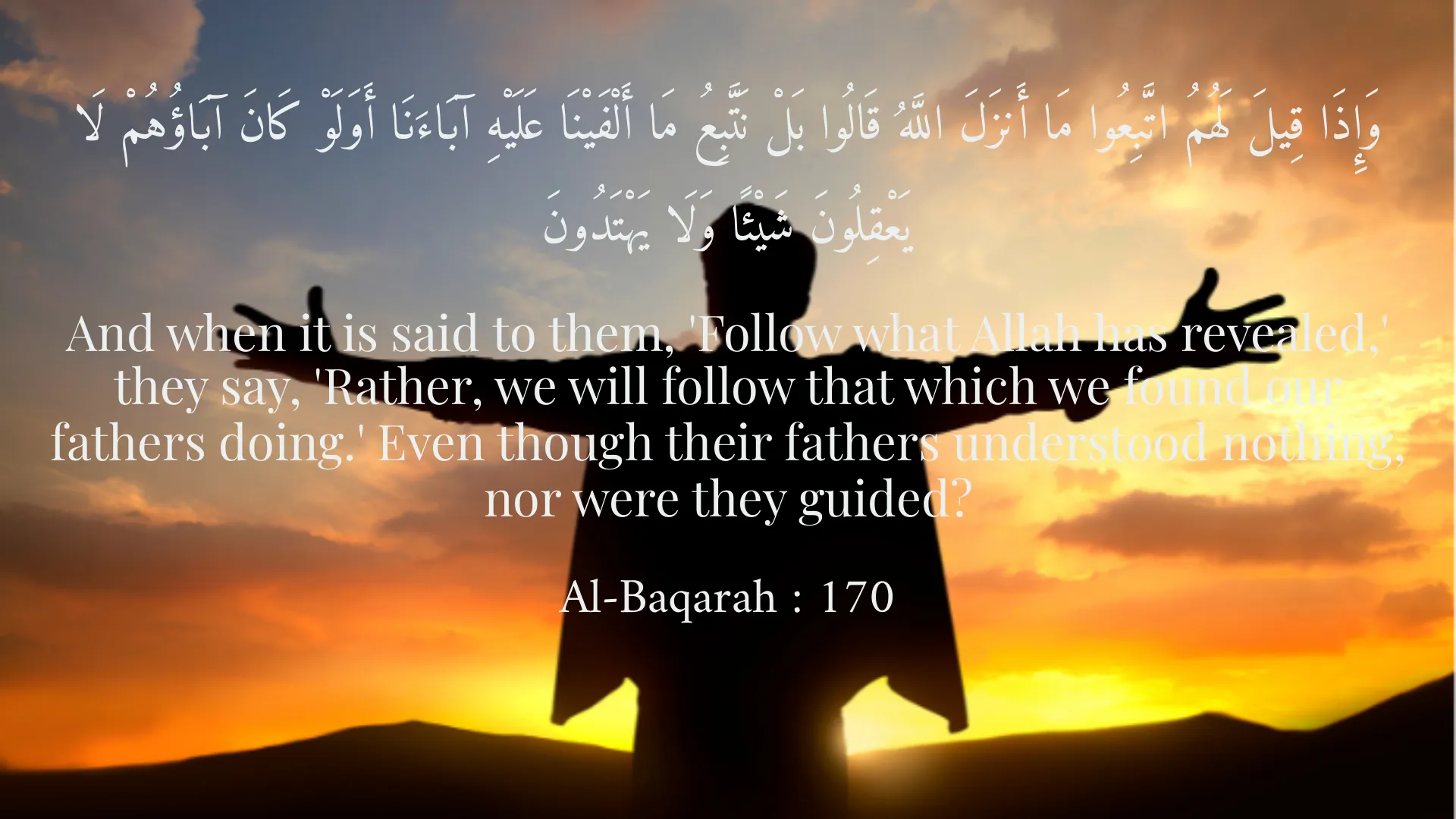
وَإِذَا قِيلَ لَهُمُ اتَّبِعُوا مَا أَنزَلَ اللَّهُ قَالُوا بَلْ نَتَّبِعُ مَا أَلْفَيْنَا عَلَيْهِ آبَاءَنَا أَوَلَوْ كَانَ آبَاؤُهُمْ لَا يَعْقِلُونَ شَيْئًا وَلَا يَهْتَدُونَ
And when it is said to them, 'Follow what Allah has revealed,' they say, 'Rather, we will follow that which we found our fathers doing.' Even though their fathers understood nothing, nor were they guided?
Al-Baqarah : 170
بَلْ قَالُوا إِنَّا وَجَدْنَا آبَاءَنَا عَلَىٰ أُمَّةٍ وَإِنَّا عَلَىٰ آثَارِهِم مُّهْتَدُونَ
Rather, they said, 'Indeed, we found our fathers upon a religion, and we are guided by their footsteps.'
Az-Zukhruf : 22
وَكَذَٰلِكَ مَا أَرْسَلْنَا مِن قَبْلِكَ فِي قَرْيَةٍ مِّن نَّذِيرٍ إِلَّا قَالَ مُتْرَفُوهَا إِنَّا وَجَدْنَا آبَاءَنَا عَلَىٰ أُمَّةٍ وَإِنَّا عَلَىٰ آثَارِهِم مُّقْتَدُونَ
And similarly, We did not send before you into any city a warner except that its affluent ones said, 'Indeed, we found our fathers upon a religion, and we are following in their footsteps.'
Az-Zukhruf : 23
أَمَّنْ هُوَ قَانِتٌ آنَاءَ اللَّيْلِ سَاجِدًا وَقَائِمًا يَحْذَرُ الْآخِرَةَ وَيَرْجُو رَحْمَةَ رَبِّهِ ۗ قُلْ هَلْ يَسْتَوِي الَّذِينَ يَعْلَمُونَ وَالَّذِينَ لَا يَعْلَمُونَ ۗ إِنَّمَا يَتَذَكَّرُ أُولُو الْأَلْبَابِ
Is he who is devoutly obedient during periods of the night, prostrating and standing, fearing the Hereafter and hoping for the mercy of his Lord, [like one who is disobedient]? Say, 'Are those who know equal to those who do not know?' Only they will remember who are people of understanding.
Az-Zumar : 9
Short Story
It is narrated that in a certain era, there were two brothers: one was a scholar and knowledgeable, and the other was a pious follower. The scholar spent his life in search of knowledge and wisdom, pondering divine verses, and everything he did was based on insight and certainty. He performed prayers with his heart connected to God, and he fasted, reflecting deeply on its meaning. However, the other brother did everything merely out of habit and imitation of his forefathers and the village scholars. One day, the scholar brother saw his imitative brother performing prayers hastily. He said, 'Brother, what kind of prayer is this? It seems as if you carry a heavy burden and wish to be rid of it quickly!' The imitative brother replied, 'But everyone prays like this; we saw our fathers do so.' The scholar smiled and said, 'Prayer is like food for the soul. Would you willingly eat food if you did not know where it came from or what benefit or harm it might bring? Conscious servitude is like wholesome food that you know comes from the merciful hand of God, and every bite revitalizes the soul. But imitative servitude is like blindly following others into the wilderness, not knowing where the destination lies. Brother, strive to make your worship out of love and knowledge, not merely out of habit and blind imitation!'