Quranic Answer
The Holy Quran, the divine scripture of Islam, presents a comprehensive and compassionate view on the rights and treatment of animals, embedding their welfare deeply within the ethical framework of the religion. Far from being mere commodities for human exploitation, animals are recognized as sentient beings, integral parts of God's vast and intricate creation, deserving of respect, kindness, and protection. This perspective stems from the foundational Islamic principle of Tawhid (Oneness of God) and Rahma (Divine Mercy), which extends to all forms of existence. One of the most profound verses illustrating the Quran's view on animals is found in Surah Al-An'am (6:38): "And there is no creature on [the earth] or a bird that flies with its wings except [that they are] communities like you. We have not neglected in the Register a thing. Then to their Lord they will be gathered." This verse is pivotal as it elevates animals from mere objects to "communities" (umam) akin to humans. This signifies that animals possess their own forms of existence, their own ways of life, and their own relationship with their Creator. Just as humans are accountable to God, animals too are part of God's grand design, and ultimately, they will return to Him. This understanding fosters a sense of shared existence and mutual respect, diminishing any notion of absolute human dominion devoid of responsibility. The Quran repeatedly emphasizes God's benevolence and mercy in creating animals for various purposes beneficial to humanity, yet this benefit comes with a clear mandate for responsible and humane treatment. Surah An-Nahl (16:5-8) highlights these benefits: "And the grazing livestock He has created for you; in them is warmth and [other] benefits, and from them you eat. And for you in them is [the enjoyment of] beauty when you bring them in [from pasture] and when you send them out [to graze]. And they carry your loads to a land you could not have reached except with difficulty to yourselves. Indeed, your Lord is Kind and Merciful. And [He created] horses, mules and donkeys for you to ride and [as] adornment. And He creates that which you do not know." While these verses acknowledge the practical uses of animals – for food, clothing, transport, and aesthetic pleasure – they simultaneously underscore God's kindness and mercy as the source of these blessings. This divine benevolence serves as a reminder that humans, as beneficiaries, must reciprocate this mercy through their treatment of these creatures. The concept of stewardship (Khalifa) is central to the human role on Earth. Humans are not owners but custodians of God's creation. This responsibility extends to animals, implying that humans must manage and care for them justly. Any form of cruelty, neglect, or unnecessary harm to animals is considered a transgression against God's trust. The Quran, while not explicitly detailing every prohibition against animal cruelty, lays down broad ethical principles that implicitly condemn such acts. The general injunctions against oppression (zulm), corruption (fasad), and waste (israf) apply to the treatment of animals as well. Causing undue suffering to any living creature is an act of zulm, disturbing the natural balance (mizan) established by God. Furthermore, the Quran touches upon the sentience of animals and their recognition of God. Surah An-Nur (24:41) states: "Do you not see that Allah is glorified by all those in the heavens and the earth, and the birds spreading their wings? Each knows its [way of] prayer and glorification. And Allah is Knowing of what they do." This verse suggests that animals, in their own unique ways, are conscious beings that engage in glorification and remembrance of God. This profound insight imbues animals with spiritual dignity, reinforcing the idea that they are not mere soulless entities but creatures that partake in the divine order. Recognizing their intrinsic value and their connection to the Creator should naturally lead to a respectful and compassionate approach. Even in situations where animals are utilized for human consumption, such as in the context of sacrifice (Qurbani) or general slaughter for food (Dhabiha), Islam prescribes strict guidelines designed to minimize suffering. Surah Al-Hajj (22:36) states concerning sacrificial animals: "And the camels and cattle We have appointed for you as among the symbols of Allah; for you therein is good. So mention the name of Allah upon them when lined up [for slaughter]; and when they are [fallen] on their sides, then eat from them and feed the needy and the beggar. Thus have We subjected them to you that you may be grateful." The emphasis here is on the gratitude to God for providing sustenance and the importance of sharing with the needy. The method of slaughter (Dhabiha) itself, though not detailed in the Quran, is extensively elaborated in prophetic traditions (Hadith) derived from the Quranic spirit of mercy – requiring a swift, clean cut with a sharp knife to ensure instantaneous death, performed in the name of God, thus acknowledging the sanctity of life even when it is taken for a legitimate purpose. This process aims to be the most humane method of slaughter, distinguishing it from cruel practices. In conclusion, the Quranic perspective on animal rights is deeply rooted in the broader Islamic worldview of mercy, justice, and stewardship. Animals are not seen as inferior beings to be exploited at will, but as dignified creations of God, possessing their own forms of existence, purpose, and relationship with their Creator. From viewing them as "communities" to acknowledging their glorification of God and emphasizing humane treatment even in their utilization, the Quran lays down a robust ethical framework for human-animal interactions. This framework calls upon believers to extend compassion, avoid cruelty, and fulfill their role as responsible custodians of all life on Earth, understanding that the welfare of animals is intertwined with human spiritual well-being and accountability before God. It's a holistic approach that celebrates the diversity of creation and underscores the interconnectedness of all living things under the benevolent gaze of the Divine. The Quran encourages humanity to reflect upon the natural world, including the animal kingdom, as a source of immense wisdom, beauty, and practical benefit, all testifying to the power and mercy of the Almighty. Therefore, treating animals with utmost kindness and respect is not merely a charitable act, but an integral part of Islamic faith and practice, reflecting one's devotion to God and understanding of His magnificent creation.
Related Verses
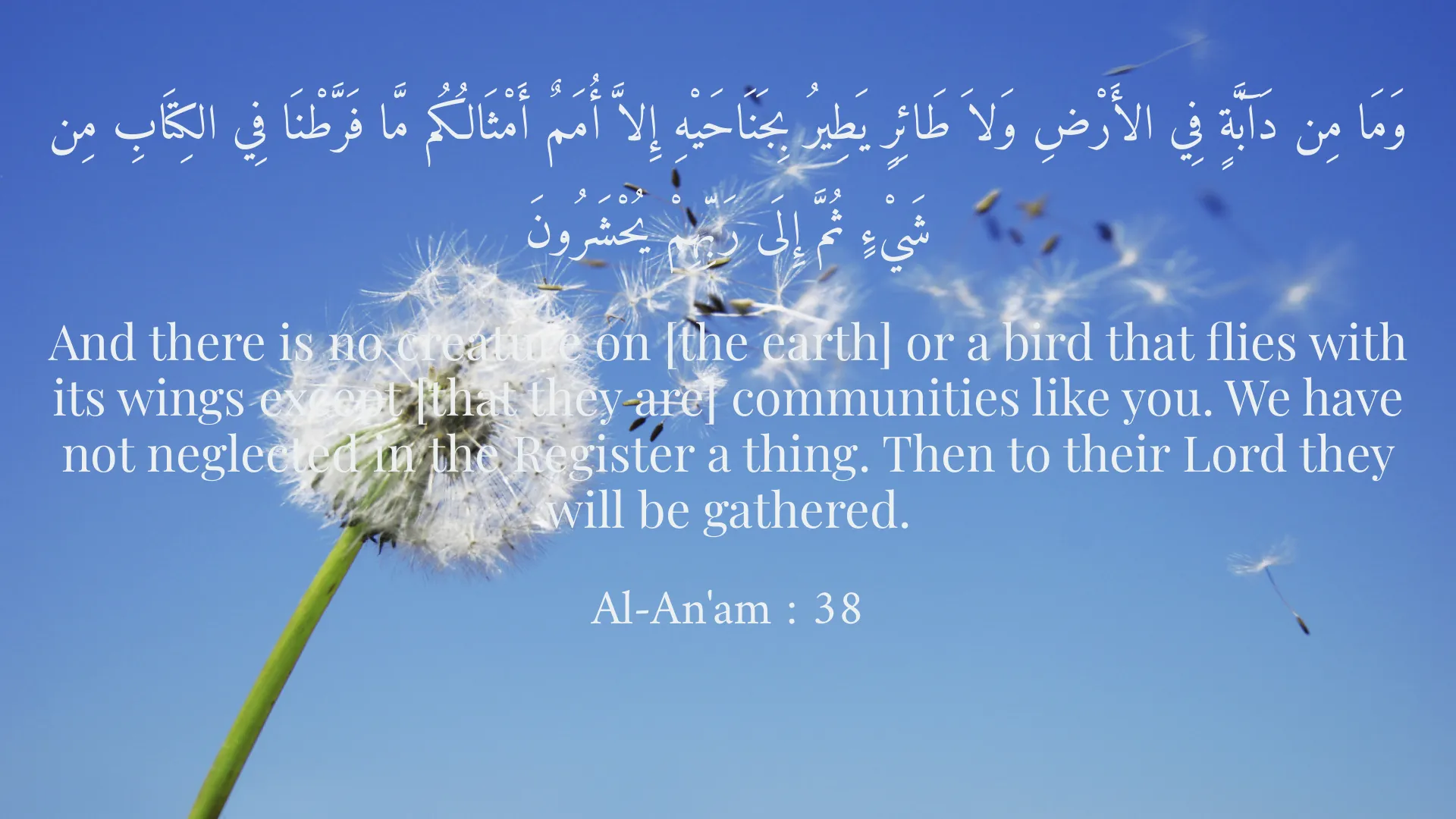
وَمَا مِن دَآبَّةٍ فِي الأَرْضِ وَلاَ طَائِرٍ يَطِيرُ بِجَنَاحَيْهِ إِلاَّ أُمَمٌ أَمْثَالُكُم مَّا فَرَّطْنَا فِي الكِتَابِ مِن شَيْءٍ ثُمَّ إِلَى رَبِّهِمْ يُحْشَرُونَ
And there is no creature on [the earth] or a bird that flies with its wings except [that they are] communities like you. We have not neglected in the Register a thing. Then to their Lord they will be gathered.
Al-An'am : 38
وَالأَنْعَامَ خَلَقَهَا لَكُمْ فِيهَا دِفْءٌ وَمَنَافِعُ وَمِنْهَا تَأْكُلُونَ
And the grazing livestock He has created for you; in them is warmth and [other] benefits, and from them you eat.
An-Nahl : 5
أَلَمْ تَرَ أَنَّ اللَّهَ يُسَبِّحُ لَهُ مَن فِي السَّمَاوَاتِ وَالْأَرْضِ وَالطَّيْرُ صَافَّاتٍ ۖ كُلٌّ قَدْ عَلِمَ صَلَاتَهُ وَتَسْبِيحَهُ ۗ وَاللَّهُ عَلِيمٌ بِمَا يَفْعَلُونَ
Do you not see that Allah is glorified by all those in the heavens and the earth, and the birds spreading their wings? Each knows its [way of] prayer and glorification. And Allah is Knowing of what they do.
An-Nur : 41
Short Story
Saadi Shirazi recounts in Golestan that a devout man was traveling through the desert when he saw a thirsty dog, its tongue lolling out from extreme thirst. The devout man, feeling pity for the dog, took off his shoe, filled it with water from a well, and gave it to the dog to drink. God Almighty rewarded him for this act and forgave him. This tale illustrates the great reward for showing mercy to creatures, even animals.