Quranic Answer
In the ethical and divine system of Islam, deeply rooted in the profound teachings of the Holy Quran, the relationship between action and intention is not merely a simple connection, but a vital and inseparable bond that serves as the primary criterion for the moral and spiritual valuation of deeds. In essence, intention is the soul of an action, and without it, the action is akin to a lifeless body, holding no value in the sight of Allah. This fundamental principle is clearly expounded in numerous Quranic verses, even though the specific term 'niyyah' (intention) in its jurisprudential sense might not be explicitly mentioned as frequently in the Quran as it is in the Hadith. Nevertheless, its essence and core meaning are repeatedly evident through the emphasis on 'ikhlas' (sincerity), 'ibtigha wajah Allah' (seeking Allah's pleasure), and avoidance of 'riyaa' (showing off). 1. The Quran instructs believers that every action, whether an act of worship or a social deed, must be performed with pure intention and solely for the pleasure of the Almighty. This sincerity not only imbues the action with spiritual value but also purifies it from any taint of polytheism or ostentation. For instance, Surah Al-Bayyinah, verse 5, states: 'And they were not commanded except to worship Allah, [being] sincere to Him in religion, inclining to truth, and to establish prayer and to give zakah. And that is the correct religion.' This verse explicitly emphasizes the necessity of sincerity in worship and all aspects of faith. Sincerity here means purifying the action from any non-divine motive, such that the sole aim is to please Allah. This indicates that an action without a pure intention not only lacks value but can also be deemed rejected. Indeed, a good and pure intention can transform even mundane daily activities into acts of worship. A sincere believer who works to earn a lawful living for their family with the intention of pleasing Allah, or eats food with the intention of thanking Allah for His blessings, or sleeps with the intention of gaining strength to serve humanity – all these actions acquire the nature of worship and are rewarded by Allah. It is the intention that gives these acts spiritual essence, distinguishing them from mere physical movements or natural needs. 2. Conversely, the Quran severely warns against actions that appear good outwardly but are performed with impure and hypocritical intentions. Surah Al-Baqarah, verse 264, declares: 'O you who have believed, do not invalidate your charities with reminders [of your generosity] or injury, like one who spends his wealth [only] to be seen by the people and does not believe in Allah and the Last Day.' This verse clearly demonstrates that even a benevolent act like giving charity, if performed with the intention of showing off and not for the sake of Allah, becomes worthless and void. An impure intention not only nullifies the value of the action but can also be considered a sin, as it signifies a lack of genuine faith and sincerity. This highlights a fundamental difference between materialistic valuation and Islamic ethical valuation; in the material world, a grand charitable act might be commendable, but in Islam, without a pure intention, it holds no spiritual or eternal value. 3. Furthermore, in Surah An-Nisa, verse 142, concerning the hypocrites, it is stated: 'Indeed, the hypocrites [think to] deceive Allah, but He is deceiving them. And when they stand for prayer, they stand lazily, showing [themselves to] the people and not remembering Allah except a little.' This verse illustrates the destructive impact of malicious intent on an act of worship like prayer. Hypocrites outwardly perform prayer, but their intention is to gain people's attention, not to worship Allah. The result of this impure intention is the worthlessness of their prayer and their classification among deceivers. Therefore, it can be concluded that from the Quranic perspective, intention is the foundation and essence of every action, and without it, the action lacks spiritual and moral validity. This emphasis on intention signifies attention to a person's inner state; for Allah is aware of what transpires in hearts and rewards or punishes based on those very intentions. This serves as a serious warning for humanity to always be mindful of their inner motivations and to perform their actions with pure intention and solely for the pleasure of the Almighty God. 4. Ultimately, the relationship between action and intention in moral valuation is a testament to Allah's infinite justice. It means that Allah does not merely look at the outward appearance of our deeds but also delves into the depths of our hearts and our hidden motivations. This truth enables individuals, by correcting their intentions, to achieve moral virtues and immense spiritual rewards, even when grand material deeds are not possible. It is an invitation to profound introspection into one's inner motivations and an endeavor to cleanse the heart from any non-divine impurities. Thus, every good deed performed with a pure intention, no matter how small, is great in the sight of Allah, and every grand deed performed with an impure intention, no matter how vast, is worthless to Him. This golden rule guides every believer on their life's journey, constantly prompting them to weigh their actions against the standard of intention and sincerity.
Related Verses
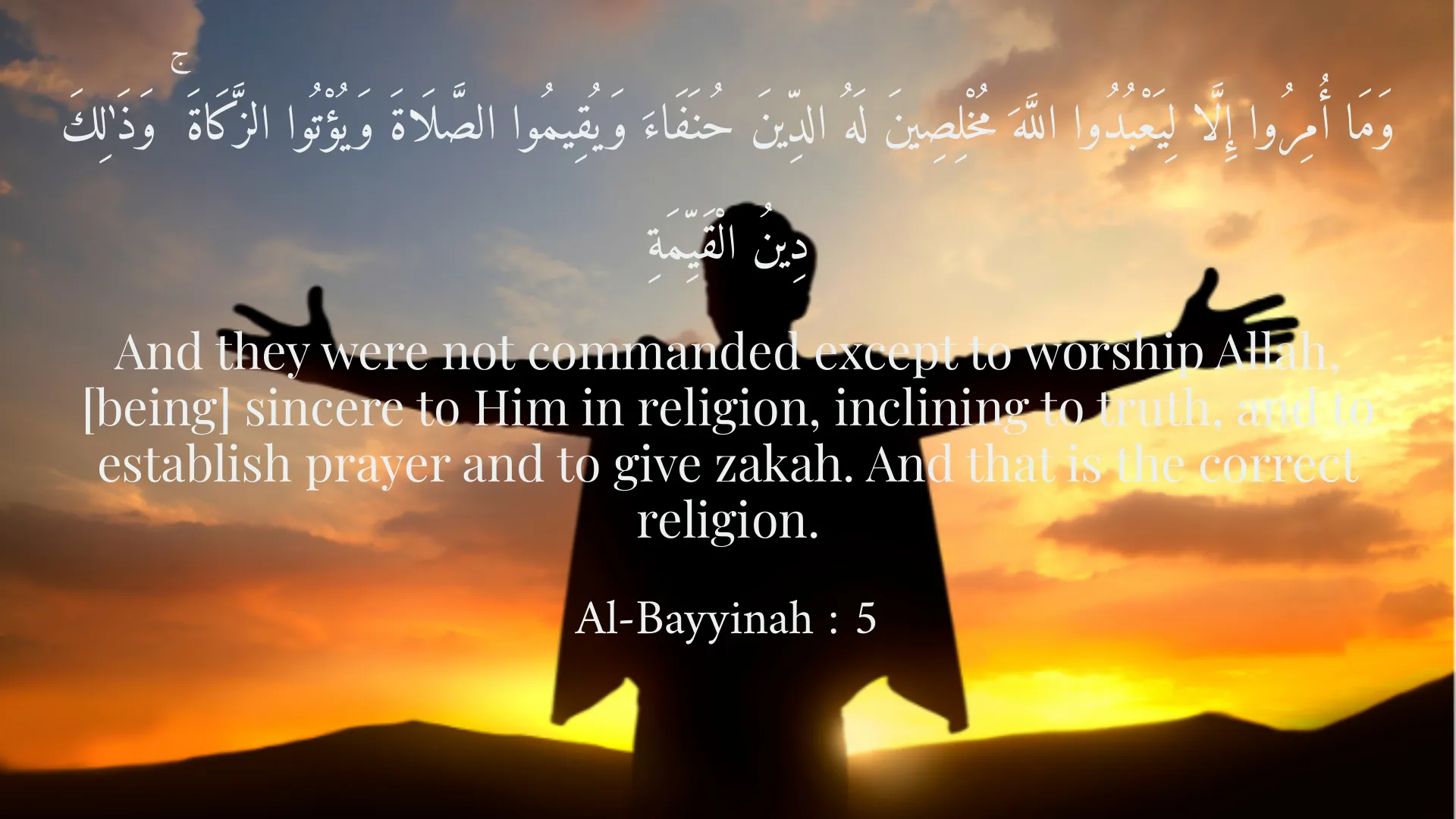
وَمَا أُمِرُوا إِلَّا لِيَعْبُدُوا اللَّهَ مُخْلِصِينَ لَهُ الدِّينَ حُنَفَاءَ وَيُقِيمُوا الصَّلَاةَ وَيُؤْتُوا الزَّكَاةَ ۚ وَذَٰلِكَ دِينُ الْقَيِّمَةِ
And they were not commanded except to worship Allah, [being] sincere to Him in religion, inclining to truth, and to establish prayer and to give zakah. And that is the correct religion.
Al-Bayyinah : 5
يَا أَيُّهَا الَّذِينَ آمَنُوا لَا تُبْطِلُوا صَدَقَاتِكُم بِالْمَنِّ وَالْأَذَىٰ كَالَّذِي يُنفِقُ مَالَهُ رِئَاءَ النَّاسِ وَلَا يُؤْمِنُ بِاللَّهِ وَالْيَوْمِ الْآخِرِ ۖ فَمَثَلُهُ كَمَثَلِ صَفْوَانٍ عَلَيْهِ تُرَابٌ فَأَصَابَهُ وَابِلٌ فَتَرَكَهُ صَلْدًا ۖ لَّا يَقْدِرُونَ عَلَىٰ شَيْءٍ مِّمَّا كَسَبُوا ۗ وَاللَّهُ لَا يَهْدِي الْقَوْمَ الْكَافِرِينَ
O you who have believed, do not invalidate your charities with reminders [of your generosity] or injury, like one who spends his wealth [only] to be seen by the people and does not believe in Allah and the Last Day. His example is like that of a [smooth] rock with dust upon it, and then a downpour strikes it and leaves it bare. They are unable [to keep] anything of what they earned. And Allah does not guide the disbelieving people.
Al-Baqarah : 264
إِنَّ الْمُنَافِقِينَ يُخَادِعُونَ اللَّهَ وَهُوَ خَادِعُهُمْ وَإِذَا قَامُوا إِلَى الصَّلَاةِ قَامُوا كُسَالَىٰ يُرَاءُونَ النَّاسَ وَلَا يَذْكُرُونَ اللَّهَ إِلَّا قَلِيلًا
Indeed, the hypocrites [think to] deceive Allah, but He is deceiving them. And when they stand for prayer, they stand lazily, showing [themselves to] the people and not remembering Allah except a little.
An-Nisa : 142
Short Story
It is narrated that a king went to a Dervish and asked him to pray for his victory in an upcoming war. The Dervish initially declined, saying, "My prayers and service to Dervishes are for myself, not for your worldly gains." But the king insisted, and the Dervish reluctantly raised his hands in prayer. Coincidentally, the king won the war and, in gratitude, sent valuable gifts to the Dervish. The Dervish rejected them, saying, "O King, your victory was not due to my prayer, but to your good intention and resolve in repelling injustice. If it were due to my outward prayer, then why do Dervishes, who pray day and night, not achieve victory like you?" The king was astonished, and the Dervish continued: "Victory and blessing in deeds come from pure intention, not from the outward appearance of actions. Human actions are merely a manifestation of inner intention. It is a pure heart and sincere intention that bring about results, not hands raised in outward prayer while the heart is preoccupied with worldly matters." This anecdote from Saadi beautifully illustrates that the true value of any action lies in its intention and inner sincerity, not in its outward appearance or magnitude.