Quranic Answer
In the rich and profound teachings of the Holy Quran, the relationship between humans and nature is not merely a simple connection, but a multifaceted, sacred, and deeply responsible bond. The Quran does not view nature merely as a resource for exploitation; rather, it introduces it as a divine creation, full of signs (ayat) and a manifestation of God's power, wisdom, and mercy. This perspective lays the foundation for a spiritual and ethical relationship between humanity and the natural world. Humans are designated in the Quran as khalifa or vicegerents of God on Earth. This position does not signify absolute, boundless dominion, but rather stewardship, trusteeship, and responsibility towards the Earth and all that is within it. God has chosen humanity to benefit from nature's bounties, but at the same time, humanity has a duty to maintain the balance (mizan) inherent in existence and to refrain from any form of corruption (fasad) or destruction within it. This responsibility includes the just management of resources, the preservation of biodiversity, and the prevention of pollution and environmental degradation. The Quran repeatedly urges humans to ponder upon the creation of the heavens and the Earth, the alternation of night and day, the movement of ships on water, life-giving rain, and the growth of plants and animals. These natural phenomena are all ayat (signs) that invite humanity to reflect on the Creator's grandeur and His oneness. Nature, in essence, is a speaking book, every leaf, every mountain, and every sea a sign of God's presence and power. This contemplation not only strengthens faith but also brings a deeper understanding of humanity's place in existence and its duties regarding these divine blessings. The utilization of nature, from the Quranic perspective, is permissible and even necessary, as God has created Earth's resources for human comfort and well-being. However, this utilization must be within the framework of moderation and gratitude. Extravagance, wastefulness, and excessive consumption are strongly condemned. The Quran explicitly prohibits corruption on Earth and emphasizes that God does not love those who cause corruption. This concept is rooted in divine justice and necessitates that humans consider the rights of other creatures and future generations in benefiting from natural resources. Environmental preservation, in Islam, is not merely an ethical issue but a religious obligation connected to the principles of Tawhid (Oneness of God), justice, and the Hereafter. Destroying nature is, in fact, an act of ingratitude towards the Creator and an disruption of the divine order. This comprehensive view elevates humans from the position of an absolute ruler over nature to that of a vigilant, protective, and responsible beneficiary. The relationship between humans and nature, from this perspective, is not a one-sided exploitative interaction, but a mutual and respectful dialogue in which humans should learn from nature, cherish it, and coexist peacefully with it. Animals are also considered nations (ummah) in the Quran, possessing rights and should not be subjected to harm or abuse. Even birds and insects glorify God and form part of the overall cosmic order. This perspective teaches humans that every part of nature has intrinsic value and should be respected. In summary, the Quran presents a holistic worldview where humans and nature are not in opposition but in coexistence and complementary interaction. Nature serves as a foundation for human life, a source for reflection and gratitude, and a divine trust that must be protected with care and responsibility. This responsibility is crucial not only for preserving the environment today but also for ensuring the survival and well-being of future generations. Therefore, every human being, by understanding this deep relationship, must play their role in preserving this divine bounty. Respect for nature is, in essence, respect for its Creator, and it signifies the spiritual and intellectual maturity of humanity. Hence, maintaining ecological balance and preventing pollution and destruction are inseparable parts of faith and righteous deeds in Islam.
Related Verses
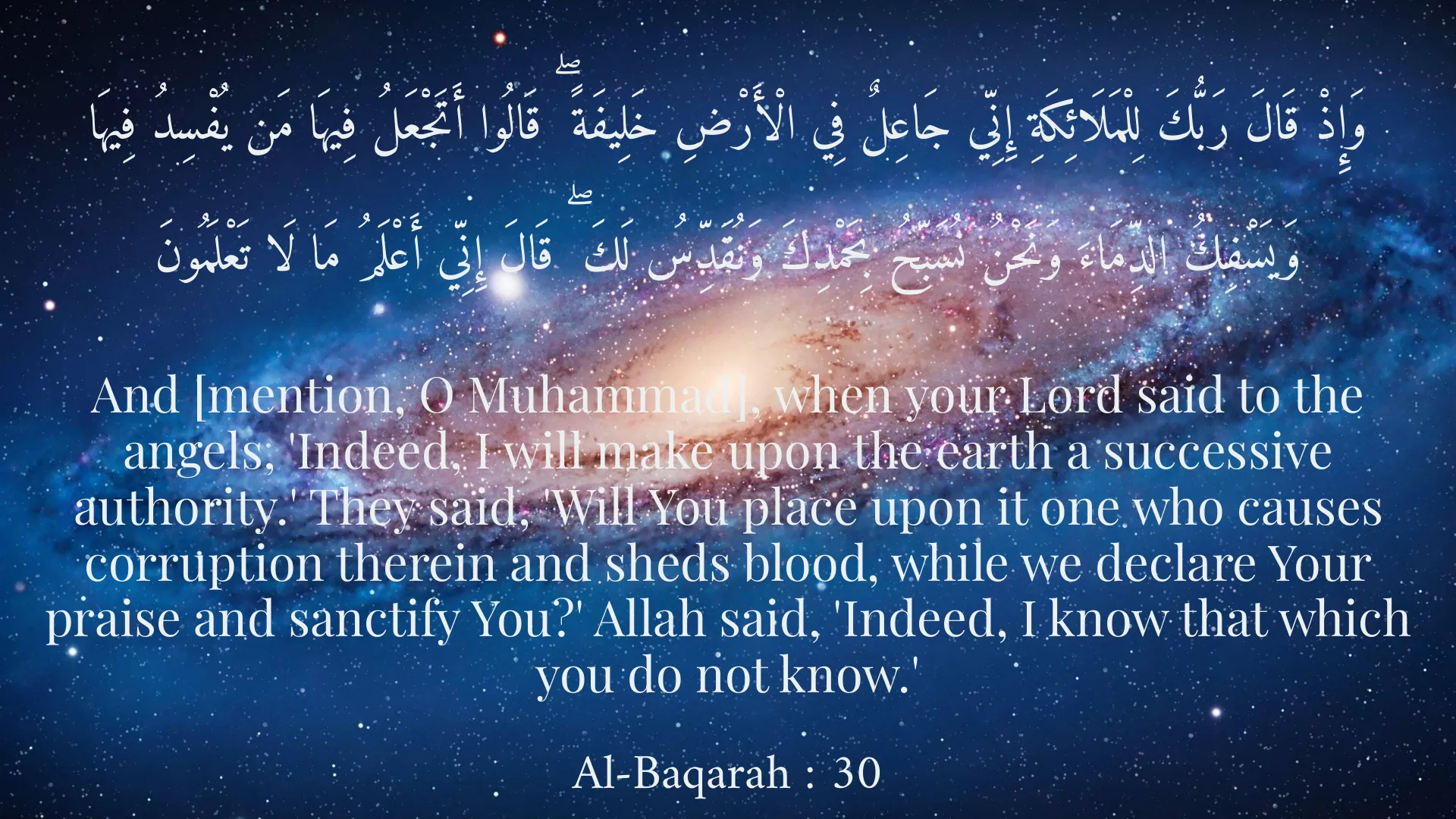
وَإِذْ قَالَ رَبُّكَ لِلْمَلَائِكَةِ إِنِّي جَاعِلٌ فِي الْأَرْضِ خَلِيفَةً ۖ قَالُوا أَتَجْعَلُ فِيهَا مَن يُفْسِدُ فِيهَا وَيَسْفِكُ الدِّمَاءَ وَنَحْنُ نُسَبِّحُ بِحَمْدِكَ وَنُقَدِّسُ لَكَ ۖ قَالَ إِنِّي أَعْلَمُ مَا لَا تَعْلَمُونَ
And [mention, O Muhammad], when your Lord said to the angels, 'Indeed, I will make upon the earth a successive authority.' They said, 'Will You place upon it one who causes corruption therein and sheds blood, while we declare Your praise and sanctify You?' Allah said, 'Indeed, I know that which you do not know.'
Al-Baqarah : 30
وَالسَّمَاءَ رَفَعَهَا وَوَضَعَ الْمِيزَانَ
And the heaven He raised and set the balance.
Ar-Rahman : 7
أَلَّا تَطْغَوْا فِي الْمِيزَانِ
That you not transgress [due bounds] in the balance.
Ar-Rahman : 8
وَأَقِيمُوا الْوَزْنَ بِالْقِسْطِ وَلَا تُخْسِرُوا الْمِيزَانَ
And establish the weight in justice and do not make deficient the balance.
Ar-Rahman : 9
وَلَا تُفْسِدُوا فِي الْأَرْضِ بَعْدَ إِصْلَاحِهَا وَادْعُوهُ خَوْفًا وَطَمَعًا ۚ إِنَّ رَحْمَتَ اللَّهِ قَرِيبٌ مِّنَ الْمُحْسِنِينَ
And cause not corruption upon the earth after its reformation. And invoke Him in fear and aspiration. Indeed, the mercy of Allah is near to the doers of good.
Al-A'raf : 56
Short Story
It is narrated that in ancient times, a just and benevolent king ruled over a lush, green land. It was his custom each morning, before entering his court, to spend an hour strolling in his palace garden, admiring the flowers and trees. One day, his servant asked, “O King, you have so many important duties; why do you spend such precious time each day gazing at flowers and greenery?” The king smiled and said, “My friend, these flowers and trees teach me the most profound lessons. Every green leaf reminds me of its Creator, and every blossom tells a tale of unparalleled beauty and order. This garden is not merely a place of recreation, but a school that teaches me how to be a good trustee and how to administer justice not only to people but to all creatures. How can one who does not respect the right of a plant uphold the right of a human? Nature is a mirror of divine wisdom, and every particle of it tells a story of creation. In this contemplation, I not only find peace but also realize that every king, no matter how powerful, must consider himself a servant of this Earth and its creatures, not its absolute owner. That is why I strive to keep my land prosperous and allow no one to break even a single branch without reason. For to corrupt nature is, in truth, to corrupt one's own soul and to show ingratitude towards the Lord.”