Quranic Answer
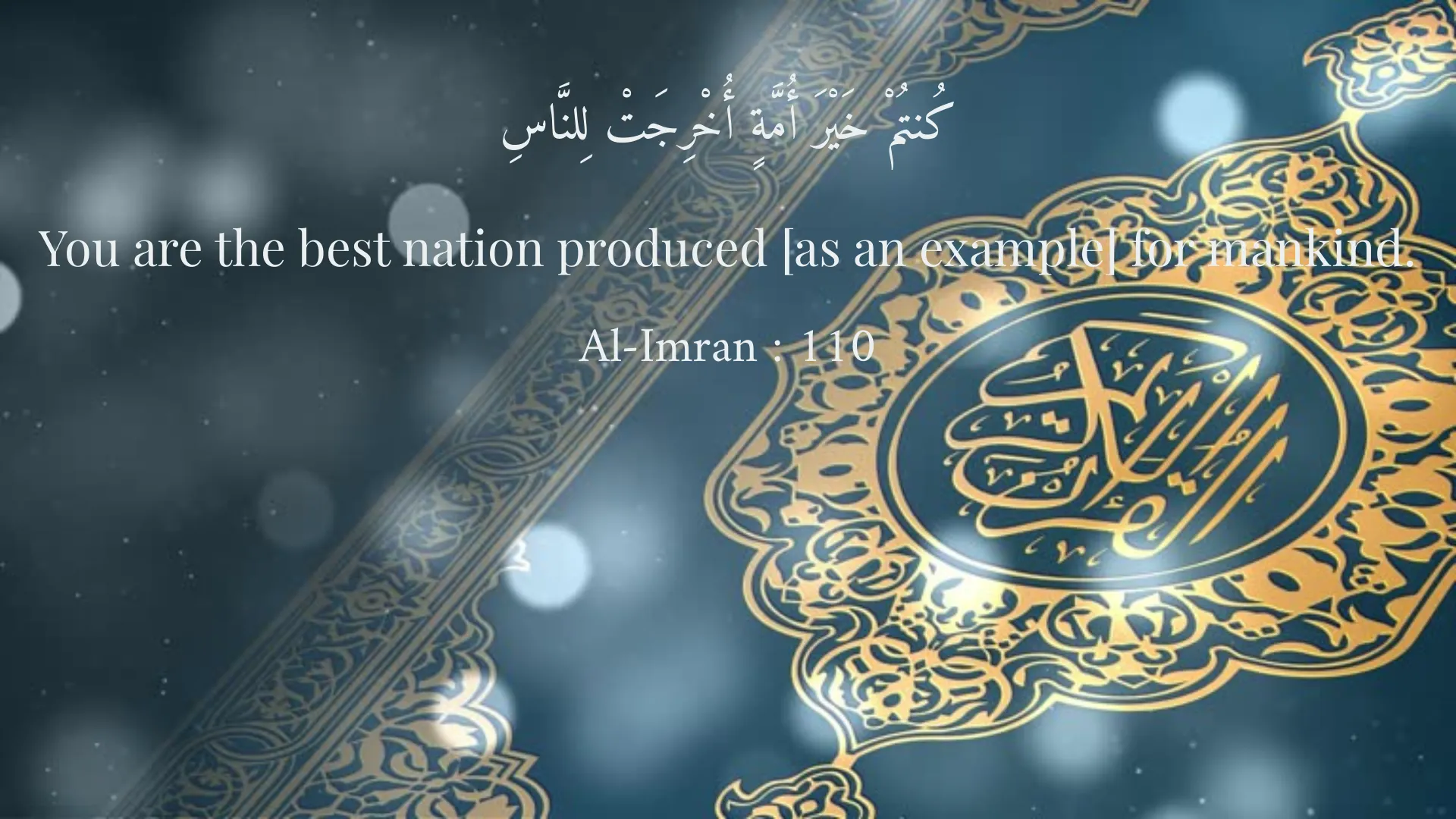
The Quran presents a profound view on the role of society in guiding or misleading individuals, emphasizing the collective responsibility of a community in promoting righteousness and preventing wrongdoing. This idea is thoroughly depicted in various verses, notably in Surah Al-Imran, verse 110, where Allah states, 'You are the best nation produced [as an example] for mankind.' This verse is not merely a compliment; it carries significant weight regarding the expectations placed upon Muslims as a community. Their designation as 'the best nation' encapsulates an obligation to embody moral excellence and serve as role models for others, thereby illustrating a critical principle: the importance of social responsibility. The essence of being the best nation is intertwined with the idea of inviting others to goodness. A significant part of belonging to a community involves the duty to guide fellow members toward virtuous behavior and to discourage actions that lead to moral decay. In Surah Hud, verse 118, Allah mentions, 'And if your Lord had willed, He would have made mankind one nation...'; implying that diversity among humans provides an opportunity for mutual assistance in the pursuit of guidance. Rather than fostering division and misunderstanding, societies should cultivate an environment where individuals help one another find truth and righteousness. Every society has a distinctive character that can either uplift or diminish the moral compass of its members. A robust community should ideally function as a supportive network, reinforcing correct beliefs while shielding its individuals from deviant paths. This responsibility includes individuals acting as positive influences within their communities, akin to how neurons function within a brain, where each part contributes to the overall health and capability of the system. It suggests that collective consciousness, driven by a shared set of values and ethics, is essential for societal progression. Conversely, when a society gravitates toward immorality, it not only risks fostering corruption but also becomes instrumental in derailing its members, leading them away from the righteous path. The Quran puts strong emphasis on the significance of community in guiding individuals, underscoring the importance of adhering to righteous leadership. In Surah Al-Furqan, verse 67, it is articulated that 'And those who, when they spend, are neither extravagant nor stingy, but are ever, between that, [justly] moderate.' This verse captures the essence of balance and moderation in social interactions. It exemplifies how societal values can shape individual behaviors. When a community promotes principles of moderation, it encourages its members to embody these attributes in their personal and social dealings. This moderation is essential not just in spending but also in character, behavior, and beliefs. Thus, when reflecting on the pivotal role of society, one must consider how communal values interact with individual choices. A society rich in moral teachings and ethics provides guidance that nurtures positive individual development. This interdependence challenges individuals to thrive while remaining accountable to their community. Furthermore, it showcases that the collective actions of the community can lead either to enlightenment or to moral bankruptcy. One might question the mechanisms through which societies wield their influence over individual beliefs. Social norms, traditions, and collective consciousness play critical roles in molding individual behaviors. The norms established within a society can influence a person's perception of morality, ethics, and socially acceptable behavior. For instance, communities that genuinely adhere to Islamic principles foster environments where individual members feel encouraged to act righteously, thus reinforcing the values that guide their lives. In contrast, environments steeped in nihilism, materialism, or other forms of moral relativity can confuse individuals about what is right or wrong. The collective desires of society can often overshadow personal convictions, highlighting the necessity of maintaining a strong moral foundation that aligns with divine teachings. To withstand the potential moral pitfalls fostered by societal pressures, it is essential for individuals to cultivate personal convictions grounded in faith and understanding. The Quran serves as a toolkit in this process, providing wisdom and guidelines that can help withstand the whims of societal attitudes. This proactive engagement within both personal faith and communal dynamics presents an opportunity for spiritual growth and collective resilience. Efforts in self-improvement should also parallel a commitment to uplift those around us, as both personal elevation and community guidance need to go hand in hand. The responsibility extends beyond self to the greater good, forming an interconnected web where the guidance offered is reciprocated, nurturing a cycle of righteousness. In summary, the interplay between society and individual conduct is intricately laid out in the Quran. The messages contained within its verses underline that societies play a crucial role in guiding or misleading individuals, emphasizing both community accountability and a personal commitment to righteousness. Understanding the influence of community, members must strive toward creating and maintaining environments that present the truth, encourage virtuous behaviors and promote social harmony. By consciously engaging in collective moral praxes, the community can fulfill its divine mandate to be the 'best nation' and can lead its members away from misdirection, fortifying a bond that benefits both individual and society alike. In conclusion, every individual has a role in this divine responsibility. Engaging in mutual guidance and encouragement not only fulfills a spiritual obligation but also contributes vastly to the overall fabric of a righteous society. It is through these concerted efforts that a community can transform itself into a beacon of light for all of humanity, living up to the prestigious title of the 'best nation' as mentioned in the Quran.
Related Verses
كُنتُمْ خَيْرَ أُمَّةٍ أُخْرِجَتْ لِلنَّاسِ
You are the best nation produced [as an example] for mankind.
Al-Imran : 110
وَلَوْ شَاءَ رَبُّكَ لَجَعَلَ النَّاسَ أُمَّةً وَاحِدَةً
And if your Lord had willed, He would have made mankind one nation.
Hud : 118
وَالَّذِينَ إِذَا أَنفَقُوا لَمْ يُسْرِفُوا وَلَمْ يَقْتُرُوا
And those who, when they spend, are neither extravagant nor stingy.
Al-Furqan : 67
Short Story
Once upon a time, a man named Ali lived in a community where everyone helped one another and encouraged each other towards goodness. One day, Ali felt very happy about this situation and wondered what made his community so harmonious. He realized that mutual support and guidance were the keys to the community's success. Therefore, he decided to take a positive step himself, helping others and always encouraging goodness in those around him. Over time, Ali saw his community moving toward brightness and positive energy.