Quranic Answer
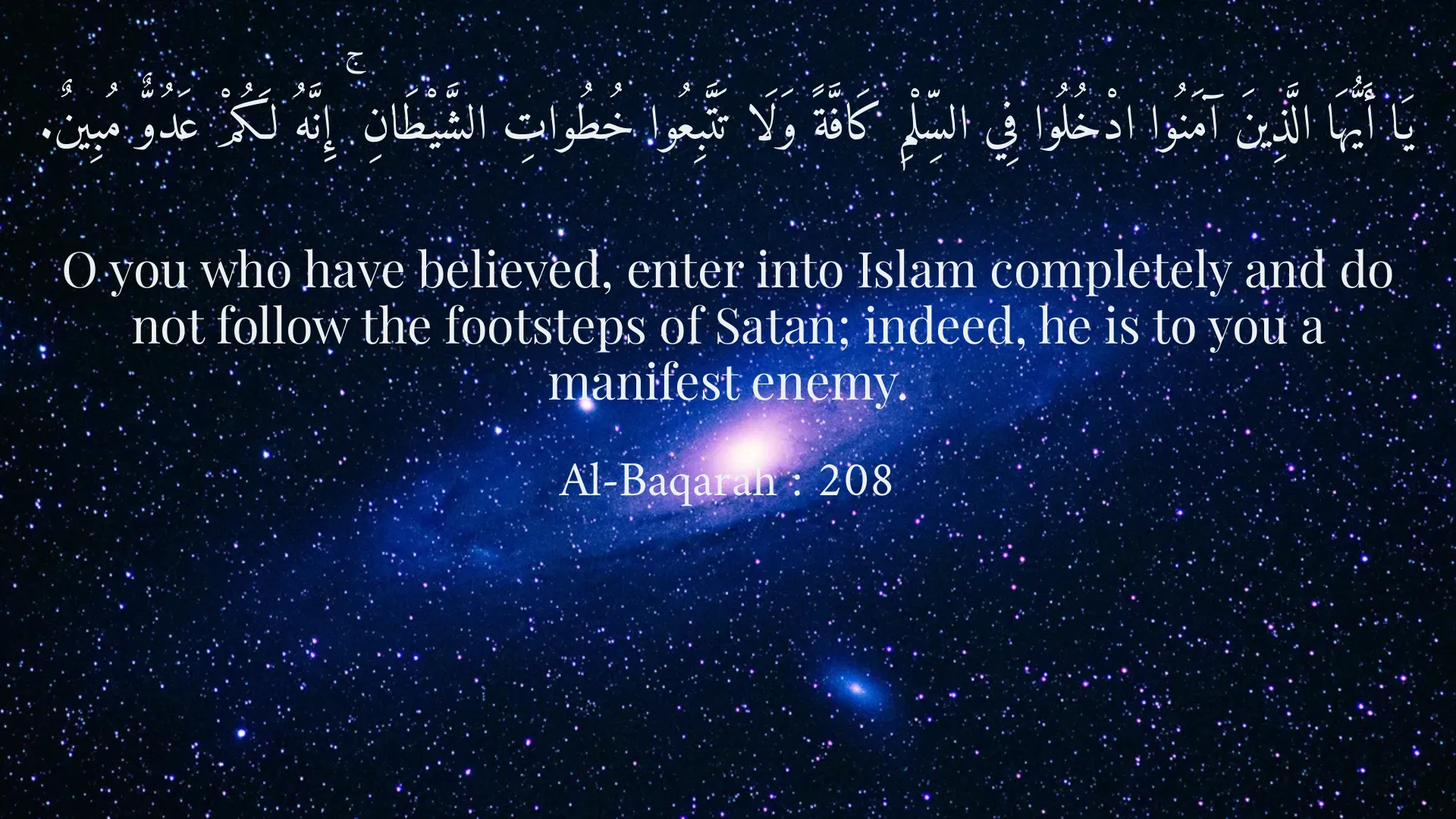
In the Holy Quran, various methods to combat and defend against the adversarial influences of Satan are distinctly outlined. One of the most significant and fundamental approaches emphasized is the remembrance of God, known as dhikr, and the cultivation of piety, or taqwa. In Surah Al-Baqarah, verse 208, Allah provides clear guidance when He states: 'O you who have believed, enter into Islam completely and do not follow the footsteps of Satan; indeed, he is to you a manifest enemy.' This verse serves as a powerful reminder of the importance of fully submitting ourselves to God's protection. For Muslim believers, this entails a comprehensive acceptance of the tenets of Islam, fostering a strong connection with Allah, and steeling oneself against the distractions and deviance that Satan presents. The exhortation to 'enter into Islam completely' speaks to the holistic nature of faith, emphasizing that mere acknowledgment is insufficient; rather, one must actively engage in and embody the principles of Islam in every aspect of life. This call serves to fortify believers in their struggle against the inevitable whispers of temptation that Satan instigates. Furthermore, in Surah Al-A'raf, verse 200, Allah states: 'And if an evil whisper comes to you from Satan, then seek refuge in Allah. Indeed, He is Hearing and Knowing.' This directive not only acknowledges the reality of Satan's attempts to lead believers astray but also offers a solution. The encouragement to seek refuge in Allah highlights the necessity of turning towards the Creator in moments of temptation or doubt. Instead of succumbing to the malevolent influences of Satan, believers are reminded that genuine strength lies in prayer and the remembrance of God. The Quran extensively emphasizes the power of prayer (salah) and supplication (du'a) as integral components of a faithful life. When faced with intrinsic doubts or external temptations, individuals are advised to turn their hearts and minds upwards in prayerful communication with Allah, beseeching His guidance and support. Engaging in regular prayer establishes a rhythm of devotion that serves to cultivate mindfulness of God, further shielding believers from Satan’s insidious touches. Through the practice of prayer, believers reinforce their allegiance to God, allowing for a profound spiritual connection that acts as armor against the trickery of Satan. Moreover, another significant approach to confronting and warding off Satan's influences as sanctioned by the Quran is through the supplication and recitation of divine verses. In particular, two chapters of the Quran, Surah Al-Falaq and Surah An-Nas, are recognized as protective chapters, often recited for refuge against the evil of Satan and other maleficent forces. In Surah Al-Falaq, Allah commands believers to seek His refuge from the evil of what He has created, and in Surah An-Nas, believers are guided to seek protection from the evil whisperer who retreats. These chapters highlight the respectful acknowledgment of the power of evil, while simultaneously asserting that ultimate protection and refuge can only be found through Allah. The act of reciting these protective verses serves dual purposes. Firstly, it helps to embed their meanings within the heart and mind of the believer, fostering a deeper understanding of God's omnipotence. Secondly, it acts as an active form of resistance against negative thoughts and influences. Reciting these verses not only wards off evil but also acts as a reminder of divine support and mercy. By engaging in such practices, believers can cultivate a profound and personal relationship with the Quran, allowing its teachings to be an ongoing source of strength and shield against misguidance. Overall, recognizing Satan as an eminent enemy is imperative for believers. By understanding this intrinsic opposition, one is prompted to become proactive in efforts to draw closer to God. The consistent practice of prayer, the recitation of the Quran, and the sincere asking of supplication are potent strategies in combating the whisperings of Satan. When believers are engaged in the remembrance of God, focused on prayer, and reflective through the readings of the Quran, they find that the power of Satan diminishes considerably. The continuous presence of God leads to a dismissal of fear, drawing believers into a realm of peace and spiritual clarity. In tumultuous times and moments of moral uncertainty, the teachings within the Quran encourage seeking guidance, reassurance, and solace in the relationship with Allah, reaffirming the unwavering reminder that in God’s remembrance, Satan loses his power to influence and gain foothold over our hearts and minds. In conclusion, the Holy Quran provides a rich and comprehensive foundation for Muslims to nurture their faith and combat the whispers and temptations posed by Satan. By indulging in the remembrance of God through prayer, the recitation of protective verses, and maintaining piety, believers establish a fortified barrier against temptation, consistently reinforcing their spiritual resolve in alignment with the teachings of Islam. Ultimately, faith, supplication, and devotion transform into profound weapons in the fight against evil, leading to a life guided by divine mercy and protection.
Related Verses
يَا أَيُّهَا الَّذِينَ آمَنُوا ادْخُلُوا فِي السِّلْمِ كَافَّةً وَلَا تَتَّبِعُوا خُطُواتِ الشَّيْطَانِ ۚ إِنَّهُ لَكُمْ عَدُوٌّ مُبِينٌ.
O you who have believed, enter into Islam completely and do not follow the footsteps of Satan; indeed, he is to you a manifest enemy.
Al-Baqarah : 208
وَإِمَّا يَنزَغَنَّكَ مِنَ الشَّيْطَانِ نَزْغٌ فَاسْتَعِذْ بِاللَّهِ ۚ إِنَّهُ سَمِيعٌ عَلِيمٌ.
And if an evil whisper comes to you from Satan, then seek refuge in Allah. Indeed, He is Hearing and Knowing.
Al-A'raf : 200
قُلْ أَعُوذُ بِرَبِّ الْفَلَقِ.
Say, 'I seek refuge in the Lord of daybreak.'
Al-Falaq : 1
Short Story
Once upon a time, there was a man named Hasan, who always fell victim to Satan's temptations. He decided to combat these temptations by engaging in the remembrance and recitation of the Quran. One day while reading Surah Al-Falaq, he felt a special peace settle in his heart. From that day on, Hasan never neglected the remembrance of God and continuously focused on learning the Quran. He realized that by remembering God, Satan could not tempt him, and his life moved towards tranquility and happiness.