Quranic Answer
The concept of justice holds an exceptionally high position in the Quranic worldview and is one of the most fundamental pillars upon which human society and individual life are built. The Holy Quran not only defines justice theoretically but also provides detailed practical solutions for its realization in all aspects of individual and social life. From the Quran's perspective, justice is not merely about absolute equality or an even distribution of everything, but rather about placing everything in its rightful place, giving due rights to those who deserve them, and maintaining balance and proportion in all matters. This concept is rooted in the divine attributes; God Himself is 'Al-Adl' (The Just) and never commits injustice, and therefore, He commands His servants to embody this attribute on Earth. The Quran explicitly and emphatically commands the establishment of justice. This command applies to all individuals, regardless of their position or status. In Surah An-Nisa, verse 58, Allah states: "Indeed, Allah commands you to render trusts to whom they are due and when you judge between people to judge with justice. Excellent is that which Allah instructs you. Indeed, Allah is ever Hearing and Seeing." This verse clearly highlights the grave responsibility of judging and governing based on justice. Furthermore, in Surah Al-Ma'idah, verse 8, the command to stand firm for justice is given even when facing enemies: "O you who have believed, be persistently [standing firm] for Allah, witnesses in justice, and let not hatred of a people prevent you from being just. Be just; that is nearer to righteousness. And fear Allah; indeed, Allah is Acquainted with what you do." This verse represents the pinnacle of the Quranic concept of justice, requiring impartiality and fairness even in situations of hostility and enmity. Achieving true justice in light of Quranic teachings requires a multifaceted approach: 1. Individual Justice (Taqwa and Self-Improvement): The primary root of justice originates from within the individual. A just person is one who first does not wrong themselves and recognizes their own rights and the rights of others. This begins with self-knowledge, control of desires, and abstaining from sins that lead to injustice (such as greed, envy, pride). Taqwa, which means God-consciousness and piety, is the most crucial internal factor for achieving justice because a pious individual always sees themselves in the presence of God and refrains from oppressing others. The Quran in Surah An-Nisa, verse 135, emphasizes the importance of justice in giving testimony, even if it is against oneself or one's parents and relatives: "O you who have believed, be persistently firm in justice, witnesses for Allah, even if it be against yourselves or parents and relatives. Whether one is rich or poor, Allah is more worthy of both. So follow not [personal] inclination, lest you deviate. And if you distort [your testimony] or turn away, then indeed Allah is ever Acquainted with what you do." This verse shows that justice must take precedence over any personal or group interest. 2. Social and Governmental Justice: The Quran emphasizes the necessity of establishing a just economic and social system. This includes: * Justice in Judgment and Law: Rulers and judges must rule impartially and based on truth (as stated in 4:58 and 5:8). No one should be above the law, and everyone's rights must be equally respected. * Economic Justice: Fair distribution of wealth, combating usury (riba), hoarding, and any form of exploitation. Encouraging Zakat (charity) and sadaqat (voluntary donations) to alleviate poverty and foster social solidarity. The Holy Quran, in several verses, emphasizes the just distribution of wealth and preventing its concentration in the hands of a few (e.g., Surah Al-Hashr, verse 7). * Justice in Social Relations: Respecting the rights of neighbors, orphans, the poor, the needy, and all segments of society. Preventing discrimination and establishing Islamic brotherhood and fraternity. 3. Adherence to Covenants and Treaties: The Holy Quran places great emphasis on fulfilling promises and treaties, whether with Muslims or non-Muslims, which is itself a cornerstone of justice. Breaking a covenant is considered a form of injustice. 4. Rejection of Oppression (Zulm): The Quran strictly forbids oppression and considers it one of the greatest sins. Oppression includes any transgression against the rights of others, whether material or spiritual. Allah Himself has declared injustice forbidden upon Himself and has made it forbidden among people. Combating oppression and aiding the oppressed are among the most important manifestations of achieving justice. 5. Impact of Faith and the Hereafter: Belief in the Hereafter and the Day of Judgment serves as a deterrent against injustice and an incentive to uphold justice. This is because a person knows that every action, good or bad, will be accounted for on the Day of Judgment, and its consequences will be faced. This inner belief helps maintain justice in private and public. Furthermore, faith in Allah and His just attributes motivates individuals to walk the path of justice and embody it in their lives. Ultimately, true justice in a society is achieved when its individuals, first on an individual level, adorn themselves with the light of taqwa and faith, and then, in all their interactions, from the smallest daily decisions to the greatest governmental laws, take justice as their criterion. This is a continuous and comprehensive process that requires collective effort and enlightened, just leadership. The Holy Quran, with its clear and repeated teachings, has paved the way for achieving this divine ideal.
Related Verses
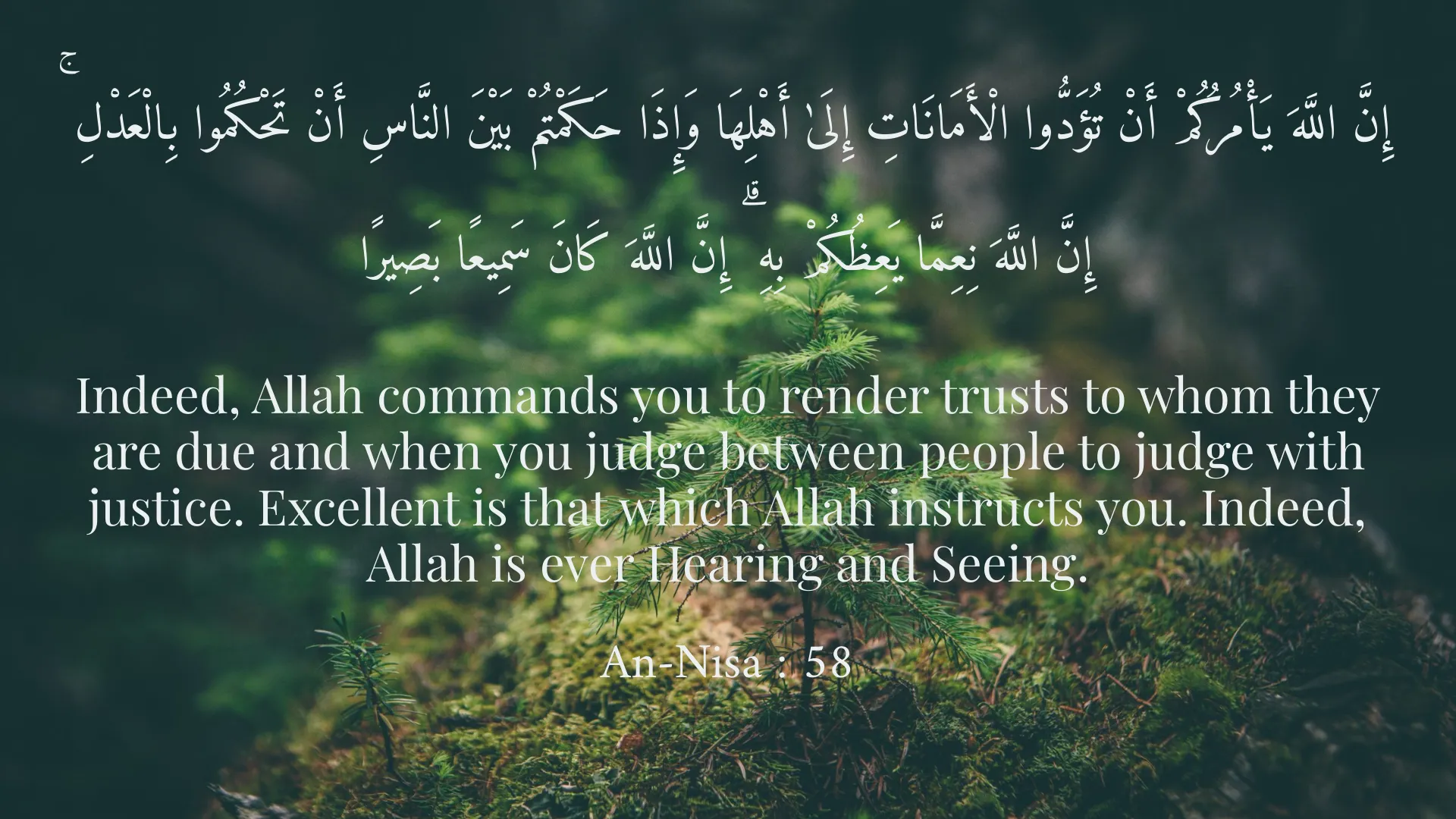
إِنَّ اللَّهَ يَأْمُرُكُمْ أَنْ تُؤَدُّوا الْأَمَانَاتِ إِلَىٰ أَهْلِهَا وَإِذَا حَكَمْتُمْ بَيْنَ النَّاسِ أَنْ تَحْكُمُوا بِالْعَدْلِ ۚ إِنَّ اللَّهَ نِعِمَّا يَعِظُكُمْ بِهِ ۗ إِنَّ اللَّهَ كَانَ سَمِيعًا بَصِيرًا
Indeed, Allah commands you to render trusts to whom they are due and when you judge between people to judge with justice. Excellent is that which Allah instructs you. Indeed, Allah is ever Hearing and Seeing.
An-Nisa : 58
يَا أَيُّهَا الَّذِينَ آمَنُوا كُونُوا قَوَّامِينَ لِلَّهِ شُهَدَاءَ بِالْقِسْطِ ۖ وَلَا يَجْرِمَنَّكُمْ شَنَآنُ قَوْمٍ عَلَىٰ أَلَّا تَعْدِلُوا ۚ اعْدِلُوا هُوَ أَقْرَبُ لِلتَّقْوَىٰ ۖ وَاتَّقُوا اللَّهَ ۖ إِنَّ اللَّهَ خَبِيرٌ بِمَا تَعْمَلُونَ
O you who have believed, be persistently [standing firm] for Allah, witnesses in justice, and let not hatred of a people prevent you from being just. Be just; that is nearer to righteousness. And fear Allah; indeed, Allah is Acquainted with what you do.
Al-Ma'idah : 8
يَا أَيُّهَا الَّذِينَ آمَنُوا كُونُوا قَوَّامِينَ بِالْقِسْطِ شُهَدَاءَ لِلَّهِ وَلَوْ عَلَىٰ أَنْفُسِكُمْ أَوِ الْوَالِدَيْنِ وَالْأَقْرَبِينَ ۚ إِنْ يَكُنْ غَنِيًّا أَوْ فَقِيرًا فَاللَّهُ أَوْلَىٰ بِهِمَا ۖ فَلَا تَتَّبِعُوا الْهَوَىٰ أَنْ تَعْدِلُوا ۚ وَإِنْ تَلْوُوا أَوْ تُعْرِضُوا فَإِنَّ اللَّهَ كَانَ بِمَا تَعْمَلُونَ خَبِيرًا
O you who have believed, be persistently firm in justice, witnesses for Allah, even if it be against yourselves or parents and relatives. Whether one is rich or poor, Allah is more worthy of both. So follow not [personal] inclination, lest you deviate. And if you distort [your testimony] or turn away, then indeed Allah is ever Acquainted with what you do.
An-Nisa : 135
Short Story
In Saadi's Golestan, it is recounted that Nushirvan the Just was hunting and needed salt for a roasted prey. A servant was dispatched to a village to fetch salt. Nushirvan said, "Buy the salt at its due price, lest injustice takes root in the village and destroys it." They asked, "What harm could come from such a small matter?" He replied, "The foundation of oppression in the world began small; each one who came added something to it until it reached this extent. If a king takes one apple from a person's garden by force, his army will uproot the tree entirely." This beautiful anecdote teaches us that true justice begins with the smallest actions, and one should never underestimate injustice, no matter how trivial. For a small injustice can lay the foundation for a great one, disrupting the peace of a society. So, let us practice justice in every step of life to have a prosperous and compassionate world.