Quranic Answer
The Holy Quran, as the divine guidance for humanity, places immense emphasis on the concept of "Ihsan" (goodness, excellence, benevolence, kindness) towards others. This is not merely an optional act of charity but a fundamental pillar of Islamic ethics and a reflection of one's faith. The Quran repeatedly calls believers to foster a society built on compassion, mutual support, and justice, extending kindness to all members of society, especially the vulnerable and needy. The verses prescribing kindness are numerous and comprehensive, covering a wide range of relationships and situations. One of the most comprehensive and foundational verses in this regard is found in Surah Al-Baqarah (2:83), where Allah states: "And [recall] when We took the covenant from the Children of Israel, [saying], 'Do not worship except Allah; and to parents, good treatment; and to relatives, orphans, and the needy. And speak to people good words and establish prayer and give zakah.' Then you turned away, except a few of you, and you were refusing." This single verse encapsulates several key recipients of kindness, beginning with the foundational principle of worshipping Allah alone, then immediately linking it to the treatment of fellow human beings. It highlights parents as the first and most deserving recipients of good treatment, followed by relatives, orphans, and the needy. Furthermore, it emphasizes the importance of "good words" (husn al-qawl) towards all people, signifying that kindness is not only about material aid but also about respectful and gentle communication. This comprehensive command underscores that kindness is an integral part of one's devotion to God, impossible to separate from true faith. Another pivotal verse, even more expansive in its scope, is Surah An-Nisa (4:36): "Worship Allah and associate nothing with Him, and to parents do good, and to relatives, orphans, the needy, the near neighbor, the far neighbor, the companion by your side, the traveler, and those whom your right hands possess. Indeed, Allah does not like those who are conceited and boastful." This verse broadens the circle of recipients of kindness to include not only immediate family but also various categories of neighbors (near and far), companions, travelers, and even those under one's care. It illustrates the far-reaching nature of Islamic ethics, commanding believers to be a source of good in their immediate environment and beyond. The mention of "the near neighbor" and "the far neighbor" signifies that kindness should extend beyond close acquaintances to anyone within one's sphere of influence, fostering a strong, interconnected community. The concluding phrase, "Indeed, Allah does not like those who are conceited and boastful," links kindness directly to humility and sincerity, indicating that true benevolence stems from a humble heart, free from arrogance, thereby stressing the importance of pure intentions in acts of kindness. The Quran also emphasizes the selfless nature of giving and kindness, particularly in verses like Surah Al-Insan (76:8-9): "And they give food, in spite of their love for it, to the needy, the orphan, and the captive, [saying], 'We feed you only for the countenance of Allah. We wish not from you reward or gratitude.'" This verse beautifully portrays the ideal motivation for acts of kindness: seeking only the pleasure of Allah, without expecting any worldly recompense or even gratitude from the recipient. This level of purity in intention elevates acts of benevolence from mere social transactions to profound spiritual worship. It teaches believers to detach from ego and worldly expectations, focusing solely on their relationship with the Divine. This is the essence of true giving: without expecting anything in return, purely for God's sake. Beyond specific categories, the Quran frequently enjoins general good conduct and justice. Surah An-Nahl (16:90) states: "Indeed, Allah orders justice and good conduct and giving to relatives and forbids immorality and wrongdoing and oppression. He admonishes you that perhaps you will be reminded." This verse provides a universal principle, commanding justice and "Ihsan" (good conduct) as overarching virtues, while explicitly linking it to giving to relatives and forbidding all forms of wrongdoing. This shows that kindness is not merely an optional act but a fundamental requirement for a just and harmonious society, forming the bedrock of moral behavior. The fact that Ihsan is mentioned alongside justice underscores its paramount importance in the divine framework of human conduct. The concept of kindness in the Quran extends beyond material aid. It encompasses empathy, forgiveness, compassion, and respect for human dignity. For instance, believers are encouraged to speak gently, even to those who may be rude or ignorant (Al-Furqan 25:63). They are urged to forgive and overlook faults (Al-Nur 24:22). This holistic view of kindness ensures that it pervades every interaction, transforming daily life into a continuous act of worship and community building. The Prophet Muhammad (peace be upon him) exemplified this, teaching that "the best among you are those who are best to their families" and "he is not a believer who eats his fill while his neighbor goes hungry." These prophetic traditions, deeply rooted in Quranic principles, further illustrate the practical application of kindness, ensuring that it is not an abstract concept but a lived reality. In essence, kindness in the Quran is a multifaceted jewel, reflecting the divine attributes of mercy and generosity. It is a command to nurture strong family bonds, to protect the vulnerable, to support the needy, to respect neighbors, and to interact with all humanity with compassion and good words. It is an act of worship, a path to spiritual purification, and a cornerstone of a righteous and flourishing society. By practicing "Ihsan" towards others, believers not only fulfill their religious obligations but also contribute to a world where empathy triumphs over indifference, and compassion reigns supreme. It is a continuous journey of giving, caring, and uplifting those around us, driven by the pure desire to please Allah and embody the beautiful teachings of Islam. The Quran provides a clear roadmap for living a life filled with meaning and purpose, centered on the profound beauty of giving and selfless love, with the knowledge that every act of goodness is recorded and rewarded by the Almighty. This comprehensive framework ensures that kindness is not an afterthought but a central tenet guiding every aspect of a believer's life, creating ripples of positive change in communities and beyond.
Related Verses
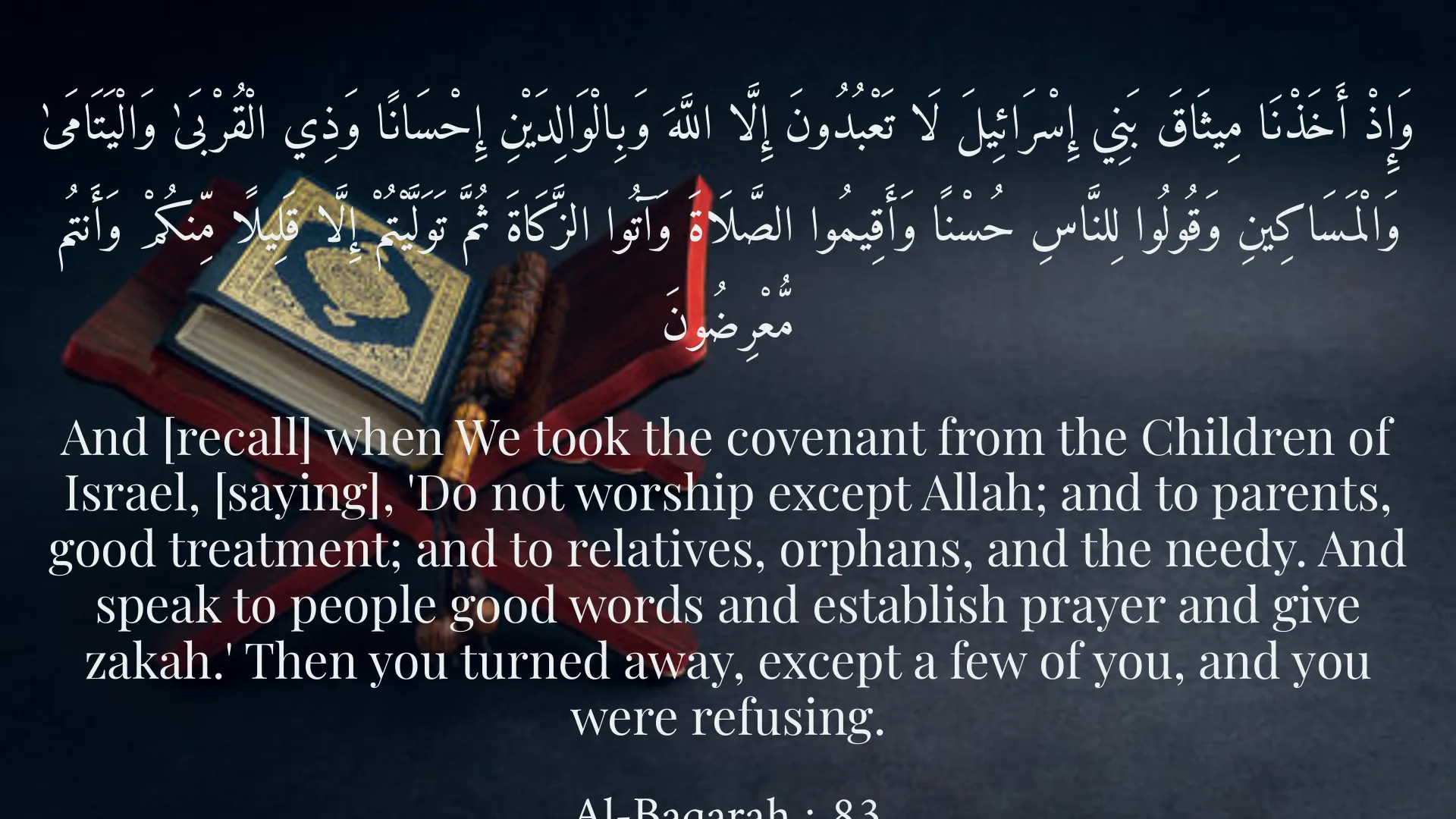
وَإِذْ أَخَذْنَا مِيثَاقَ بَنِي إِسْرَائِيلَ لَا تَعْبُدُونَ إِلَّا اللَّهَ وَبِالْوَالِدَيْنِ إِحْسَانًا وَذِي الْقُرْبَىٰ وَالْيَتَامَىٰ وَالْمَسَاكِينِ وَقُولُوا لِلنَّاسِ حُسْنًا وَأَقِيمُوا الصَّلَاةَ وَآتُوا الزَّكَاةَ ثُمَّ تَوَلَّيْتُمْ إِلَّا قَلِيلًا مِّنكُمْ وَأَنتُم مُّعْرِضُونَ
And [recall] when We took the covenant from the Children of Israel, [saying], 'Do not worship except Allah; and to parents, good treatment; and to relatives, orphans, and the needy. And speak to people good words and establish prayer and give zakah.' Then you turned away, except a few of you, and you were refusing.
Al-Baqarah : 83
وَاعْبُدُوا اللَّهَ وَلَا تُشْرِكُوا بِهِ شَيْئًا ۖ وَبِالْوَالِدَيْنِ إِحْسَانًا وَبِذِي الْقُرْبَىٰ وَالْيَتَامَىٰ وَالْمَسَاكِينِ وَالْجَارِ ذِي الْقُرْبَىٰ وَالْجَارِ الْجُنُبِ وَالصَّاحِبِ بِالْجَنبِ وَابْنِ السَّبِيلِ وَمَا مَلَكَتْ أَيْمَانُكُمْ ۗ إِنَّ اللَّهَ لَا يُحِبُّ مَن كَانَ مُخْتَالًا فَخُورًا
Worship Allah and associate nothing with Him, and to parents do good, and to relatives, orphans, the needy, the near neighbor, the far neighbor, the companion by your side, the traveler, and those whom your right hands possess. Indeed, Allah does not like those who are conceited and boastful.
An-Nisa : 36
وَيُطْعِمُونَ الطَّعَامَ عَلَىٰ حُبِّهِ مِسْكِينًا وَيَتِيمًا وَأَسِيرًا إِنَّمَا نُطْعِمُكُمْ لِوَجْهِ اللَّهِ لَا نُرِيدُ مِنكُمْ جَزَاءً وَلَا شُكُورًا
And they give food, in spite of their love for it, to the needy, the orphan, and the captive, [saying], 'We feed you only for the countenance of Allah. We wish not from you reward or gratitude.'
Al-Insan : 8-9
إِنَّ اللَّهَ يَأْمُرُ بِالْعَدْلِ وَالْإِحْسَانِ وَإِيتَاءِ ذِي الْقُرْبَىٰ وَيَنْهَىٰ عَنِ الْفَحْشَاءِ وَالْمُنكَرِ وَالْبَغْيِ ۚ يَعِظُكُمْ لَعَلَّكُمْ تَذَكَّرُونَ
Indeed, Allah orders justice and good conduct and giving to relatives and forbids immorality and wrongdoing and oppression. He admonishes you that perhaps you will be reminded.
An-Nahl : 90
Short Story
It is narrated that in the city of Isfahan, there was a merchant who, every night, would take a portion of his food to a poor neighbor. One night, heavy rain fell, and the poor man was not at home. The merchant thought to himself, "This neighbor will go hungry!" He returned home with a heavy heart and in a dream, he saw angels saying: "O virtuous man, glad tidings to you, for your kindness has been accepted in the Divine court. Because even in your state of abundance and comfort, you did not forget Our servant and remained faithful to your covenant of benevolence, even when no one saw." The merchant awoke delighted, knowing that even hidden acts of kindness hold immense status with the Almighty, and every good deed, however small, is noticed and rewarded. This story serves as a reminder that kindness and benevolence towards others, especially in secret and without expectation, hold great value and are preserved by the Almighty.