Quranic Answer
Fear of changing direction is a very natural human emotion that many of us experience throughout life. This fear stems from uncertainty about the future, anxiety about losing current security and comfort, and dread of failure in a new path. Humans are inherently inclined towards stability and predictability, and any departure from a comfort zone can evoke feelings of uncertainty and vulnerability. However, from the perspective of the Holy Quran, while these fears are natural and understandable, they should never impede a person's growth, development, and forward movement. The Quran, with its profound and guiding teachings, offers solutions for confronting this fear and transforming it into a force for progress, fundamentally rooted in the concepts of reliance on Allah, patience, and a correct understanding of divine will. One of the most central concepts the Quran presents for overcoming fear of change is 'Tawakkul,' which means absolute and complete trust in Allah Almighty. When you decide to change the course of your life, whether in your career, personal relationships, or even your spiritual approach, you face a world of unknowns. These unknowns are precisely what instill fear. The Quran repeatedly instructs believers to place their trust in Allah, as He is the sole supporter and guide for humanity. In Surah At-Talaq, verse 3, it states: "And whoever relies upon Allah – He is sufficient for him." This verse radiates hope, assuring a person that if they take a step with pure intention and trust in Allah, He will suffice for them, and there will be no need to fear potential consequences. Tawakkul does not mean abandoning effort; rather, it means that after exerting all necessary effort and planning, one entrusts the outcome to Allah and trusts in His wisdom. Fear of change often arises from the notion that we do not have complete control over outcomes; Tawakkul lifts this burden from us and frees us from anxiety. The concept of 'Sabr' (patience) is another key that the Quran offers for confronting fear and the adversities of change. Change often comes with difficulties, challenges, and sometimes temporary setbacks. The fear of these difficulties can be a strong deterrent to making a change. The Quran invites believers to patience and considers patience to be one of the prominent characteristics of the righteous. In Surah Al-Baqarah, verse 153, it states: "O you who have believed, seek help through patience and prayer. Indeed, Allah is with the patient." This verse indicates that patience is not merely a moral virtue but a powerful tool for seeking help against problems. Changing direction may require enduring initial hardships, resisting temptations, and persevering against despair. The belief that Allah is with the patient and that ease follows hardship, as stated in Surah Ash-Sharh, verses 5 and 6: "So, verily, with every difficulty there is ease; Verily, with every difficulty there is ease," reassures a person that no hardship is permanent and that after every challenging period, there will be relief. This perspective reduces the fear of the unknown and potential difficulties. In addition to Tawakkul and Sabr, understanding 'Qadar' or divine decree also plays a significant role in reducing fear of change. The Quran teaches us that everything that happens in the universe is within Allah's knowledge and will. This does not mean that a person should be passive and not strive; rather, it means that after fulfilling their duty and exerting maximum effort, whatever the outcome, there is wisdom hidden in it. In Surah Al-Hadid, verse 22, it says: "No disaster strikes upon the earth or among yourselves except that it is in a register before We create it – indeed that, for Allah, is easy." This verse can bring comfort to a person, assuring them that even if a change of direction does not lead to the desired results, it is still part of Allah's larger plan, and there is good and wisdom in it. This understanding removes the heavy burden of the fear of failure, enabling a person to embrace change with greater confidence. Finally, the Quran advises people not to become overly attached to the worldly life and its manifestations. Fear of change often stems from attachment to the current situation, status, wealth, or existing relationships. The Quran considers worldly life fleeting and transient, and it identifies the primary goal as preparation for the Hereafter. If a person's heart is attached to worldly stabilities, it is natural to fear any change that challenges these stabilities. However, with an eschatological view, one realizes that every change and challenge in this world is an opportunity for spiritual growth and earning eternal reward. This perspective gives a person the courage to act for higher goals, even if it requires leaving the comfort zone and facing the unknown. Therefore, to overcome the fear of changing direction, one must rely on Allah, be patient on the new path, trust in divine decree, and remember that the ultimate goal is the pleasure of Allah and eternal life, not merely temporary worldly comfort. With this Quranic approach, fear will transform into a motivation for greater reliance on God and a step towards elevation.
Related Verses
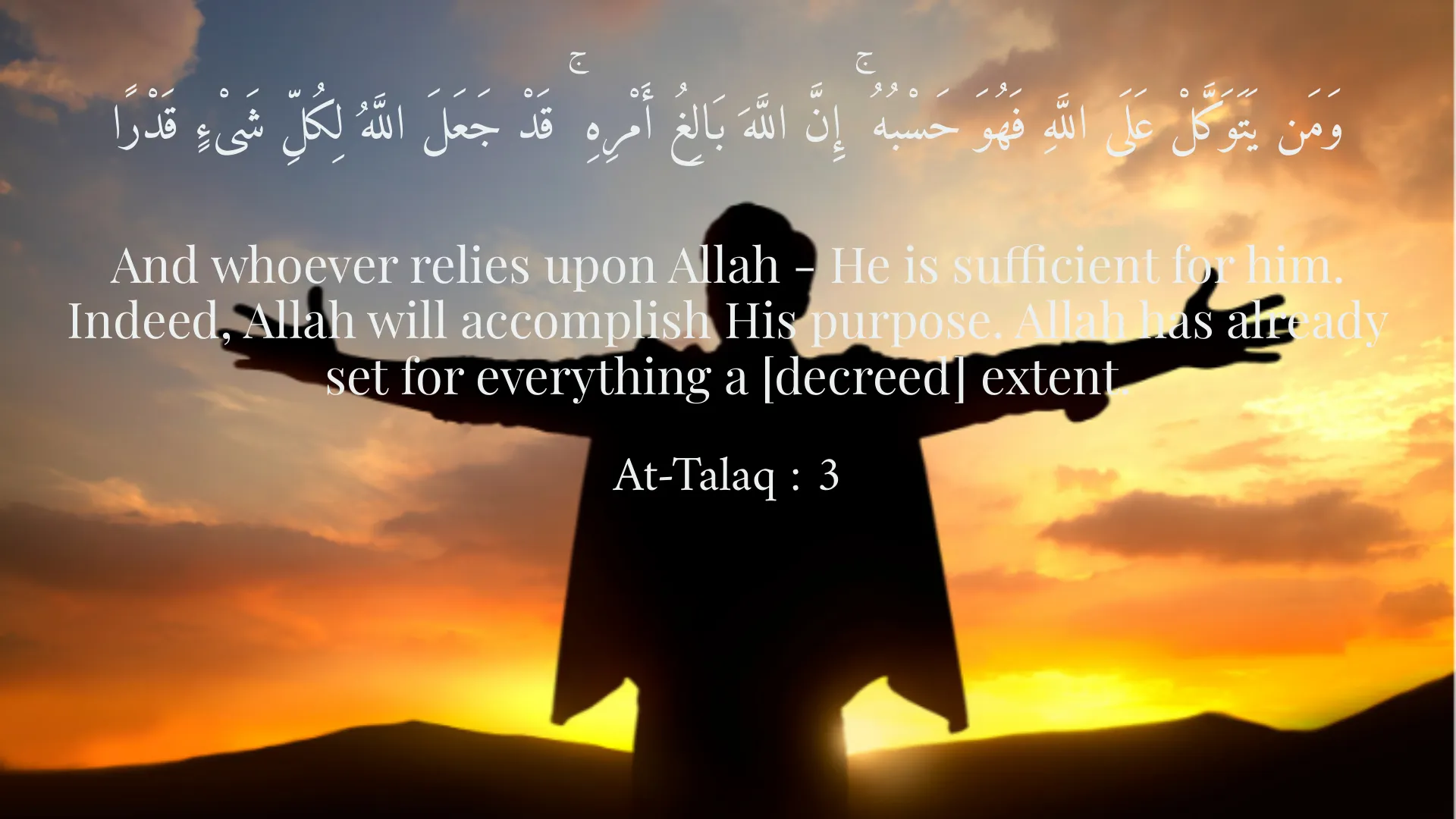
وَمَن یَتَوَکَّلْ عَلَى اللَّهِ فَهُوَ حَسْبُهُ ۚ إِنَّ اللَّهَ بَالِغُ أَمْرِهِ ۚ قَدْ جَعَلَ اللَّهُ لِکُلِّ شَیْءٍ قَدْرًا
And whoever relies upon Allah - He is sufficient for him. Indeed, Allah will accomplish His purpose. Allah has already set for everything a [decreed] extent.
At-Talaq : 3
یَا أَیُّهَا الَّذِینَ آمَنُوا اسْتَعِینُوا بِالصَّبْرِ وَالصَّلَاةِ ۚ إِنَّ اللَّهَ مَعَ الصَّابِرِینَ
O you who have believed, seek help through patience and prayer. Indeed, Allah is with the patient.
Al-Baqarah : 153
فَإِنَّ مَعَ الْعُسْرِ یُسْرًا
So, verily, with every difficulty there is ease.
Ash-Sharh : 5
إِنَّ مَعَ الْعُسْرِ یُسْرًا
Verily, with every difficulty there is ease.
Ash-Sharh : 6
Short Story
They say there was a man named Fereydoun, who was always worried in his small workshop. Whenever he wanted to buy new tools or change his work method, a great fear would seize his heart. He thought he might lose his capital or his business might decline. One day, a wise man passed by his workshop and saw him distressed. The wise man asked, "O Fereydoun, what troubles you so that you are worried and restless?" Fereydoun recounted his fears. The wise man smiled and said, "My friend, the river water does not remain stagnant out of fear of changing its course, nor does it fear that there might be rocks and boulders in its path; rather, with reliance on its Creator and with perseverance, it moves forward, encompassing or overcoming every obstacle until it reaches the sea. Be like the river; with trust and patience, take steps towards the destination you are certain of. Know that Allah is the best helper, and every difficulty is followed by ease." From that day on, Fereydoun took the plunge, and with reliance and effort, he not only ceased to fear change but found many hidden treasures in new paths, and his business prospered day by day.