Quranic Answer
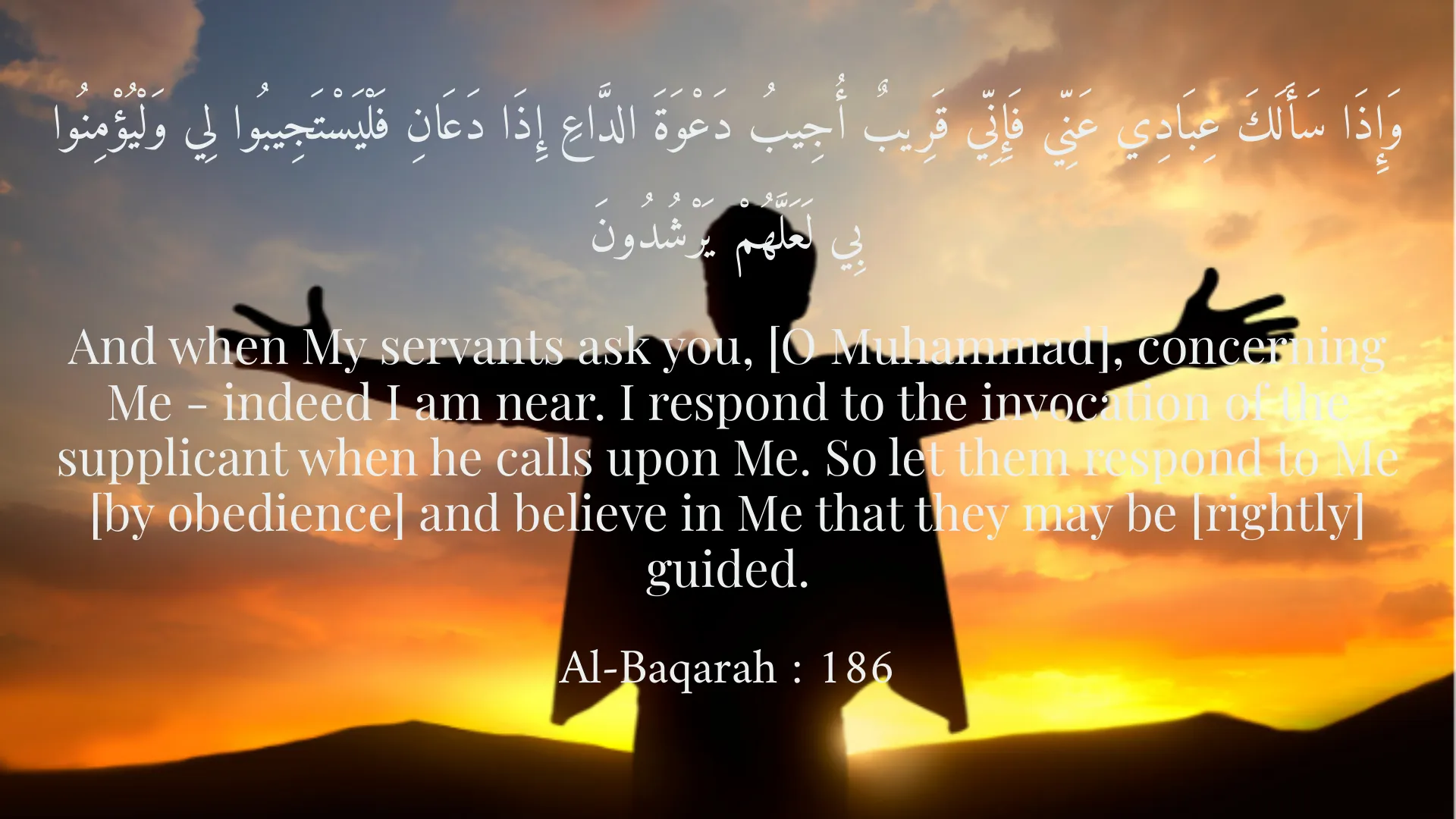
The topic of delayed answers to prayers (du'a) is one of the profound and often challenging issues that many believers encounter throughout their lives. It can sometimes lead to feelings of frustration, confusion, and even questions about divine justice and mercy. However, within the sublime teachings of the Holy Quran, there is absolutely no room for despair. Instead, there is a strong emphasis on patience (sabr), absolute reliance on God (Tawakkul), and a deep understanding of boundless Divine Wisdom. The Quran constantly reminds us that our Lord is "As-Sami'" (The All-Hearing) and "Al-Baseer" (The All-Seeing); He not only listens to every whisper and supplication of His servants but is also fully aware of the slightest details of their conditions and the innermost needs of their hearts. Surah Al-Baqarah, verse 186, expresses this truth in a comforting and direct manner: "And when My servants ask you, [O Muhammad], concerning Me - indeed I am near. I respond to the invocation of the supplicant when he calls upon Me. So let them respond to Me [by obedience] and believe in Me that they may be [rightly] guided." This verse is not merely a clear Divine promise for the acceptance of prayers but also reassures us that Allah is closer to us than our jugular vein. However, it is crucial to understand that the quality, form, and timing of the answer to a prayer are subject to His boundless wisdom and supreme will, which are regulated by His absolute knowledge and the true well-being of the servant. One of the most fundamental and significant reasons for the perceived delay in the fulfillment of our prayers is not a weakness in Divine power nor a lack of attention from Him, but rather His "Absolute Divine Wisdom." We, as human beings, with our limited understanding and knowledge, often ask for things that may appear attractive and desirable to us, but in reality, may not be truly beneficial for our ultimate good, or could even bring irreparable harm and loss in the long run. Allah Almighty, who is "Al-Aleem" (The All-Knowing) and "Al-Hakeem" (The All-Wise) in an absolute sense, possesses complete and comprehensive knowledge of the past, present, and future. He knows perfectly what will bring the greatest good and benefit to His servants at every moment of their lives. This concept is beautifully and clearly elucidated in Surah Al-Baqarah, verse 216: "...But perhaps you hate a thing and it is good for you; and perhaps you love a thing and it is bad for you. And Allah Knows, while you know not." This verse imparts a profound lesson: our perception of "good" and "evil" is often very limited, superficial, and based solely on immediate desires and fleeting worldly appearances. In contrast, Allah is fully aware of all the consequences, outcomes, and unseen dimensions of every matter, evaluating it on the broader scale of existence and our eternal happiness. Therefore, a delay in the fulfillment of a specific prayer, or even its non-fulfillment in the way we expect, might, in truth, be the greatest manifestation of Divine favor and mercy, protecting us from falling into the trap of greater evils or facing more significant hardships. Sometimes, Allah Almighty does not grant what we persistently ask for because He intends to bestow upon us something far superior and beyond our imagination at the opportune moment, or because He knows that that particular request might divert us from the straight path and our ultimate purpose of creation. Another crucial reason is "Divine Testing and Trial (Ibtila')." The very essence of worldly life, much like a grand university, is a place of examination and passage. Allah tests His servants with various ups and downs, hardships and reliefs, to reveal their inner essence, the extent of their sincerity, and the steadfastness of their faith. A delay in the answer to a prayer can be one form of these Divine trials; a test that measures our patience, endurance, the depth of our reliance, and the stability of our faith in the face of Divine decree. Do we succumb to despair and turn away from Allah's threshold when our desires are delayed? Or, conversely, does our faith grow stronger, leading us to continue supplicating with even greater certainty and humility? These trials are not merely for testing us but also serve as a means for our spiritual and moral growth and development, transforming us into more patient, stronger, and more faithful individuals. In this process, our connection with Allah deepens, and we realize that the purpose of prayer is not merely to fulfill a list of requests but to establish a deep, unbreakable, and loving bond with the Creator of the universe. Such delays provide a precious opportunity for self-reflection, re-evaluation of our actions and intentions, and strengthening the aspects of servitude within our being. "Sins and spiritual obstacles" can also create significant barriers to the acceptance of prayers. Although Allah's mercy and forgiveness are boundless and encompassing, inappropriate actions and sins can erect a thick veil between the servant and his Lord, preventing the whispers of his heart from reaching the Divine Throne. In such circumstances, sincere "repentance (Tawbah)" and "seeking forgiveness (Istighfar)" for sins are the keys to lifting these veils and opening the path to acceptance. In Surah Nuh, verses 10-12, the profound effect of seeking forgiveness on the descent of both material and spiritual blessings is beautifully highlighted: "And said, 'Ask forgiveness of your Lord. Indeed, He was and ever remains Sparing in forgiveness. He will send [rain from] the sky upon you in [abundance] and give you increase in wealth and children and provide for you gardens and provide for you rivers.'" These verses clearly demonstrate that purifying oneself from sins and returning sincerely to Allah not only brings forgiveness for wrongdoings but also smooths the path for the descent of Divine mercies, bounties, and blessings, both material and spiritual. Therefore, one of the first steps in investigating the reasons for delayed answers to prayers is honest self-reflection and sincere repentance for anything that might have hindered this sacred connection. Furthermore, it is essential to comprehend with full insight the significant point that our prayers are answered in "various ways" that we might not immediately discern or understand. Sometimes, instead of granting exactly what we asked for, Allah "averts a harm" from us, of which we were not even aware of its existence or dire consequences. This warding off of calamity is, in itself, the greatest acceptance and an unparalleled blessing. Other times, He reserves the reward of our prayer for the "Hereafter" and the eternal abode, whose value and significance are far superior and more enduring than any fleeting worldly recompense. The Prophet Muhammad (peace be upon him) stated in a precious Hadith: "There is no Muslim who supplicates with a supplication in which there is no sin or breaking of family ties, except that Allah will give him one of three things: either He will hasten his supplication in the world, or He will store it up for him in the Hereafter, or He will avert from him a similar amount of evil." This noble Hadith provides complete reassurance, indicating that no supplication is wasted or rendered ineffective by Allah; rather, it is responded to in a manner that ensures the servant's true and eternal well-being. Beyond all these reasons, one must not overlook the truth that the "act of supplicating itself" is a great and valuable act of worship. Allah Almighty says in Surah Ghafir, verse 60: "And your Lord says, 'Call upon Me; I will respond to you.' Indeed, those who disdain My worship will enter Hell [rendered] contemptible." This verse clearly shows that calling upon Allah and supplicating to Him is an act of pure servitude and obedience. Even if it does not yield immediate or tangible material results, it leads to greater closeness with Allah, the attainment of Divine pleasure, and an increase in spiritual ranks. This continuous and heartfelt connection with Allah bestows deep tranquility upon the heart and soul and strengthens faith to its very core. Therefore, even if a prayer seems delayed, one should never cease supplicating, because continuing to pray is a powerful means to achieve proximity to Allah, earn immense eternal rewards, and establish the spirit of reliance within us. Delays in answers offer us a precious opportunity to spend more time in solitude with Allah, to feel our true need for Him more profoundly, and to increase our humility and servitude in the utmost state of reverence and devotion. Ultimately, "heartfelt faith in Divine Timing" and "complete and unconditional reliance on Him" are the main keys to peace and tranquility when faced with delayed answers to prayers. We must believe with all our being that Allah is too Merciful and Compassionate to ignore or disregard the sincere and needy supplications of His servants. At the same time, He is too Wise and Knowledgeable not to know when and how to grant them the best and most appropriate response. These delays are absolutely not a sign of us being overlooked, nor a symbol of a lack of Divine love, nor an indication of His powerlessness; rather, all of them are manifestations of His boundless knowledge, flawless planning, and expansive mercy that always consider our ultimate and eternal well-being. So, with a heart overflowing with certainty, a tongue constantly supplicating, and a soul full of reliance, let us continue on the path of servitude, knowing that Allah Almighty will answer our prayers in the best way, at the best time, and in the most exalted manner possible.
Related Verses
وَإِذَا سَأَلَكَ عِبَادِي عَنِّي فَإِنِّي قَرِيبٌ أُجِيبُ دَعْوَةَ الدَّاعِ إِذَا دَعَانِ فَلْيَسْتَجِيبُوا لِي وَلْيُؤْمِنُوا بِي لَعَلَّهُمْ يَرْشُدُونَ
And when My servants ask you, [O Muhammad], concerning Me - indeed I am near. I respond to the invocation of the supplicant when he calls upon Me. So let them respond to Me [by obedience] and believe in Me that they may be [rightly] guided.
Al-Baqarah : 186
كُتِبَ عَلَيْكُمُ الْقِتَالُ وَهُوَ كُرْهٌ لَّكُمْ ۖ وَعَسَىٰ أَن تَكْرَهُوا شَيْئًا وَهُوَ خَيْرٌ لَّكُمْ ۖ وَعَسَىٰ أَن تُحِبُّوا شَيْئًا وَهُوَ شَرٌّ لَّكُمْ ۗ وَاللَّهُ يَعْلَمُ وَأَنتُمْ لَا تَعْلَمُونَ
Fighting has been enjoined upon you while it is hateful to you. But perhaps you hate a thing and it is good for you; and perhaps you love a thing and it is bad for you. And Allah Knows, while you know not.
Al-Baqarah : 216
وَقَالَ رَبُّكُمُ ادْعُونِي أَسْتَجِبْ لَكُمْ ۚ إِنَّ الَّذِينَ يَسْتَكْبِرُونَ عَنْ عِبَادَتِي سَيَدْخُلُونَ جَهَنَّمَ دَاخِرِينَ
And your Lord says, 'Call upon Me; I will respond to you.' Indeed, those who disdain My worship will enter Hell [rendered] contemptible.
Ghafir : 60
Short Story
In Sa'di's Bustan, it is narrated that a man asked a dervish, "Why is it that although I pray constantly, my needs are not fulfilled?" The dervish smiled and replied, "O friend, the Almighty God hears your prayer, but sometimes He does not hasten in answering to test you on the path of patience and servitude. Just as a man in a scorching desert, parched with thirst, was praying for rain. The rain did not fall, and he despaired. But when he reached an inhabited area, he heard that heavy rain had caused floods on his path, drowning anyone who was there. The man then understood that the delay in his prayer's answer was itself an act of Divine mercy and grace. So, whenever a prayer is delayed, know that there is a hidden wisdom in it, or a greater good is prepared for you, or a calamity has been averted from you."