Quranic Answer
Dear brothers and sisters, this is a question that may have crossed the minds of many of us, especially during difficult times in life when we feel an intense need for God's help and assistance. The worry about prayers seemingly not being answered might overshadow our faith. However, if we look deeper into the teachings of the Holy Quran, we will realize that Allah Almighty is always close to His servants, hears their prayers, and responds to them in various forms. Allah’s promise in the Quran is clear and explicit: “And when My servants ask you, [O Muhammad], concerning Me - indeed I am near. I respond to the invocation of the supplicant when he calls upon Me.” (Surah Al-Baqarah, verse 186). This verse clearly states that Allah answers all those who supplicate, but the key point here is the 'how' and 'when' of the response, not the absence of a response itself. Furthermore, in Surah Ghafir, verse 60, Allah states: “And your Lord has said, 'Call upon Me; I will respond to you.'” These verses serve as strong evidence for the divine promise of answering prayers and negate any despair in this regard. One of the most significant reasons why our prayers might seemingly go unanswered is the unparalleled wisdom and absolute knowledge of Allah. We, as humans, only perceive a small fraction of reality and are unaware of the long-term consequences of our desires. It may often be the case that we ask God for something with all our heart, whereas if it were granted, it would bring about a greater harm or corruption for us. Allah Almighty says in Surah Al-Baqarah, verse 216: “But perhaps you hate a thing and it is good for you; and perhaps you love a thing and it is bad for you. And Allah Knows, while you know not.” This verse teaches us that our scope of vision is limited, whereas Allah is aware of all hidden and manifest dimensions of the universe and knows what is truly good and beneficial for us better than we do ourselves. Sometimes, the non-fulfillment of our request is itself the ultimate divine favor and mercy, as the Lord does not wish to grant us something that would be detrimental to us. In addition to divine wisdom, we must also note that the acceptance of prayer does not always mean the exact fulfillment of our specific request. Islamic narrations (and concepts inferred from the Quran) remind us that the response to a prayer can take one of three forms: First, exactly what we asked for is granted to us. Second, Allah diverts a calamity from us that would certainly have befallen us had we not prayed, and this itself is a form of acceptance. Third, our request is not fulfilled in this world, but its reward is stored for our Hereafter, which is the best form of acceptance, as the eternal reward is infinite and everlasting. Therefore, even if our prayer seemingly goes unanswered in this world, it will never be fruitless and will not be lost with Allah. Furthermore, there are certain conditions for the acceptance of prayer, adhering to which can facilitate the acceptance of our supplications. One such condition is sincerity and complete attentiveness in prayer. Supplication must be made from the depths of the heart and with pure intention, not merely out of habit or as a perfunctory act. Another condition is that we must strive to live according to Allah’s commands and abstain from what He has forbidden. Earning lawful sustenance (halal rizq), avoiding sins, repentance (tawbah) and seeking forgiveness (istighfar), and fulfilling our covenants and promises with Allah are among the factors that remove barriers between us and the acceptance of our prayers. Imam Baqir (AS) stated: “The prayer of a believing servant is not rejected unless he repents from his sins.” Sins can create a veil between the servant and the Lord, preventing the prayer from ascending. Repentance removes these veils. Moreover, patience and perseverance in prayer are crucial. We should not despair or cease supplicating if the answer is delayed. Haste and saying, “I prayed and it was not answered,” can itself be a barrier to acceptance, as it signifies a lack of complete trust in divine wisdom and mercy. We must continually pray with full reliance on Allah and a heart full of hope, knowing that Allah ordains what is best for us. Ultimately, prayer is not merely asking for a need to be fulfilled; it is itself a great act of worship and a sign of our poverty and need for the Self-Sufficient Divine Essence. The very act of turning to Him is worship and a means of drawing closer to Allah, regardless of the apparent outcome of the prayer. So, never cease praying, for with every prayer, you are indeed returning to the inexhaustible source of mercy and power, and this itself is the greatest blessing.
Related Verses
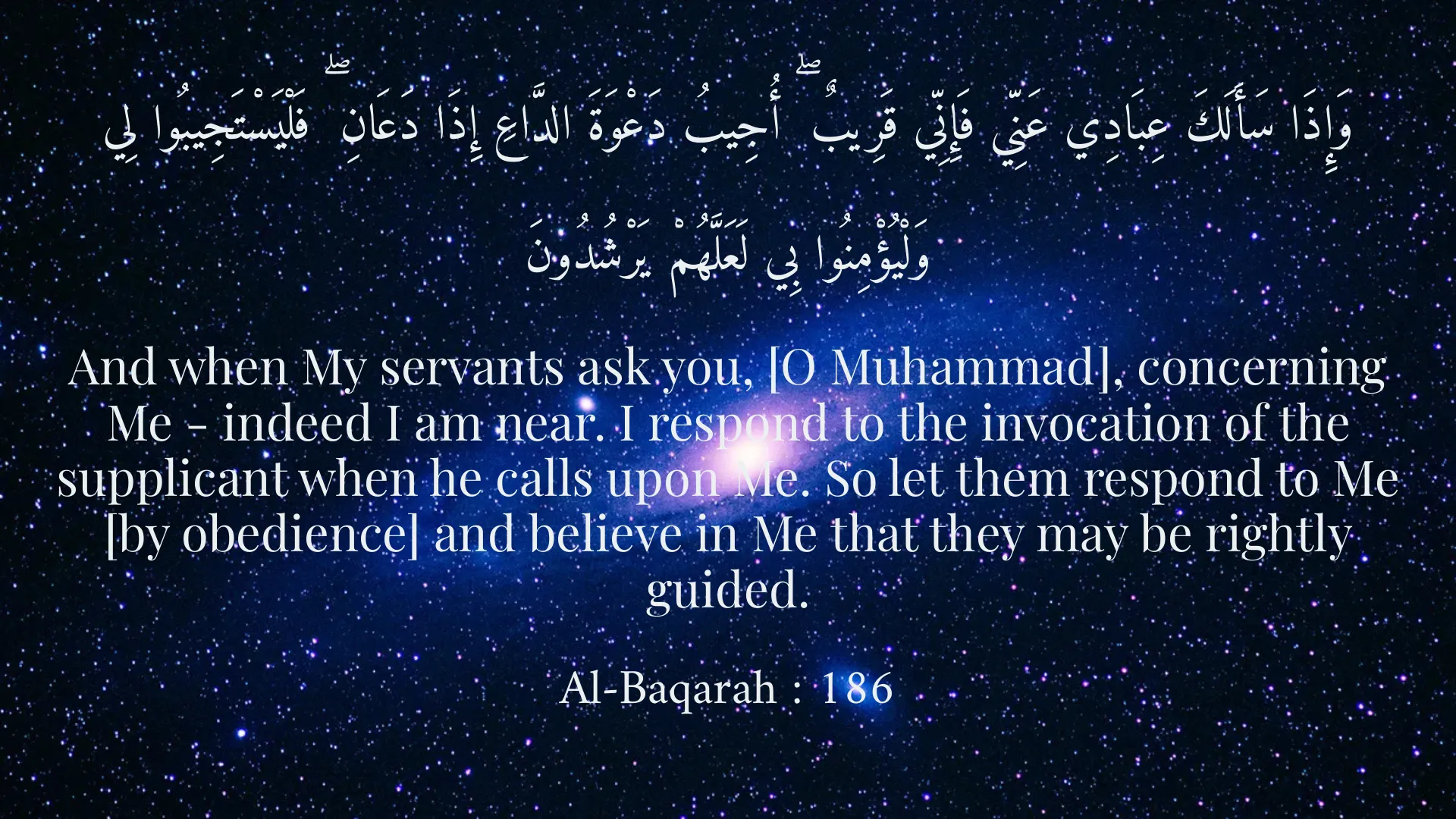
وَإِذَا سَأَلَكَ عِبَادِي عَنِّي فَإِنِّي قَرِيبٌ ۖ أُجِيبُ دَعْوَةَ الدَّاعِ إِذَا دَعَانِ ۖ فَلْيَسْتَجِيبُوا لِي وَلْيُؤْمِنُوا بِي لَعَلَّهُمْ يَرْشُدُونَ
And when My servants ask you, [O Muhammad], concerning Me - indeed I am near. I respond to the invocation of the supplicant when he calls upon Me. So let them respond to Me [by obedience] and believe in Me that they may be rightly guided.
Al-Baqarah : 186
وَقَالَ رَبُّكُمُ ادْعُونِي أَسْتَجِبْ لَكُمْ ۚ إِنَّ الَّذِينَ يَسْتَكْبِرُونَ عَنْ عِبَادَتِي سَيَدْخُلُونَ جَهَنَّمَ دَاخِرِينَ
And your Lord has said, "Call upon Me; I will respond to you." Indeed, those who disdain My worship will enter Hell in humiliation.
Ghafir : 60
كُتِبَ عَلَيْكُمُ الْقِتَالُ وَهُوَ كُرْهٌ لَّكُمْ ۖ وَعَسَىٰ أَن تَكْرَهُوا شَيْئًا وَهُوَ خَيْرٌ لَّكُمْ ۖ وَعَسَىٰ أَن تُحِبُّوا شَيْئًا وَهُوَ شَرٌّ لَّكُمْ ۗ وَاللَّهُ يَعْلَمُ وَأَنتُمْ لَا تَعْلَمُونَ
Fighting has been enjoined upon you while it is hateful to you. But perhaps you hate a thing and it is good for you; and perhaps you love a thing and it is bad for you. And Allah Knows, while you know not.
Al-Baqarah : 216
Short Story
It is said that in ancient times, there was a devout man, a dervish, who prayed day and night to God to become wealthy. Years passed, and his condition remained unchanged. He became heartbroken and despairing from the apparent lack of response to his prayers, murmuring to himself in the 'Garden of Destiny': 'Why are my prayers not answered?' One day, he came to the assembly of a wise Sheikh and lamented his situation. The Sheikh smiled and said: 'O brother, what have you learned from the gardener? Does he unearth the seed every day to see if it has sprouted? No! He plants the seed and trusts in the water, the sun, and the wisdom of his Creator. Your prayer is also a seed in the garden of Divine mercy. Allah, the All-Wise and All-Knowing, sometimes postpones the fruit to another season, or grants a different fruit, far sweeter and more lasting than what you imagine, for He knows what is truly beneficial for His servant. Be patient and trust in His boundless wisdom, for whatever comes from Him is good, and whenever He deems it appropriate, that is the best time, and His gifts are superior to our desires.' The dervish took heed of the Sheikh's words, and his heart found peace. With reliance and patience, he continued his life, realizing that inner tranquility and contentment with divine decree were the greatest treasures.