Quranic Answer
“Why are some prayers like silence?” This question carries a profound depth, pointing to the exalted place of the heart and soul in one’s connection with the Almighty. In Quranic teachings, prayer (Dua) is not merely confined to spoken words; rather, it extends beyond them to encompass inner states, heartfelt desires, absolute reliance (Tawakkul), beautiful patience (Sabr), and even contemplation (Tafakkur) and reflection on the grandeur of divine creation. This form of prayer, which can be termed “silent prayer” or “prayer of the heart,” signifies the depth of a servant's bond with their Creator, where words become unnecessary because Allah Himself is fully aware of what lies within the hearts. The Holy Quran repeatedly emphasizes that Allah is aware of the most hidden intentions and desires, and everything that passes through the breasts of His servants. In Surah Al-Baqarah, verse 284, we read: “To Allah belongs whatever is in the heavens and whatever is in the earth. And whether you disclose what is in your souls or conceal it, Allah will call you to account for it. Then He will forgive whom He wills and punish whom He wills. And Allah is over all things competent.” This verse clearly states that Allah knows all that is in the heavens and on earth, and even that which you conceal or reveal within yourselves. This absolute divine knowledge forms the bedrock of this kind of heartfelt prayer; for the servant knows that even before articulating a need, Allah is already aware of it. Thus, silence in this state is a sign of ultimate submission, trust, and reliance. This kind of silence does not stem from an inability to express oneself, but rather from complete confidence in Allah's flawless hearing and understanding. In fact, this silence is filled with unspoken cries and deep heartfelt desires that do not require translation into a material language. Another manifestation of “silent prayer” or heartfelt prayer is the concept of “Dhikr” (remembrance of Allah). Dhikr is not solely limited to uttering phrases like “SubhanAllah” (Glory be to Allah) or “Alhamdulillah” (Praise be to Allah). More profoundly, it signifies the constant remembrance of Allah in the heart and soul, His perpetual presence in one’s mind. In Surah Al-A'raf, verse 205, Allah commands: “And remember your Lord within yourself in humility and in fear, and without loudness in words, in the mornings and in the evenings. And do not be among the heedless.” This divine instruction explicitly refers to silent Dhikr or Dhikr of the heart, which does not require a loud voice and is performed in the solitude of one’s inner being. Such remembrance demands utmost concentration and sincerity of intention, and it can have deeper impacts on one’s soul and psyche, as it is far removed from any show-off or hypocrisy, being solely for the sake of attaining Allah’s pleasure. This state of Dhikr can become so pervasive and internal that it transforms into a meaningful silence, a silence full of praise, glorification, and supplication. The tranquility of heart mentioned in Surah Ar-Ra'd, verse 28, with the phrase “Unquestionably, by the remembrance of Allah hearts are assured,” is often achieved in a space of silence and inner peace where the heart, without words, turns towards its Creator. Furthermore, patience (Sabr) and reliance (Tawakkul) are also considered forms of “silent prayer.” When an individual, instead of complaining or lamenting in the face of difficulties and calamities, calmly and submissively entrusts their affairs to Allah, they are, in fact, engaging in a deep form of prayer. This submission is a wordless, profound connection with the Creator, where the servant, through silence and inner peace, trusts in divine wisdom and power. In Surah Al-Baqarah, verse 153, Allah says: “O you who have believed, seek help through patience and prayer. Indeed, Allah is with the patient.” Here, patience is mentioned alongside prayer as a means of seeking help from Allah. Patience itself is a state of heartfelt trust and reliance that needs no verbal expression and manifests in inner silence and tranquility. This reliance and patience serve as a continuous, wordless prayer, demonstrating the ultimate faith and belief in divine providence. When a person reaches a point where they can no longer utter a word due to the multitude of problems and their own helplessness, they resort to silence, and in this silence, their heart calls upon the Divine Helper and relies on Him. This submission to divine will is a type of 'Rida' (contentment) that demonstrates the highest degree of confidence and servitude; meaning the servant trusts Allah so completely that even in the most difficult circumstances, they have no words other than submission. The concept of “Tafakkur” (contemplation and reflection) on Allah’s verses and the magnificence of creation can also be a form of “silent prayer.” The Quran repeatedly invites Muslims to reflect on the creation of the heavens and the earth and the divine signs. This contemplation, which usually occurs in silence and solitude, helps individuals grasp the Creator’s grandeur, elevating their sense of servanthood and humility before Him. This state of reflection naturally leads to heartfelt and wordless praise and glorification, which is more valuable than any vocal prayer, as it originates from the depths of one’s being with full insight. This is the state where the human heart gently and without the need for speech, soars towards the Originator of existence and converses with Him. Silence in the face of the grandeur of creation is itself eloquent and full of praise and glorification; it is as if every particle of one's being is whispering gratitude and praise to the Lord, without the need for the tongue to move. Therefore, “some prayers are like silence” means that the deepest and most effective forms of communication with Allah sometimes transcend the realm of words. These prayers take shape in the form of reliance, patience, heartfelt remembrance, contemplation, and complete submission to divine will. In these states, the silence of the tongue provides an opportunity for the heart’s cry to grow louder; a cry that only Allah hears and responds to. This type of prayer indicates spiritual maturity and a profound understanding of the servant-Lord relationship, in which the servant knows that Allah is more aware of their hidden needs than anyone else, and will respond to them even before a verbal request is made. This silence is filled with inner whispers that not only do not indicate an inability to express oneself, but rather depict the pinnacle of connection and trust. This wordless connection is a symbol of ultimate humility and submission; where the servant sees themselves as so small and needy that they cannot even articulate their needs, and entrusts all matters to Allah's infinite knowledge and power. These prayers are often experienced in moments of ultimate need or in the deepest states of inner peace and contentment.
Related Verses
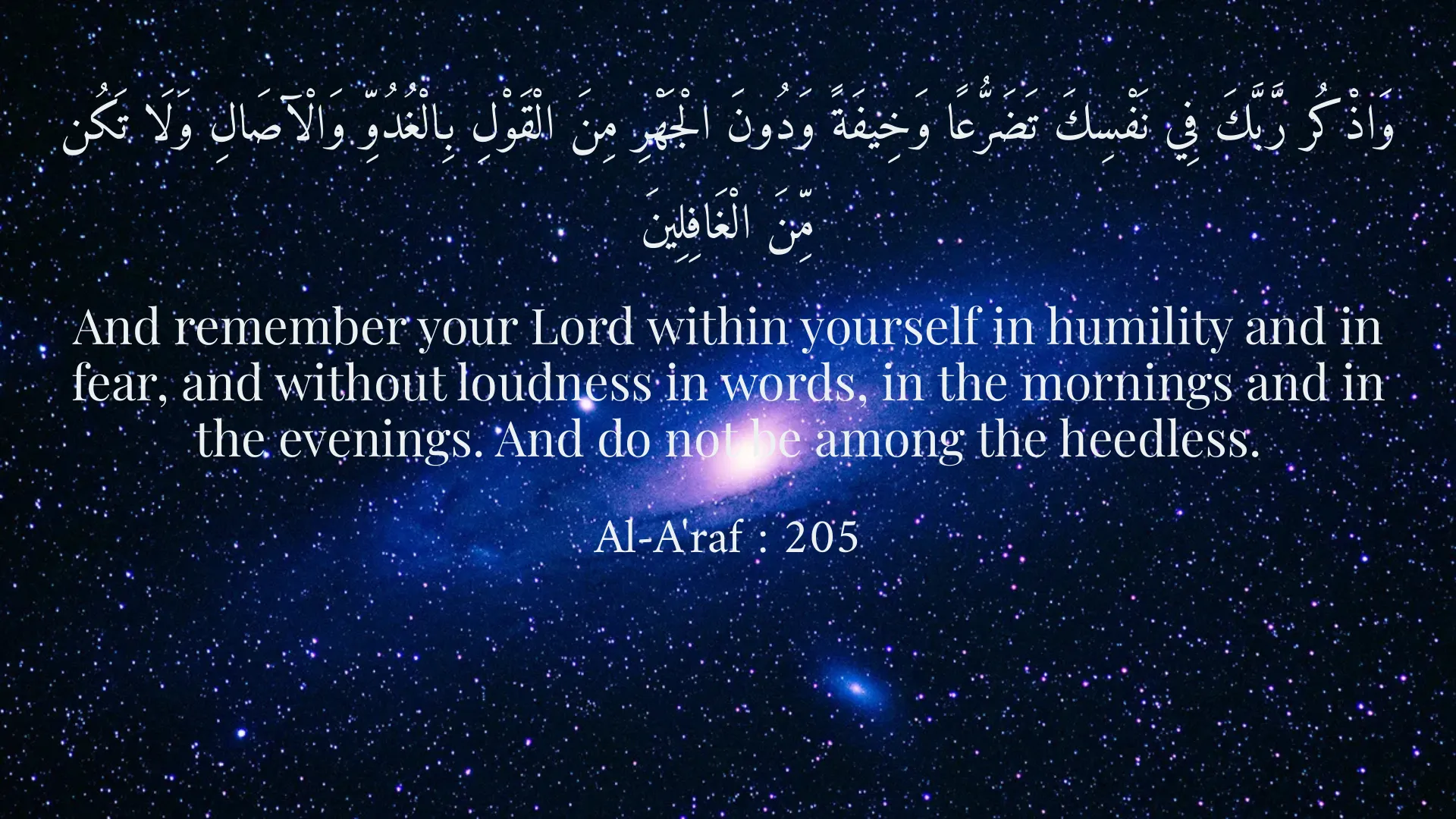
وَاذْكُر رَّبَّكَ فِي نَفْسِكَ تَضَرُّعًا وَخِيفَةً وَدُونَ الْجَهْرِ مِنَ الْقَوْلِ بِالْغُدُوِّ وَالْآصَالِ وَلَا تَكُن مِّنَ الْغَافِلِينَ
And remember your Lord within yourself in humility and in fear, and without loudness in words, in the mornings and in the evenings. And do not be among the heedless.
Al-A'raf : 205
لِّلَّهِ مَا فِي السَّمَاوَاتِ وَمَا فِي الْأَرْضِ ۗ وَإِن تُبْدُوا مَا فِي أَنفُسِكُمْ أَوْ تُخْفُوهُ يُحَاسِبْكُم بِهِ اللَّهُ ۖ فَيَغْفِرُ لِمَن يَشَاءُ وَيُعَذِّبُ مَن يَشَاءُ ۗ وَاللَّهُ عَلَىٰ كُلِّ شَيْءٍ قَدِيرٌ
To Allah belongs whatever is in the heavens and whatever is in the earth. And whether you disclose what is in your souls or conceal it, Allah will call you to account for it. Then He will forgive whom He wills and punish whom He wills. And Allah is over all things competent.
Al-Baqarah : 284
الَّذِينَ آمَنُوا وَتَطْمَئِنُّ قُلُوبُهُم بِذِكْرِ اللَّهِ ۗ أَلَا بِذِكْرِ اللَّهِ تَطْمَئِنُّ الْقُلُوبُ
Those who have believed and whose hearts find tranquility in the remembrance of Allah. Unquestionably, by the remembrance of Allah hearts are assured.
Ar-Ra'd : 28
Short Story
It is narrated that a devout and inwardly-focused man, known as "Arif-e Del" (the Knower of the Heart), lived in quiet solitude, constantly engaged in remembrance and contemplation. A king of that land heard of his asceticism and piety and yearned to meet him. The king, with much retinue, went to visit the Arif and found him in a state of profound silence. The king asked, "O Sheikh, everyone seeks your prayers and considers you a man of divine grace, yet I see you speak little and are immersed in silence. What kind of prayer is this?" The Arif smiled and said, "O King! Sometimes the loudest prayers are those that do not flow from the tongue, but rather rise from the depths of the soul and reach the Divine Presence through the language of silence. A heart that finds tranquility through the remembrance and presence of God is itself an endless prayer. In this silence, no need is articulated, nor is any complaint voiced; rather, there is only absolute reliance and submission, which Allah knows well and answers. He whose heart is with God needs no elaborate words, for his Beloved is aware of every hidden thought and hears the silent cry of the heart more beautifully." The king pondered these words and realized that the paths of connection with the Creator extend beyond outward appearances and words, and sometimes the most meaningful prayers lie hidden in the deep silence of the heart. This story echoes Sa'di's saying: "Worship is naught but serving creation / Not in rosary, prayer-mat, or patched-robe demonstration." This implies that the essence of worship lies in the depth of intention and heartfelt connection, not merely in outward rituals.