Quranic Answer
The feeling of being deprived of God's forgiveness is one of the deepest and most painful spiritual experiences many individuals may face. This feeling, contrary to what it might seem, often does not stem from God's unwillingness to forgive, but rather from misunderstandings, despair, pride, or even an insufficient understanding of the infinite Divine essence and His vast mercy. The Holy Quran, which is a word of guidance and mercy, repeatedly emphasizes the breadth of God's mercy and forgiveness and admonishes believers against despair. This feeling that one is outside the sphere of Divine mercy is more a product of the commanding self (nafs al-ammarah) and Satanic whispers than a reality from the Lord. One of the primary reasons individuals feel deprived of God's forgiveness is despair of His mercy. The Quran explicitly rejects this state, stating: “Say, ‘O My servants who have transgressed against themselves [by sinning], do not despair of the mercy of Allah. Indeed, Allah forgives all sins. Indeed, it is He who is the Forgiving, the Merciful.’” (Surah Az-Zumar: 53). This verse is a bright lamp in the darkness of despair. Despair not only prevents repentance and return to God but is also considered a great sin, as it signifies a denial of God's immense power and mercy. Satan constantly strives to lead humans to this point of hopelessness to deter them from the path of repentance and reform, thereby perpetuating their sins. Another reason is an incorrect understanding of repentance (Tawbah) and its conditions. Some people assume that repentance must be an extremely difficult or unilateral act, and if they commit a major sin, there is no way back. However, the Quran defines repentance as a heartfelt and practical process requiring genuine regret, abandonment of the sin, a firm resolution not to return to it, and making amends for the rights of others (if applicable). God promises to accept sincere repentance in numerous verses. For example, in Surah An-Nisa, verse 110, He says: “And whoever does evil or wrongs himself then seeks forgiveness of Allah will find Allah Forgiving and Merciful.” This indicates that the door of Divine mercy is always open, and it is we who, through doubt and despair, deprive ourselves of this grace. Sometimes, pride and arrogance, whether in the form of self-importance or self-righteousness, prevent the feeling of needing forgiveness. Conversely, excessive self-blame and intense feelings of inferiority can also lead to a hidden form of pride—a pride that makes an individual view their sins as so immense that even God's mercy is incapable of erasing them. This perspective is, in itself, a form of denying Divine greatness. Yet, God describes Himself as “At-Tawwab” (The Acceptor of Repentance) and “Al-Ghafoor” (The All-Forgiving). Humans must humbly confess their sins before God’s greatness and, with certainty in His mercy, seek forgiveness. Furthermore, an insufficient understanding of God's Names and Attributes, such as Al-Ghafoor, Ar-Rahim, At-Tawwab, Al-Haleem (The Forbearing), and Al-’Afuw (The Pardoner), can exacerbate this feeling of deprivation. If one truly understands how eager God is to forgive and how He loves those who repent, they would never consider themselves deprived of His mercy. The Prophet Muhammad (PBUH) said: “Allah rejoices over the repentance of His sinful servant more than one of you rejoices over finding his lost camel in the desert.” This Hadith illustrates the pinnacle of Divine love and compassion. Ultimately, to overcome this feeling of deprivation, several essential steps must be taken: First, completely abandon despair and strengthen hope in Divine mercy by reflecting on verses and Hadiths related to forgiveness. Second, perform sincere and true repentance (Tawbah Nasuh), which includes deep remorse, abandoning the sin, resolving not to return, and striving to make amends (if necessary). Third, increase knowledge of God's Names and Attributes and a heartfelt belief in His greatness and mercy. Fourth, engage in frequent Istighfar (seeking forgiveness) in all circumstances, even for unintentional and minor sins. Fifth, perform good deeds (Hasanaat), which, according to the Quran, erase bad deeds: “Indeed, good deeds do away with evil deeds” (Surah Hud: 114). Let us remember that the door of Divine mercy is always open to His servants, and it is only we who, through our choices, might deprive ourselves of this boundless grace. God never deprives anyone of His forgiveness unless they turn away and insist on sin and despair. The feeling of being deprived of God's forgiveness can be a profound spiritual challenge, but it is important to understand that this feeling often stems from our incorrect perception of Divine greatness and mercy, rather than from the reality of God's essence. The Holy Quran repeatedly emphasizes that Allah is 'Arhamur-Rahimeen' (the Most Merciful of those who show mercy) and 'Ghaffarudh-Dhunoob' (the Forgiver of sins). We must accept, with both our hearts and minds, that no sin is too great to be beyond His forgiveness, provided that repentance is sincere and accompanied by a firm resolve to abandon the sin. It is crucial for believers to distance themselves from the temptation of despair and hopelessness, as despair itself is a major sin that undermines faith in God's infinite power and compassion. In reality, it is often we ourselves who, with our harsh self-judgments regarding our sins and our disbelief in God's ability to cleanse all errors, prevent ourselves from receiving His mercy and forgiveness. This internal belief of 'I will never be forgiven' is a Satanic deception that diverts individuals from the path of returning to God. God eagerly awaits His servants to return to Him and accepts their repentance, as the very purpose of creation is humanity's mercy and guidance. Therefore, whenever guilt and heaviness weigh upon our hearts, instead of succumbing to despair, we should immediately remember that the door of Divine mercy is always open, and with just one sincere step towards Him, we can be immersed in the ocean of His forgiveness.
Related Verses
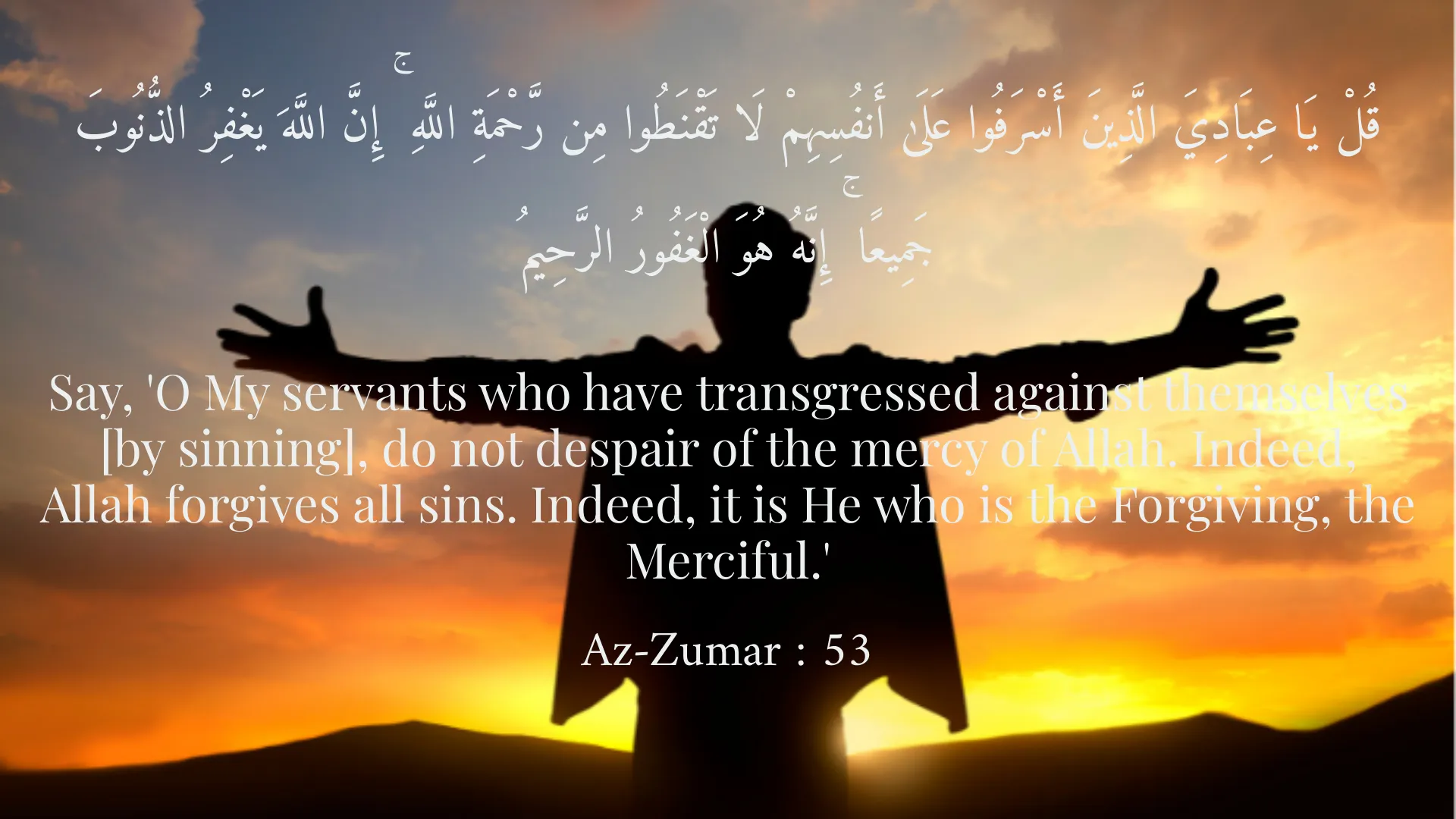
قُلْ يَا عِبَادِيَ الَّذِينَ أَسْرَفُوا عَلَىٰ أَنفُسِهِمْ لَا تَقْنَطُوا مِن رَّحْمَةِ اللَّهِ ۚ إِنَّ اللَّهَ يَغْفِرُ الذُّنُوبَ جَمِيعًا ۚ إِنَّهُ هُوَ الْغَفُورُ الرَّحِيمُ
Say, 'O My servants who have transgressed against themselves [by sinning], do not despair of the mercy of Allah. Indeed, Allah forgives all sins. Indeed, it is He who is the Forgiving, the Merciful.'
Az-Zumar : 53
وَمَن يَعْمَلْ سُوءًا أَوْ يَظْلِمْ نَفْسَهُ ثُمَّ يَسْتَغْفِرِ اللَّهَ يَجِدِ اللَّهَ غَفُورًا رَّحِيمًا
And whoever does evil or wrongs himself then seeks forgiveness of Allah will find Allah Forgiving and Merciful.
An-Nisa : 110
وَأَقِمِ الصَّلَاةَ طَرَفَيِ النَّهَارِ وَزُلَفًا مِّنَ اللَّيْلِ ۚ إِنَّ الْحَسَنَاتِ يُذْهِبْنَ السَّيِّئَاتِ ۚ ذَٰلِكَ ذِكْرَىٰ لِلذَّاكِرِينَ
And establish prayer at the two ends of the day and at the approach of night. Indeed, good deeds do away with evil deeds. That is a reminder for those who remember.
Hud : 114
Short Story
One day, a broken-hearted man, burdened by the weight of countless sins, sat alone in despair of God's mercy. He believed he would never be forgiven and that there was no path back to the light. At that moment, a wise old man passed by. Kindly, he asked, 'My son, why are you so sad and hopeless?' The sinner, with a heavy sigh, recounted his numerous transgressions, saying, 'My sins are like a mighty mountain; how can a drop of water move a mountain?' The wise elder smiled gently and said in a comforting tone: 'My dear child, know that the ocean of God's mercy is vaster than all the mountains of sin you can ever imagine. If a king would forgive his repentant servant, how much more so would the King of Kings, whose mercy precedes His wrath? Your despair is a greater sin than your past misdeeds, for it denies the very essence of His boundless grace. Turn to Him with a sincere heart, even if it feels like a mere whisper, and you shall find His embrace wider than your imagination.' Encouraged by these words, the sinner lifted his gaze; tears of hope replaced those of despair, and whispering prayers of repentance, he found an indescribable peace in the boundless ocean of Divine forgiveness.