Quranic Answer
The feeling that God doesn't hear our prayers is a profound and sometimes distressing human experience that many believers encounter throughout their lives. In moments of hardship, when we pray and don't immediately see a response or a resolution, it's easy for this thought to creep into our minds: 'Perhaps my voice isn't reaching God,' or worse, 'Maybe He isn't paying attention to me.' However, the Holy Quran, our guiding scripture, offers a vastly different and immensely reassuring perspective on this matter. The Quran teaches us that Allah, the Exalted, is always present, always hearing, and all-knowing. No voice, no prayer, no whisper, and not even a single thought is hidden from Him. Our feelings are merely reflections of our limited human understanding and perception, not the divine reality of God. Allah emphasizes His closeness and His encompassing knowledge over humanity repeatedly in the Quran. In Surah Qaf, verse 16, He states: 'And We have already created man and know what his soul whispers to him, and We are closer to him than [his] jugular vein.' This verse unequivocally demonstrates that Allah is not only aware of all our inner thoughts and whispers, but His presence to us transcends any physical proximity. How could someone who is closer to us than our jugular vein not hear our voice? This proximity signifies absolute awareness, constant presence, and complete encompassment of our being. Therefore, the first step to overcoming this feeling is to grasp this fundamental Quranic truth: Allah is always hearing, and there is no veil between Him and His servant, except for the veils that we ourselves create through our actions and thoughts. One of the most beautiful and comforting verses in this regard is from Surah Al-Baqarah, verse 186: 'And when My servants ask you, [O Muhammad], concerning Me - indeed I am near. I respond to the invocation of the supplicant when he calls upon Me. So let them respond to Me [by obedience] and believe in Me that they may be [rightly] guided.' This verse is a clear and unconditional promise from Allah. He not only states that He is near but also pledges to respond to the invocation of every supplicant. The crucial point here is that 'response' does not always equate to 'receiving exactly what we asked for.' Divine response manifests in various forms and dimensions, often beyond our limited comprehension. Different Forms of Divine Response from a Quranic and Prophetic Perspective: 1. Direct Fulfillment of the Request: Sometimes, Allah grants us precisely what we have asked for. This is the outcome we often anticipate, and it leads to an immediate feeling of having been heard and answered. This in itself is a great mercy and a tangible sign of His benevolence. 2. Substitution with Something Better: It might be that what we desire is not ultimately good for us in the long run, or Allah has something far superior planned for us. In Surah Al-Baqarah, verse 216, it is stated: '...But perhaps you hate a thing and it is good for you; and perhaps you love a thing and it is bad for you. And Allah Knows, while you know not.' This verse points to divine wisdom. Allah, being aware of the future and the consequences of all matters, might respond to our prayer in a different way that holds greater good and benefit for us, even if we initially do not recognize it and feel our prayer has gone unanswered. This form of response showcases His profound knowledge and care, prioritizing our ultimate well-being over our immediate desires. 3. Aversion of Calamity or Harm: At times, the answer to a prayer is the removal or prevention of a misfortune or disaster that was destined to befall us. We may be unaware of this impending harm, but Allah, through our supplication, diverts it from us. In such a scenario, we don't receive something tangible, but rather we are saved from something detrimental. Because we are oblivious to what was averted, we might feel our prayer was left unanswered. This is one of Allah's hidden graces and a powerful demonstration of His protective love for His servants. 4. Storage for the Hereafter: One of the most beautiful forms of answering prayer is the reservation of its reward for the Day of Judgment. The Prophet Muhammad (peace be upon him) said: 'There is no Muslim who supplicates with a supplication, and it is not a sin nor breaking the ties of kinship, but Allah will give him one of three things: either He will hasten it for him in this world, or He will store it up for him in the Hereafter, or He will avert from him an evil equivalent to it.' This means that every prayer, even if it yields no apparent fruit in this world, ultimately does not go unanswered. It will come to our aid on a day when we are in dire need of good deeds and rewards. This exemplifies the pinnacle of Allah's mercy and generosity. 5. Change in Perspective and Cultivation of Patience: Sometimes, the answer to a prayer is the strengthening of our patience, trust in God (Tawakkul), and inner insight. Allah might place us in a situation through which we can learn valuable lessons, grow stronger spiritually, and attain a deeper understanding of His wisdom. This, too, is a form of divine response that contributes significantly to our spiritual development and resilience. Obstacles to Feeling Answered and Quranic Solutions to Overcome Them: * Impatience and Despair: The Quran calls believers to patience and steadfastness. In Surah Al-Isra, verse 11, it states: 'And man is hasty, and he invokes evil as he invokes good; and ever is man hasty.' This haste and despair can prevent us from perceiving Allah's hidden responses. Faith that Allah always knows what is best and will bring it about at the optimal time is key to overcoming this feeling. Patience is a virtue highly praised in Islam, and it is often through patience that we witness the unfolding of divine plans. * Sins and Disobedience: Although Allah never closes the door of His mercy to His servants, sins can create a barrier between us and the acceptance of our prayers. Repentance (Tawbah) and turning back to Allah are ways to remove these barriers. Allah says in Surah An-Nur, verse 31: 'And turn to Allah in repentance, all of you, O believers, that you might succeed.' Repentance and seeking forgiveness strengthen our spiritual connection with God and clear the path for His blessings and responses. * Lack of Sincerity and Doubt: Prayer must be accompanied by a pure heart, sincere intention, and firm faith. Doubt in Allah's power or solely worldly intentions can diminish the effectiveness of prayer. Absolute faith and reliance (Tawakkul) on Allah are fundamental principles of an accepted supplication. Sincerity ensures that our plea is genuinely directed towards the Divine, not merely a ritual. * Unlawful Earnings and Infringement on Rights (Haqq al-Nas): Islamic traditions emphasize that unlawful earnings and violating the rights of others are significant impediments to the acceptance of prayers. The Quran also strongly emphasizes lawful earnings and respecting people's rights. Rectifying one's life and purifying it from prohibited matters is a way to open the doors of divine mercy and make one's prayers more readily heard and accepted. This holistic approach to life ensures that our outward actions align with our inward supplications. In conclusion, the feeling that God does not hear us is often due to our incomplete understanding of the nature of divine response and our human impatience for tangible, immediate results. Allah is closer to us than anyone or anything else; He is All-Hearing, All-Seeing, and fully aware of all our needs. He is the Most Merciful and never desires anything but good for His servants. Our duty is to continuously pray, converse with Him, trust in His wisdom, and be patient. Even if a prayer does not appear to be answered in this world, it is never lost with Allah and will be compensated in the Hereafter in the best possible way. This inner certainty brings profound peace to the soul and saves one from despair and hopelessness. Therefore, always and in every state, speak to Allah with your whole being, and know that He is always hearing and responding, even if His response takes a form we initially do not expect. The relationship with God requires patience, perseverance, and deep trust. The deeper this relationship becomes, the stronger the feeling of His presence and being heard will be.
Related Verses
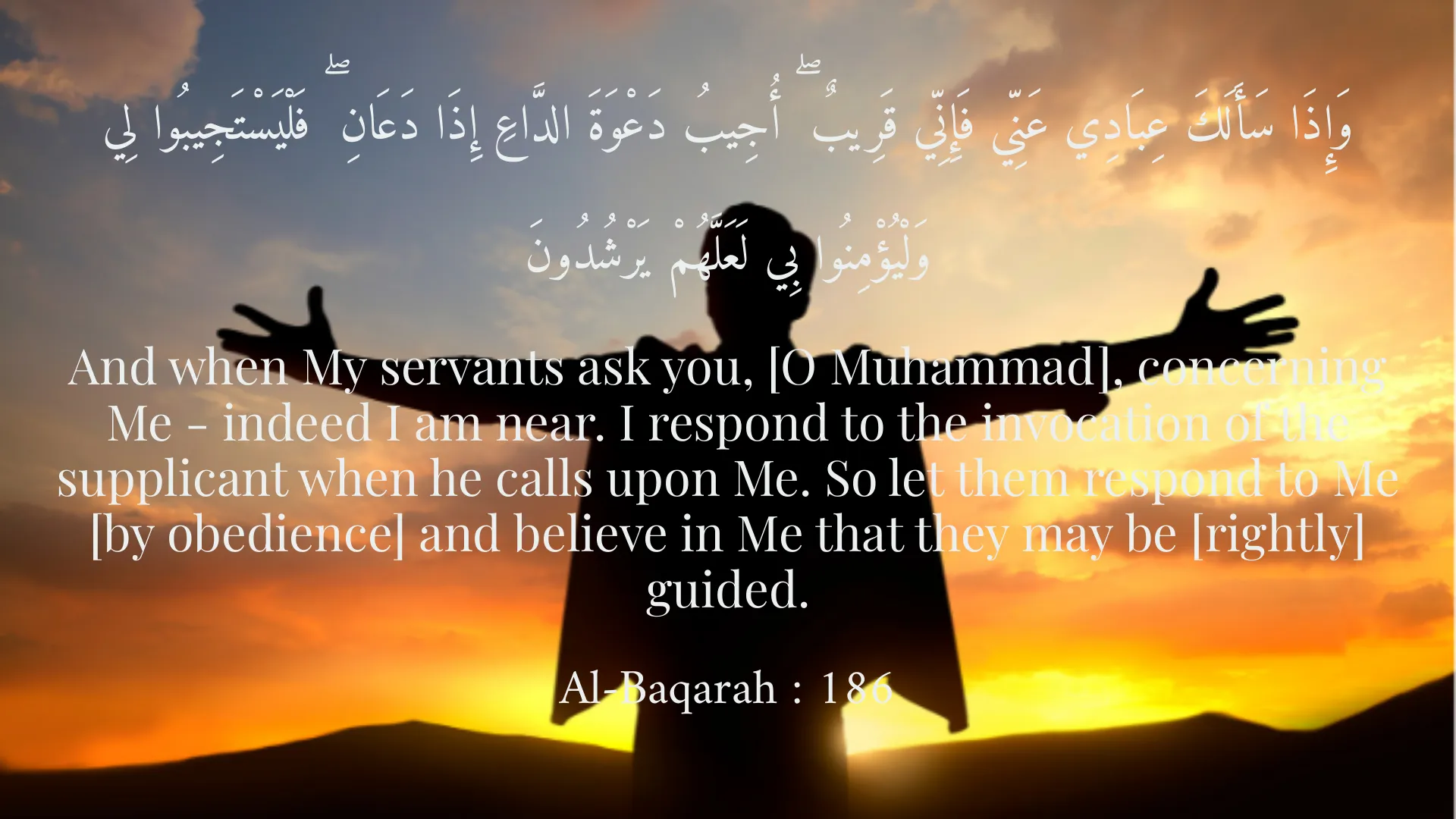
وَإِذَا سَأَلَكَ عِبَادِي عَنِّي فَإِنِّي قَرِيبٌ ۖ أُجِيبُ دَعْوَةَ الدَّاعِ إِذَا دَعَانِ ۖ فَلْيَسْتَجِيبُوا لِي وَلْيُؤْمِنُوا بِي لَعَلَّهُمْ يَرْشُدُونَ
And when My servants ask you, [O Muhammad], concerning Me - indeed I am near. I respond to the invocation of the supplicant when he calls upon Me. So let them respond to Me [by obedience] and believe in Me that they may be [rightly] guided.
Al-Baqarah : 186
وَلَقَدْ خَلَقْنَا الْإِنسَانَ وَنَعْلَمُ مَا تُوَسْوِسُ بِهِ نَفْسُهُ ۖ وَنَحْنُ أَقْرَبُ إِلَيْهِ مِنْ حَبْلِ الْوَرِيدِ
And We have already created man and know what his soul whispers to him, and We are closer to him than [his] jugular vein.
Qaf : 16
وَقَالَ رَبُّكُمُ ادْعُونِي أَسْتَجِبْ لَكُمْ ۚ إِنَّ الَّذِينَ يَسْتَكْبِرُونَ عَنْ عِبَادَتِي سَيَدْخُلُونَ جَهَنَّمَ دَاخِرِينَ
And your Lord says, "Call upon Me; I will respond to you." Indeed, those who disdain My worship will enter Hell [rendered] contemptible.
Ghafir : 60
Short Story
A distressed dervish would raise his hands in prayer every night, asking God for abundant provisions. Days passed, and he remained a dervish, with no sign of what he had requested. In despair, he went to a wise elder and said, 'O Sheikh, I have prayed for years, and God does not answer. Does my voice not reach Him?' The elder smiled and replied, 'My son, the Lord not only hears your voice, but He is also aware of your innermost intentions. Yet, His wisdom transcends our understanding. Sometimes His giving is in withholding, and sometimes His withholding is the very essence of giving. Perhaps what you seek is not truly good for you, or what is destined for you is better than what you know. Just be patient and trust in His wisdom. He never abandons His servant, but He answers in a way that we might not outwardly perceive. Sometimes, not giving is the ultimate gift.' The dervish found peace in these words. From then on, he continued to pray with a calmer heart and greater certainty. Before long, a door of divine mercy opened for him, one he had never imagined, but in a completely different form from his initial request. He realized that God always hears and gives the best, even if its form differs from his desires.