Quranic Answer
“Why do I feel hopeless when I repeat a sin?” This question is a profound and frequently asked one, rooted in human nature and the whispers of Shaytan (Satan). The feeling of hopelessness after committing a sin, especially a repeated one, can be incredibly burdensome. This sensation often stems from a false belief that there is no way back, or that God will no longer forgive us. However, in the luminous teachings of the Holy Quran, this despair and hopelessness are strongly condemned, and the boundless ocean of divine mercy is always open to His servants, even if they have stumbled repeatedly. Almighty Allah describes Himself in the Quran with attributes such as “Al-Ghafoor” (The Oft-Forgiving), “Ar-Rahim” (The Most Merciful), and “At-Tawwab” (The Acceptor of Repentance). These attributes not only signify the vastness and grandeur of divine mercy but also convey a clear message to all humanity: never despair of My mercy. Verse 53 of Surah Az-Zumar explicitly delivers this hopeful message: “Say, 'O My servants who have transgressed against themselves [by sinning], do not despair of the mercy of Allah. Indeed, Allah forgives all sins. Indeed, it is He who is the Forgiving, the Merciful.'” This verse serves as a beacon of light for every heart weary and despaired by the burden of sin. Even if a sin is repeated, the door of repentance and return to Allah never closes. Despair itself is a greater sin than many transgressions, as it, in a way, denies the infinite power and mercy of Allah. Shaytan exploits this very weakness to make humans despair. He whispers, “You are too bad; Allah will not forgive you anymore; give up trying.” While Shaytan’s exact goal is to sever the connection between the servant and their Lord. Repeating a sin can result from weakness of the soul, heedlessness, an unsuitable environment, or intense temptations. However, what is crucial is that each time after committing a sin, even if it is a repeated one, the feeling of remorse and regret is revived in the heart, and the individual immediately returns to repentance (Tawbah). Repentance is not merely “saying Astaghfirullah” (I seek forgiveness from Allah); rather, it is a heartfelt decision to return, to regret the past, and to firmly resolve not to return to that sin in the future. Even if a person repents several times and then falters again, as long as they return to Allah each time with genuine regret and remorse, the doors of divine mercy remain open to them. This continuous repentance is a sign of a living conscience and an inner desire for purity and closeness to Allah. In verse 135 of Surah Ali 'Imran, we read: “And those who, when they commit an immorality or wrong themselves, remember Allah and seek forgiveness for their sins—and who can forgive sins except Allah?—and do not persistently insist upon what they have done while they know.” This verse beautifully expresses that what matters is not to insist on the sin and to remember Allah. It is persistence in sin and indifference towards it that leads to distance from divine mercy, not merely the repetition of a lapse. Therefore, the feeling of hopelessness after repeating a sin is a trick from Shaytan to distance you from divine mercy. The Quranic solution to counter this despair is a deep understanding of Allah's boundless mercy and persistence in repentance. Every time you stumble, immediately feel remorse, seek forgiveness from Allah, and resolve to abandon that sin. This continuous act gradually strengthens the soul and increases the ability to resist sin. Remember that Allah not only forgives sins but also loves those who repent and even transforms their evil deeds into good ones, as stated in verse 70 of Surah Al-Furqan: “Except for those who repent, believe and do righteous deeds; for those, Allah will change their evil deeds into good ones. And Allah is ever Forgiving, Most Merciful.” This is the utmost forgiveness and generosity of Allah, which gives humanity hope that even after repeated lapses, a new door to a pure and prosperous life is open to them. So, refrain from despair, do not give up striving, and always return to Allah. The path to salvation and peace lies in this continuous repentance and hope in divine grace. The feeling of guilt can be constructive if it leads to repentance, but despair is destructive. It is important that this feeling of guilt acts as a wake-up call, not an impenetrable wall.
Related Verses
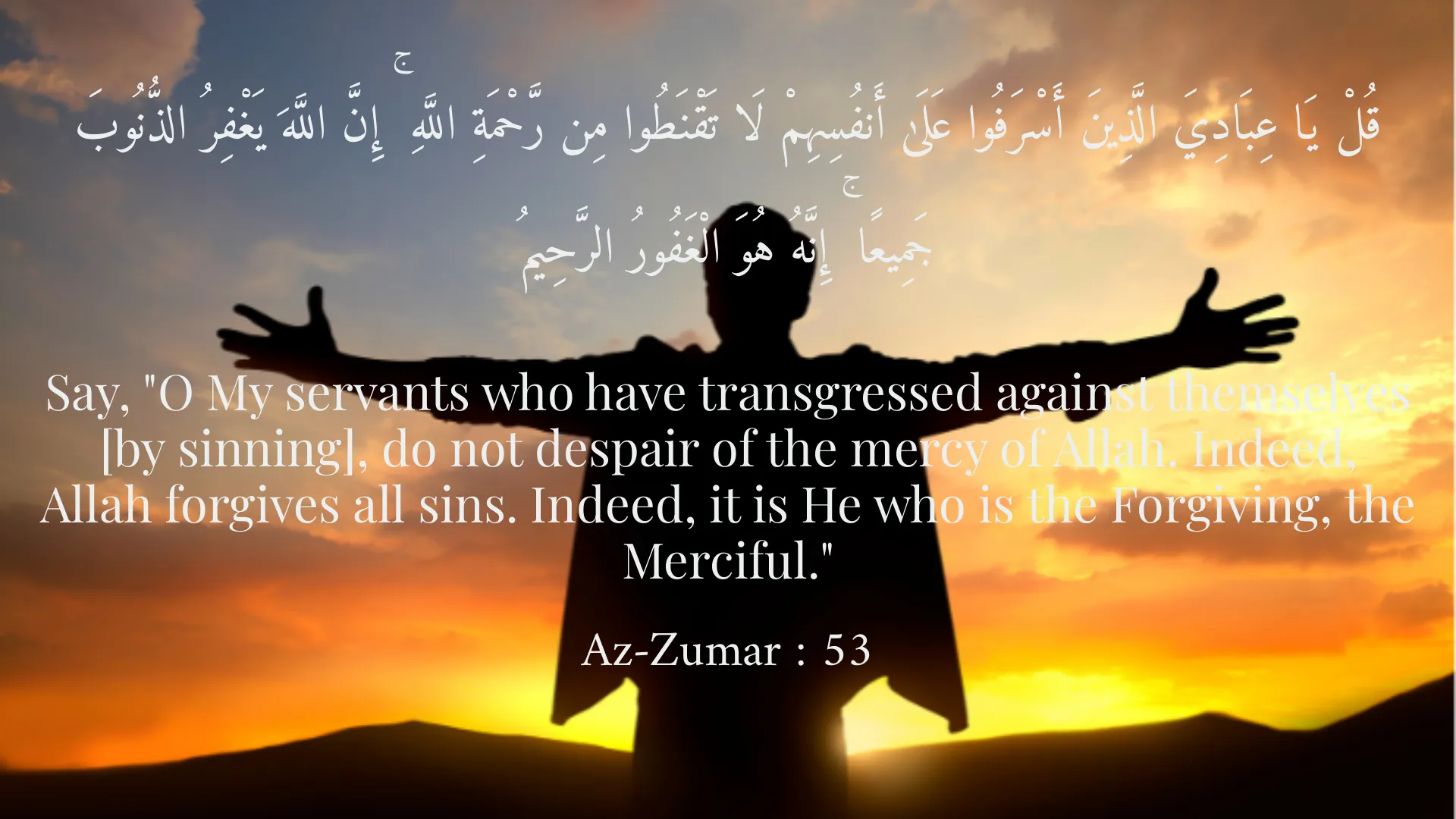
قُلْ يَا عِبَادِيَ الَّذِينَ أَسْرَفُوا عَلَىٰ أَنفُسِهِمْ لَا تَقْنَطُوا مِن رَّحْمَةِ اللَّهِ ۚ إِنَّ اللَّهَ يَغْفِرُ الذُّنُوبَ جَمِيعًا ۚ إِنَّهُ هُوَ الْغَفُورُ الرَّحِيمُ
Say, "O My servants who have transgressed against themselves [by sinning], do not despair of the mercy of Allah. Indeed, Allah forgives all sins. Indeed, it is He who is the Forgiving, the Merciful."
Az-Zumar : 53
وَالَّذِينَ إِذَا فَعَلُوا فَاحِشَةً أَوْ ظَلَمُوا أَنفُسَهُمْ ذَكَرُوا اللَّهَ فَاسْتَغْفَرُوا لِذُنُوبِهِمْ وَمَن يَغْفِرُ الذُّنُوبَ إِلَّا اللَّهُ وَلَمْ يُصِرُّوا عَلَىٰ مَا فَعَلُوا وَهُمْ يَعْلَمُونَ
And those who, when they commit an immorality or wrong themselves, remember Allah and seek forgiveness for their sins—and who can forgive sins except Allah?—and do not persistently insist upon what they have done while they know.
Ali 'Imran : 135
إِلَّا مَن تَابَ وَآمَنَ وَعَمِلَ عَمَلًا صَالِحًا فَأُولَٰئِكَ يُبَدِّلُ اللَّهُ سَيِّئَاتِهِمْ حَسَنَاتٍ ۗ وَكَانَ اللَّهُ غَفُورًا رَّحِيمًا
Except for those who repent, believe and do righteous deeds; for those, Allah will change their evil deeds into good ones. And Allah is ever Forgiving, Most Merciful.
Al-Furqan : 70
Short Story
In bygone days, there lived a virtuous man named "Sabir" (meaning Patient). He had a pure heart, yet sometimes he would stumble against temptations and commit a sin. Each time this happened, Sabir felt a great sorrow in his heart, and despair enveloped him like a cold wind. He would say to himself, "My Lord, I have repented many times, but I have stumbled again. Will You ever forgive me?" One day, with a broken heart, he went to a wise master and recounted his situation. The master, with a kind smile, said, "O Sabir, do you despair of washing your clothes every time they become soiled with mud? No! Every time your garment gets dirty, you wash it. Your soul is likewise; whenever a lapse occurs, immediately wash it with the water of repentance and remorse. The Lord's mercy is like rain that cleanses every impurity. Have you ever seen the rain say, 'I will no longer water this ground that I have soaked many times?' No, the rain falls continuously. So you, too, repent continuously and never despair of divine mercy, for He is the Acceptor of Repentance and the Most Merciful." Sabir was heartened by the master's words. From then on, whenever he faltered, he returned to God with a more hopeful heart and deeper regret, and by Allah's grace, the peace in his heart increased day by day.