Quranic Answer
Scientific arrogance is a complex psychological and social phenomenon whereby individuals take excessive pride in their knowledge, often interacting with others in a way that exudes superiority. This state of mind can manifest in various ways, from dismissive attitudes toward those perceived as less knowledgeable to a tendency to monopolize discussions and undermine the contributions of others. Rather than fostering an atmosphere of shared learning and collaboration, scientific arrogance can create barriers between individuals, stifling the spirit of inquiry and mutual growth that is often essential in the pursuit of knowledge. At the core of scientific arrogance lies a contradiction: the very pursuit of knowledge, which should ideally lead to self-awareness, understanding, and humility, can instead become a source of ego inflation and elitism. Individuals entrenched in this mindset may become so absorbed in their expertise that they fail to recognize the value of differing perspectives and the continuous nature of learning. In essence, this arrogance serves as a hindrance, not just to personal growth but to the collective advancement of society. The Holy Quran approaches the concept of knowledge with profound insight, emphasizing that true wisdom must lead to humility rather than arrogance. In Surah Al-Jathiya, verse 23, Allah raises a critical question: Can someone who relies solely on their reasoning be equated to one who listens to divine revelation? This rhetorical question suggests that human intellect, with all its capabilities, has limitations, and there lies a higher source of knowledge that ought to be heeded. This divine reference underscores the notion that humility is intrinsic to the pursuit of truth. The underlying message conveyed by this verse serves to remind believers that the accumulation of knowledge should not lead to pride but rather inspire individuals to recognize their place within the greater context of existence. It prompts individuals to seek a deeper understanding—a recognition that the answers may lie beyond human reasoning alone, thereby encouraging a posture of humility and openness. While human knowledge is undoubtedly valuable, it is essential to approach it with the awareness that our understanding is always partial, and that wisdom can come from various sources, including divine teachings. Furthermore, in Surah Al-An'am, verse 31, Allah warns of the dangers that accompany knowledge accompanied by arrogance. The verse articulates that seemingly knowledgeable individuals who become consumed by their own insights may end up distancing themselves from the truth. This is particularly poignant in the modern age, where access to information has increased exponentially, allowing for the proliferation of misguided or superficial interpretations of knowledge. When scholars or experts allow their academic achievements to overshadow their capacity for empathy and understanding, they risk becoming ensnared in their own delusions, losing sight of their role as conveyors of knowledge. This cautionary note extends into the fabric of societal interactions and relationships in academic and professional environments. Knowledge, while a powerful tool, requires careful stewardship. Those who wield it must do so with the consciousness of their impact on others. The act of teaching, sharing, or discussing knowledge should inherently come with an acknowledgment of the shared humanity and diversity of experiences among individuals. It is crucial to foster an environment where dialogue is encouraged, and where questioning and curiosity are welcomed, rather than stifled by a perceived hierarchy of knowledge. The Holy Quran's emphasis on humility as a product of knowledge resonates with numerous philosophical traditions and ethical frameworks that advocate for the greater good of humanity. Humility, when paired with knowledge, has the potential to pave the way for cooperation, innovation, and collective progress. If individuals can transcend their pride and recognize that knowledge is not a measure of superiority, they can cultivate connections that enrich interpersonal relationships and empower those around them. The ideal of using knowledge to serve humanity rather than to elevate oneself is a foundational tenet of many spiritual and philosophical teachings. In aligning with this ideal, it becomes imperative for individuals to internalize the principle that knowledge is, at its core, a tool for service. The internet, educational institutions, research facilities, and all venues of knowledge dissemination should be viewed as platforms for communal enlightenment, not battlegrounds of superiority. This shift in mindset can profoundly affect how individuals engage with one another, promoting collaboration over competition and inspiring a collective pursuit of understanding. To solidify this perspective further, we can turn to Surah Al-Baqarah, verse 269, which states, 'Allah grants wisdom to whomever He wills.' This verse beautifully encapsulates the divine source of wisdom, indicating that knowledge is not merely attained through effort but is rather a gift bestowed by God. This understanding reinforces the notion that the accumulation of knowledge should not instill arrogance but, conversely, encourage gratitude and humility. As individuals recognize that wisdom is a divine gift, they may be inspired to adopt a more humble approach to learning and sharing their insights. By acknowledging the contributions of others, they can encourage a collaborative environment where diverse voices are heard and valued. The challenges posed by scientific arrogance may often seem daunting; however, by striving to prioritize humility, individuals can shift the paradigm towards a more inclusive, respectful, and synergistic exchange of knowledge. In conclusion, scientific arrogance is a detrimental state that can obstruct personal growth and serve as a barrier to collective understanding. The lessons echoed in the Holy Quran serve as timeless reminders that knowledge must lead to humility and connection rather than superiority and separation. As we navigate the complexities of modern knowledge landscapes, it is incumbent upon each individual to embrace their learning journeys with an attitude of openness, service, and modesty, remembering that our shared quest for truth is enriched by the diverse insights of all humankind. Indeed, the ultimate purpose of knowledge is not to elevate oneself but to uplift others, broadening the horizons of understanding for all.
Related Verses
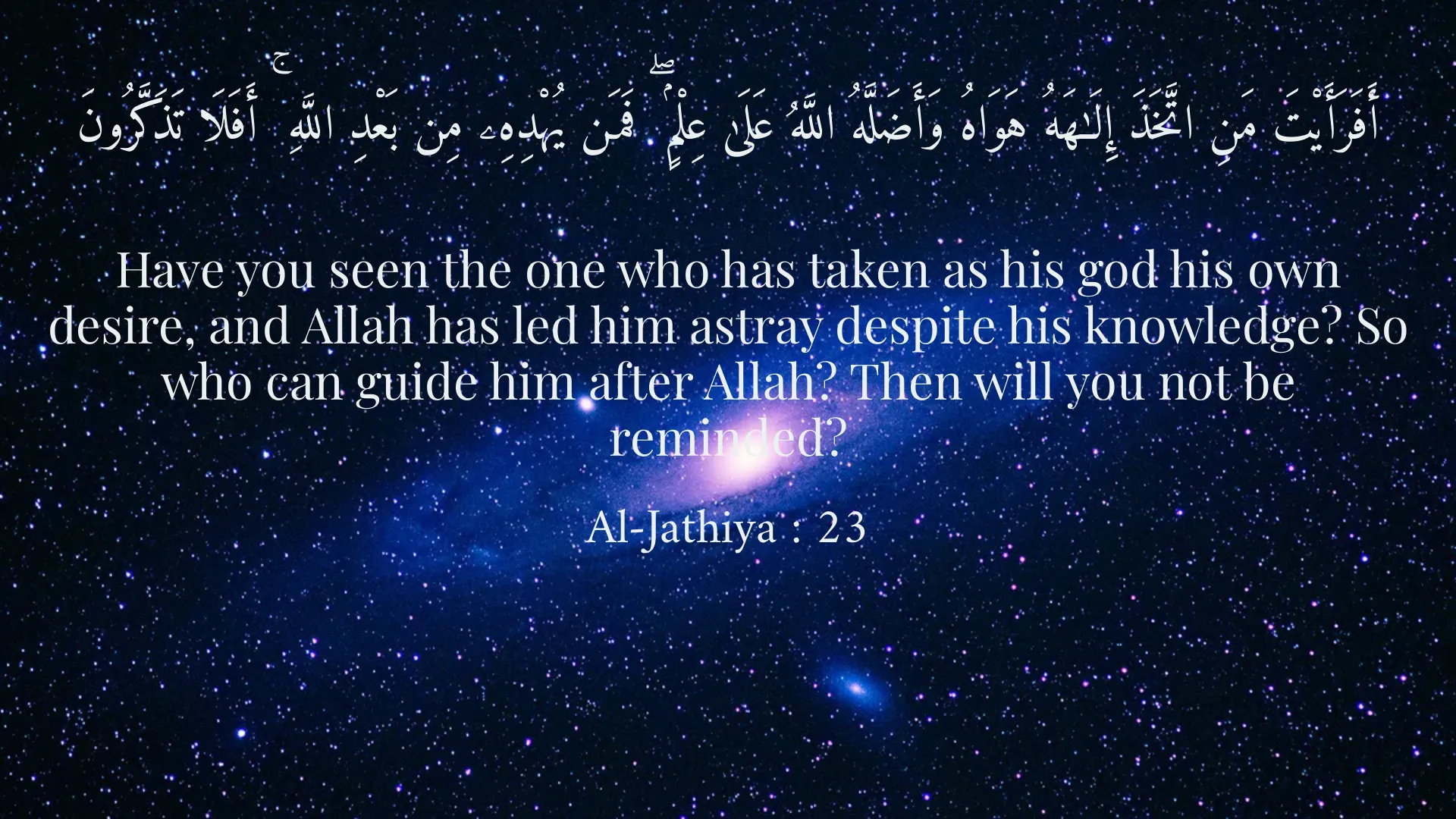
أَفَرَأَيْتَ مَنِ اتَّخَذَ إِلَٰهَهُ هَوَاهُ وَأَضَلَّهُ اللَّهُ عَلَىٰ عِلْمٍۢ ۖ فَمَن يُهْدِهِۦ مِن بَعْدِ اللَّهِ ۚ أَفَلَا تَذَكَّرُونَ
Have you seen the one who has taken as his god his own desire, and Allah has led him astray despite his knowledge? So who can guide him after Allah? Then will you not be reminded?
Al-Jathiya : 23
قُلْ هَلْ نُنَبِّئُكُمْ بِالأَخْسَرِينَ أَعْمَالًا * الَّذِينَ ضَلَّ سَعْيُهُمْ فِي الْحَيَاةِ الدُّنْيَا وَهُمْ يَحْسَبُونَ أَنَّهُمْ يُحْسِنُونَ صُنْعًا
Say, 'Shall we inform you of the greatest losers in [their] deeds?' Those whose effort is in vain while they think that they are doing well.
Al-An'am : 31
يُؤْتِي الْحِكْمَةَ مَن يَشَاءُ ۖ وَمَن يُؤْتَ الْحِكْمَةَ فَقَدْ أُوتِيَ خَيْرًا كَثِيرًا ۚ وَمَا يَذَّكَّرُ إِلَّا أُولُو الأَلْبَابِ
He gives wisdom to whom He wills, and whoever has been given wisdom has certainly been given much good. And none will remember except those of understanding.
Al-Baqarah : 269
Short Story
One day, a man with extensive knowledge was sitting in a gathering. While he was expressing his opinions, one of the attendees asked a question. The man arrogantly responded and belittled him. However, everyone realized that the young man's question was closer to the truth, and he used his knowledge to serve others. In the end, the man repented from his scientific arrogance and decided to teach others with humility.