Quranic Answer
Arrogance and pride are among the most destructive spiritual and psychological ailments that can nullify the fruits of a person's good deeds and worship. Your question, as to why some individuals fall into the trap of arrogance despite performing righteous acts, is a profound and thought-provoking inquiry whose roots can be traced back to the teachings of the Holy Quran and the tradition of Prophet Muhammad (PBUH). The Quran, with its eloquent and clear expression, repeatedly warns against the dangers of pride and offers guidance on how to combat it. This phenomenon appears to be a paradox: how can an act whose very purpose is to achieve proximity to God and purify the soul lead to a destructive illness like arrogance? The answer lies in the complexities of the human psyche and the subtle whisperings of Satan. Below, we will elaborate on the Quranic and psychological factors contributing to this phenomenon and the remedies to overcome it. One of the primary reasons for succumbing to arrogance, even when performing good deeds, is the 'lack of sincerity' (Ikhlas). The Holy Quran clearly states that the criterion for the acceptance of deeds by Allah is the purity of intention and performing the act solely for His pleasure. If an act, no matter how great or righteous, is performed with ulterior motives such as seeking fame, the praise of people, or even to assert one's superiority over others, it loses its true value. This phenomenon is known in Islamic teachings as 'Riya' or ostentation, meaning performing an act for 'show' to people. An individual who performs a good deed with the intention of Riya is, in fact, seeking the attention and admiration of creation instead of focusing on a pure connection with the Creator. In such cases, when people praise them, these commendations, instead of leading them to greater humility and gratitude for divine blessings, serve to reinforce their 'nafs al-ammarah' (the commanding self) and their sense of superiority. Verse 264 of Surah Al-Baqarah beautifully illustrates this danger, stating, 'O you who have believed, do not invalidate your charities with reminders [of it] or [other] injury, like one who spends his wealth [only] to be seen by the people and does not believe in Allah and the Last Day.' This verse demonstrates how a benevolent act (charity) can become ineffective and even a source of arrogance due to impure intentions (Riya). The absence of sincerity fundamentally shifts the purpose of the deed from divine seeking to human validation, leaving the heart susceptible to spiritual diseases. Another reason is 'Ujb,' or self-admiration, which is a more subtle form of pride. While Riya is an initial impurity in intention, Ujb can emerge after a good deed has been performed. After accomplishing a virtuous act, a person becomes pleased with themselves and their deed, attributing it to their own abilities and perfections rather than to divine success and grace. This self-admiration gradually leads to the false belief that they are superior to others and that their actions are flawless. They forget that every good deed is an opportunity granted by Allah, and every success in doing good comes from Him. This forgetfulness diverts the individual from the path of gratitude and leads them towards 'taking credit' over Allah or others. In this state, the person becomes oblivious to the truth that not a single moment of steadfastness on the path of good is possible without divine aid and grace. Unfortunately, some people mistakenly believe that performing good deeds entitles them to 'claim' something from Allah, whereas every good act is merely a 'duty' of the servant and a sign of the Lord's favor in granting them the ability to obey. This type of pride is far more dangerous because it can afflict a person even in solitude, silently eroding their spiritual core without anyone else noticing. The character of Satan also plays a significant role in this context. The story of Iblis in the Quran is a prime example of arrogance stemming from self-superiority. Despite thousands of years of worship and devotion, when Iblis was commanded by Allah to prostrate to Adam, he showed arrogance and considered himself superior to Adam, perceiving himself to be created from fire while Adam was from clay. This arrogance led to his expulsion from the divine presence. This story serves as a warning to humanity never to use their good deeds as a pretext for feeling superior to others. This sense of superiority originates from an incorrect comparison of oneself with others, causing individuals to overlook their own faults and only boast about their perceived (or real) virtues. Satan is always lying in wait to exploit a person's strengths, particularly their good deeds, to ensnare them and divert them from the straight path through the temptation of pride. He beautifies the person's actions in their own eyes, leading them to self-admiration and preventing them from looking towards Allah and others with humility and perspective. The profound lesson here is that even immense piety can be undone by a single moment of self-aggrandizement. Furthermore, an incomplete understanding of humanity's true status and the concept of servitude can also lead to arrogance. A person might forget that, in the face of Allah's grandeur, they are nothing, and everything they possess and every good they do comes from divine grace and mercy. This unawareness of humanity's inherent neediness before Allah's absolute self-sufficiency can lead to self-importance even on the path of worship. The Holy Quran repeatedly emphasizes humility and modesty. Verse 18 of Surah Luqman explicitly states: 'And do not turn your cheek [in contempt] toward people and do not walk through the earth exultantly. Indeed, Allah does not like everyone self-deluded and boastful.' This verse not only prohibits outward arrogance but also warns against inner pride that leads to boasting. It serves as a reminder that true virtue lies not in outward displays or internal self-congratulations, but in a profound sense of submission and gratitude to the Creator. The primary solution to combat this spiritual illness is to strengthen 'sincerity' (Ikhlas), 'humility' (Tawadu'), and genuine 'gratitude.' A person must always remember that their good deeds, no matter how outwardly grand, are insignificant compared to the ocean of Allah's grace and mercy. They should constantly seek Allah's help for sincerity and deliverance from pride, and instead of focusing on 'me' and 'my deeds,' they should focus on 'Him' and 'His grace.' Whenever a feeling of self-admiration or superiority over others crosses their mind, they should immediately turn their attention to their own flaws and the humility of their soul before the Creator of existence. Studying the life and character of Prophet Muhammad (PBUH) and the infallible Imams (AS), who exemplified the pinnacle of servitude and humility, can be highly beneficial. Despite their supreme deeds and lofty status, they always displayed the utmost modesty and never used their good actions as a means for seeking superiority. Instead, they regarded them as a favor and grace from Allah bestowed upon them. Ultimately, we must understand that the purpose of good deeds is to attain proximity to Allah and purify the soul, and arrogance is a significant obstacle on this path that can prevent a person from achieving spiritual perfections and even nullify the fruits of their righteous actions.
Related Verses
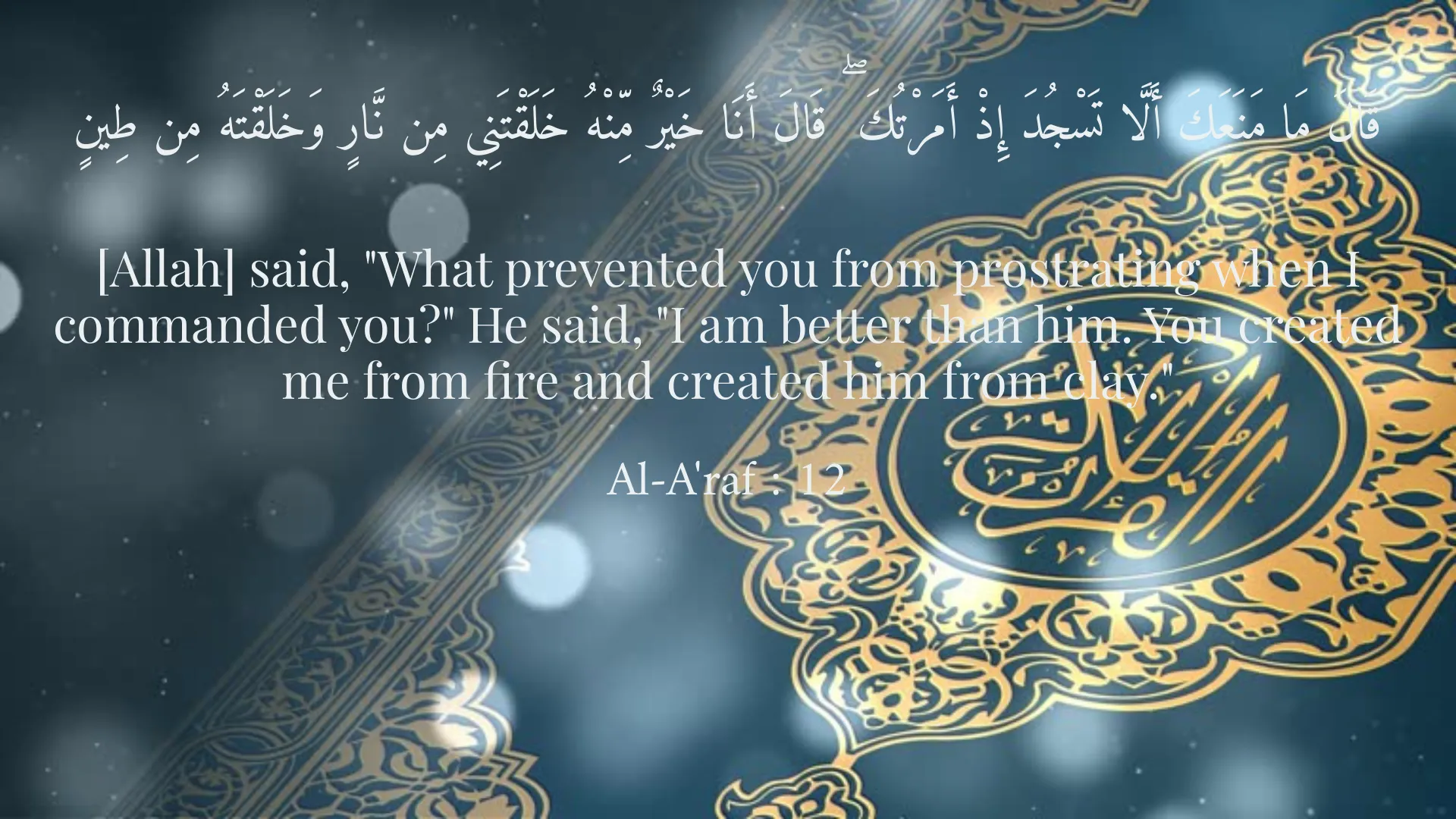
قَالَ مَا مَنَعَكَ أَلَّا تَسْجُدَ إِذْ أَمَرْتُكَ ۖ قَالَ أَنَا خَيْرٌ مِّنْهُ خَلَقْتَنِي مِن نَّارٍ وَخَلَقْتَهُ مِن طِينٍ
[Allah] said, "What prevented you from prostrating when I commanded you?" He said, "I am better than him. You created me from fire and created him from clay."
Al-A'raf : 12
يَا أَيُّهَا الَّذِينَ آمَنُوا لَا تُبْطِلُوا صَدَقَاتِكُم بِالْمَنِّ وَالْأَذَىٰ كَالَّذِي يُنفِقُ مَالَهُ رِئَاءَ النَّاسِ وَلَا يُؤْمِنُ بِاللَّهِ وَالْيَوْمِ الْآخِرِ ۖ فَمَثَلُهُ كَمَثَلِ صَفْوَانٍ عَلَيْهِ تُرَابٌ فَأَصَابَهُ وَابِلٌ فَتَرَكَهُ صَلْدًا ۖ لَّا يَقْدِرُونَ عَلَىٰ شَيْءٍ مِّمَّا كَسَبُوا ۗ وَاللَّهُ لَا يَهْدِي الْقَوْمَ الْكَافِرِينَ
O you who have believed, do not invalidate your charities with reminders [of it] or [other] injury, like one who spends his wealth [only] to be seen by the people and does not believe in Allah and the Last Day. His example is like that of a [bare] rock upon which is dust and then a heavy rain strikes it, leaving it smooth. They are unable [to retain] anything of what they earned. And Allah does not guide the disbelieving people.
Al-Baqarah : 264
وَلَا تُصَعِّرْ خَدَّكَ لِلنَّاسِ وَلَا تَمْشِ فِي الْأَرْضِ مَرَحًا ۖ إِنَّ اللَّهَ لَا يُحِبُّ كُلَّ مُخْتَالٍ فَخُورٍ
And do not turn your cheek [in contempt] toward people and do not walk through the earth exultantly. Indeed, Allah does not like everyone self-deluded and boastful.
Luqman : 18
وَعِبَادُ الرَّحْمَٰنِ الَّذِينَ يَمْشُونَ عَلَى الْأَرْضِ هَوْنًا وَإِذَا خَاطَبَهُمُ الْجَاهِلُونَ قَالُوا سَلَامًا
And the servants of the Most Merciful are those who walk upon the earth easily, and when the ignorant address them [harshly], they say [words of] peace.
Al-Furqan : 63
Short Story
In Saadi's Golestan, it is narrated that a wealthy king, arrogant because of his countless treasures and armies, would constantly boast about himself. A wise man was sitting in his assembly, silent. The king asked him, 'O wise one, what ails you that you speak no words amidst all my splendor and glory?' The wise man smiled gently and said, 'O King! Indeed, all this splendor and glory are transient. True power lies not in abundance of wealth and status, but in humility and submission before the Lord. How many wealthy individuals have become poor, and how many humble souls have risen in status. If you accompany good deeds with arrogance and self-admiration, it is like pouring water into salty desert ground; it will yield no fruit nor quench any thirst.' The king was awakened by these words and understood that good deeds are only valuable with sincerity and humility, and that arrogance is the bane of every virtue.