Quranic Answer
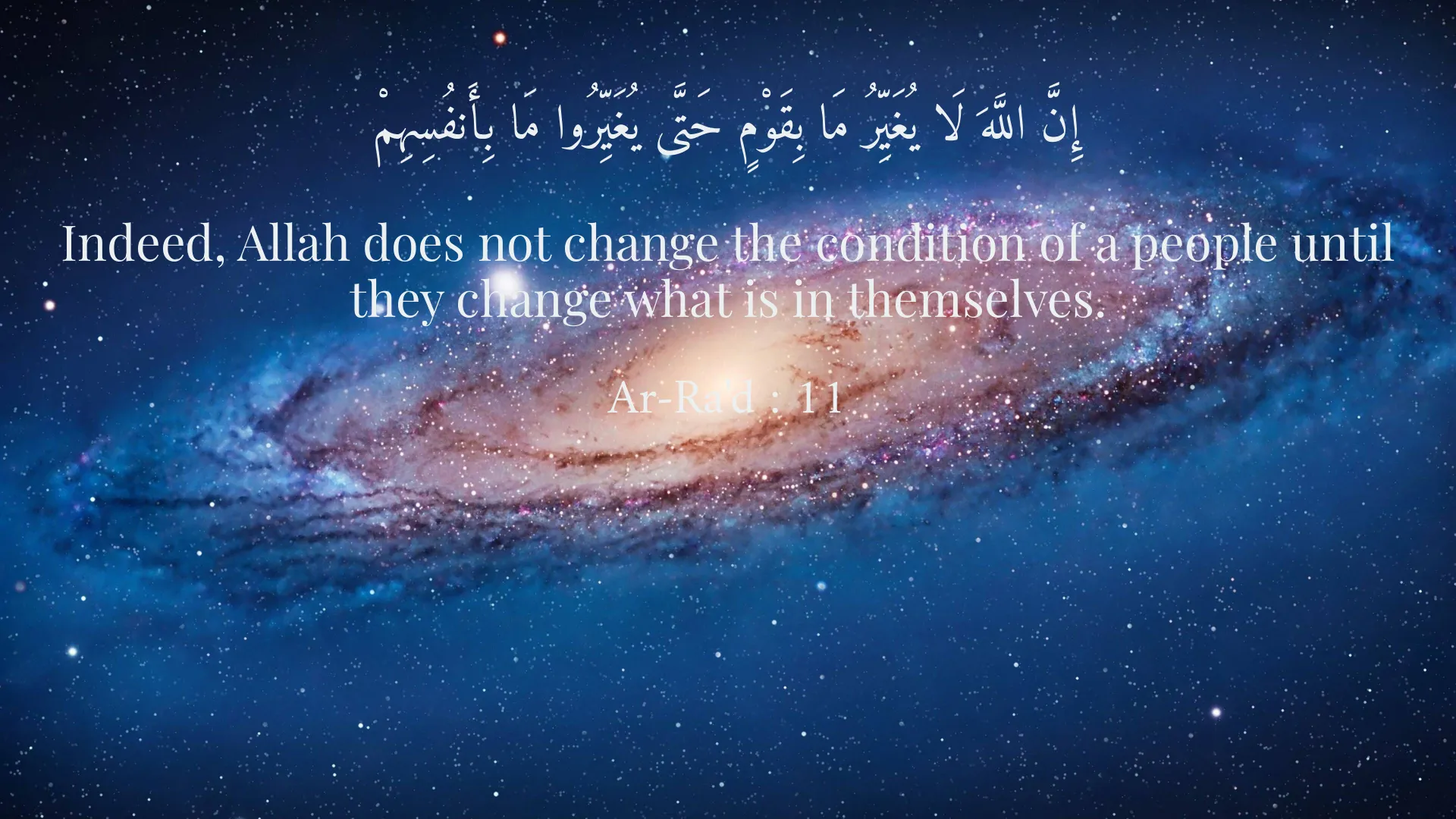
The concept of change within human existence is one that has been studied, debated, and pondered over throughout history. However, in the Holy Quran, this notion is articulated in a manner that is not only profound but also consequential in guiding the lives of the faithful. The verses of the Quran serve as a reminder of the significance of personal responsibility and the power of choice when it comes to leading a fruitful life. One of the most notable references to human change is found in Surah Ar-Ra'd, verse 11, where Allah states, "Indeed, Allah does not change the condition of a people until they change what is in themselves." This simple yet powerful proclamation reveals the intimate relationship between individual will and societal condition. At its core, the verse highlights that external circumstances are often reflections of internal states. Human beings are endowed with the ability to make conscious decisions—choices that can either contribute to their stagnation or foster growth and improvement. Change often operates as a precursor to progress, encouraging individuals to transcend their limitations and aspire towards something greater. For instance, one might consider how personal challenges can serve as catalysts for growth. The saying, "necessity is the mother of invention," resonates well in this context. A person facing financial difficulties may be prompted to evaluate their skills and consider alternative employment paths or educational opportunities. Challenges, in essence, sometimes unveil the dormant potential that exists within an individual, compelling them to strive for betterment. This concept is further echoed in Surah Al-Imran, verse 137, where Allah reminds believers, "Certainly, there have passed away before you [other] ways; so travel in the land and observe how was the end of those who denied." This verse serves as both a historical lesson and an encouragement to reflect on past peoples and their eventual fates. The implication here is dichotomous; one must learn either from the successes of those who embraced change or the failures of those who resisted it. In this regard, history becomes a powerful teacher, reminding individuals of the inevitability of challenges and the imperative of resilience. Humans have always encountered obstacles—and the key differentiator among individuals is how they respond to these formidable trials. Rather than viewing hardships as insurmountable barriers, they can be reframed as opportunities for reflection, growth, and the actualization of potential. In practical terms, the willingness to embrace change can lead to profound transformation. Consider a person who has endured significant personal loss; instead of succumbing to despair, this individual may channel their grief into altruistic endeavors—starting a charity, mentoring others, or finding solace in creative expression. Such changes not only contribute to personal healing but can also inspire others to journey through their own struggles towards personal growth. Furthermore, the process of change is inherently tied to self-awareness. Understanding one's motivations, values, and the precise nature of the changes one wishes to undertake requires introspection and honest evaluation. In many cases, fear of the unknown acts as a significant deterrent to change. However, the Quran's teaching that change begins from within encourages individuals to confront their fears and rediscover inner strengths. By cultivating an open mindset, people can approach change with a perspective that views it as a necessary step on the path toward flourishing. Moreover, the relationship between change and moral development is significant. The notion of improving oneself and reforming behavior is central to many teachings within the Quran. Moral and ethical dimensions of personal change involve not only an evaluation of habits but also a deep reflection on one’s interactions with others and their contributions to society. Having a holistic view of change encompasses self-improvement, ethical living, and fostering contributions to the community as a whole. One may draw parallels between the concept of change in the Quran and various philosophical schools of thought that engage with the theme of personal development, ethics, and social responsibility. For instance, existential philosophy touches on the freedom and responsibility of individuals to define their essence through choices and actions. This is not unlike the pivotal essence of the Quranic verse which speaks to individual agency in effecting change. The freedom to choose is paired intimately with the responsibility to act for one’s benefit and the benefit of others. In conclusion, the notion of change as depicted in the Holy Quran is multifaceted. It emphasizes the central role of individual choices, the inevitability of challenges, and the intrinsic link between internal shifts and external manifestations. The Quran serves as a timeless source that guides humanity towards self-improvement and highlights the path that leads to personal growth and moral advancement. In the grand tapestry of life, these changes are essential threads that weave together the fabric of human experience, pushing each individual toward not only personal enhancement but also toward the betterment of society as a whole. As believers engage with these teachings, they are invited to reflect on their journeys, embolden their spirits, and invite the transformative power of change into their lives, thus paving the way toward a brighter future.
Related Verses
إِنَّ اللَّهَ لَا يُغَيِّرُ مَا بِقَوْمٍ حَتَّى يُغَيِّرُوا مَا بِأَنفُسِهِمْ
Indeed, Allah does not change the condition of a people until they change what is in themselves.
Ar-Ra'd : 11
قد خلت من قبلكم سنن فنسير في الأرض
Certainly, there have passed away before you [other] ways; so travel in the land.
Al-Imran : 137
Short Story
One day, a friend named Amir faced a problem. He was dealing with significant financial issues and felt very upset. However, after some time, he decided that instead of despairing, he must change. He said he needed to learn new skills. Amir started learning programming and soon found his passion. He rapidly achieved success, and his income increased significantly. This change in his life not only made him happy but also demonstrated that with the right decision, one can move towards betterment.