Quranic Answer
In the Holy Quran, the theme of the hardness of the heart is frequently highlighted as one of the serious consequences of neglecting the remembrance of Allah (God) and failing to uphold the principles of repentance. This profound concept serves as a reminder of the spiritual state of the human heart and its critical role in the relationship between an individual and the divine. The Quran intricately weaves together the necessity of maintaining a soft heart through remembrance, the consequences of hard-heartedness, and the importance of adhering to one's spiritual commitments. In essence, the discourse surrounding the heart in the Quran teaches us invaluable lessons about faith, spirituality, and personal development. One of the most poignant references to the hardening of the heart is found in Surah Al-Baqarah (Chapter 2), verse 74, which states: 'Then your hearts became hard after that, so they are like stones or even harder.' This verse makes a powerful comparison, illustrating how, in the absence of faith and remembrance, the human heart can become as impenetrable as stone. The surface-level understanding of this verse speaks to an observation about the human condition; neglecting the remembrance of Allah due to heedlessness leads to a hardened heart and detachment from divine guidance. The metaphor of the heart as something that can become hard is significant. While the physical heart pumps blood and sustains life, the spiritual heart represents one’s emotional and spiritual well-being. Throughout the Quran, the heart is often seen as the center of awareness and understanding, and thus, when it hardens, one becomes indifferent to truth, morality, and guidance. The concept of a softened heart is interwoven through the Quranic text, indicating that a heart can regain its softness through the consistent practice of remembrance. The act of 'dhikr,' or remembering Allah, is transcendent; it creates tranquility and a gentle nature within one’s being. In Surah Al-Ra'd (Chapter 13), verse 28 states, 'Verily, in the remembrance of Allah do hearts find rest.' This fundamental belief nourishes the understanding that contemplation and remembrance draw individuals toward spiritual tranquility, leading to a more compassionate disposition. The emphasis on the importance of remembrance of Allah serves as a continuous theme throughout the Quran, and it implies that the human heart flourishes and is revitalized by engaging in spirituality. Another critical aspect highlighted in the Quran concerning the softening of the heart is the necessity of responding to divine calls as depicted in Surah Al-Anfal (Chapter 8), verse 24: 'O you who have believed, respond to Allah and the Messenger when he calls you to that which gives you life.' This verse instills in the believers a sense of urgency and obligation to adhere to divine teachings. It points out that a lack of response to Allah and His Messenger leads to spiritual desensitization. Conversely, a sincere response to these calls creates a personal connection with Allah, nurturing a heart that is not only soft but alive with faith and hope. By striking a balance between devotion and action, believers can continually invigorate their spirits. Furthermore, in Surah Al-Ma'idah (Chapter 5), verse 13, it states: 'But because of their breach of [their] covenant, We cursed them and made their hearts hard.' Here, the Quran illustrates the consequences of disobedience and the breach of spiritual commitments. It emphasizes that when individuals neglect their promises made to Allah, whether through inaction or deviation from righteous behavior, they invite the hardening of their heart. This statement implies a profound reality; covenant-breaking does not merely lead to divine disfavor but also to a self-inflicted spiritual ailment. It suggests that integrity and faithfulness in one's spiritual practices are paramount to avoiding the pitfalls of hard-heartedness. As we reflect on the severity of hard-heartedness, it becomes evident that the Quranic narrative is not solely a warning but a guide for spiritual growth and development. Two crucial principles emerge: the remembrance of Allah and faithfulness to one's covenant. Practicing these principles can mitigate the risks of hard-heartedness and illuminate the path toward spiritual enlightenment. These teachings encourage an engagement with spirituality that is active, responsive, and committed. The journey of understanding the state of the heart is essential for personal transformation. Engaging deeply with these Quranic lessons allows the believer to examine their spiritual life critically. Are they frequent in their remembrance? Are they responding to Allah's calls earnestly? Is their commitment to their spiritual duties resolute? Such reflections pave the way for individuals to embrace a heart that is neither indifferent nor stone-like but instead rejuvenated, filled with compassion, and aligned with divine purpose. In conclusion, the exploration of the hardening of the heart within the context of the Holy Quran offers profound insights into the cultivation of spiritual health through the remembrance of Allah and fidelity to spiritual covenants. It acts as a reminder that the heart, when separated from its Creator, can suffer severe consequences, leading to spiritual and moral decay. However, the Quran provides hope—by engaging with its teachings and striving to keep the remembrance of Allah at the forefront of daily life, believers can soften their hearts, find peace, and ultimately live in harmony with their faith. The Quran's teachings serve as both a cautionary tale and a beacon of hope, guiding individuals toward a fulfilling spiritual journey characterized by a soft and resilient heart.
Related Verses
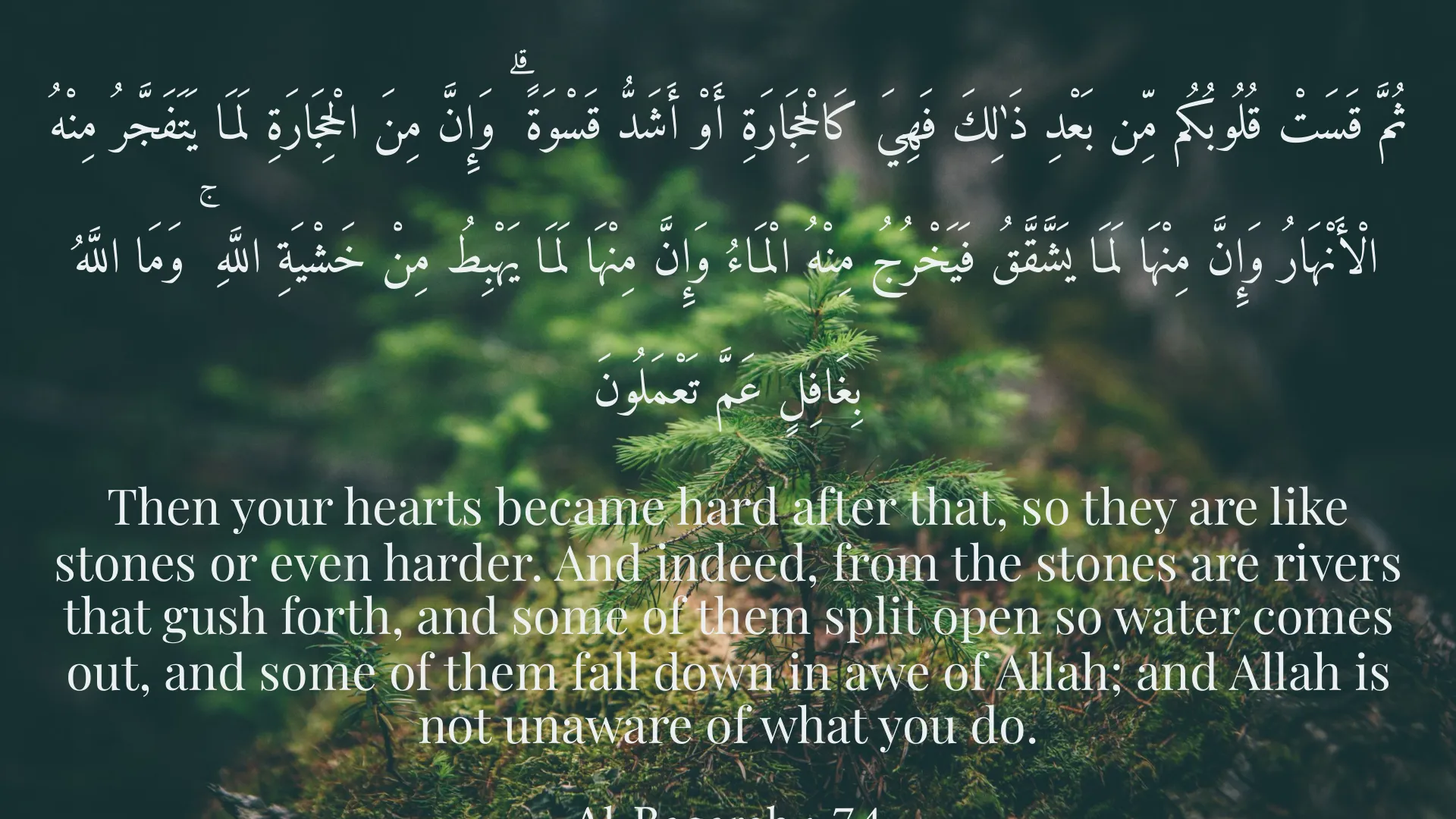
ثُمَّ قَسَتْ قُلُوبُكُم مِّن بَعْدِ ذَٰلِكَ فَهِيَ كَالْحِجَارَةِ أَوْ أَشَدُّ قَسْوَةً ۗ وَإِنَّ مِنَ الْحِجَارَةِ لَمَا يَتَفَجَّرُ مِنْهُ الْأَنْهَارُ وَإِنَّ مِنْهَا لَمَا يَشَّقَّقُ فَيَخْرُجُ مِنْهُ الْمَاءُ وَإِنَّ مِنْهَا لَمَا يَهْبِطُ مِنْ خَشْيَةِ اللَّهِ ۚ وَمَا اللَّهُ بِغَافِلٍ عَمَّ تَعْمَلُونَ
Then your hearts became hard after that, so they are like stones or even harder. And indeed, from the stones are rivers that gush forth, and some of them split open so water comes out, and some of them fall down in awe of Allah; and Allah is not unaware of what you do.
Al-Baqarah : 74
يَا أَيُّهَا الَّذِينَ آمَنُوا اسْتَجِيبُوا لِلَّهِ وَلِلرَّسُولِ إِذَا دَعَاكُمْ لِمَا يُحْيِيكُمْ ۚ وَاعْلَمُوا أَنَّ اللَّهَ يَحُولُ بَيْنَ الْمَرْءِ وَقَلْبِهِ ۖ وَأَنَّهُ إِلَيْهِ تُحْشَرُونَ
O you who have believed, respond to Allah and the Messenger when he calls you to that which gives you life. And know that Allah intervenes between a man and his heart, and that to Him you will be gathered.
Al-Anfal : 24
فَبِمَا نَقْضِهِم مِّيثَاقَهُمْ لَعَنَّاهُمْ وَجَعَلْنَا قُلُوبَهُمْ قَاسِيَةً ۖ لَا يَفْهَمُونَ ۚ أَوْ كَثِيرٌ مِّنْهُمْ ۚ وَمَا تَغْفِلُ النَّاسُ عَن نَعِيمِ اللَّهِ
But because of their breach of [their] covenant, We cursed them and made their hearts hard; they do not understand much.
Al-Ma'idah : 13
Short Story
Once upon a time, in a lush green forest, there was a big tree that paid attention to the tranquility and beauty around it. The tree saw how its leaves danced in the wind and how the birds joyfully sang. However, it grew worried when humans entered the forest, chopping and taking it down with axes. The nature of human life was changing, and the tree worried whether humans would someday forget the remembrance of Allah. So, it decided to help the humans: each day it would remind them of Allah’s blessings, bringing a sense of peace back into their lives.