Quranic Answer
The Quest for Guidance: A Comprehensive Exploration of Misguidance in the Light of the Holy Quran The journey of life encompasses myriad pathways and choices, and within this intricate web lies the fundamental quest for guidance. The Holy Quran, revered as the divine scripture of Islam, addresses the profound theme of guidance and misguidance through various verses. The text elucidates that the phenomenon of misguidance can often affect individuals who are, paradoxically, endowed with knowledge. This essay seeks to explore the Quranic perspective on guidance, the reasons that lead to misguidance, and the overarching importance of faith and sincerity in truly following the righteous path. At the very heart of this discourse lies the assertion that the lack of faith often serves as a breeding ground for misguidance. Surah Al-Jathiya, verse 23, raises a compelling rhetorical question: "Is one who is guided to the truth better than one who is led astray by his own desires?" This verse not only highlights the distinction between the one who follows the truth and the one who succumbs to personal desires, but it also serves as a cautionary reminder of the consequences of unchecked ambition and distorted intentions. The verse implicitly suggests that knowledge, while crucial, can easily become a double-edged sword when wielded without a sincere heart. Indeed, some individuals may indeed possess a vast repository of information yet still find themselves adrift due to their self-serving ambitions. As Surah Al-An'am, verse 141 poignantly states, "And they are the losers." This verse underscores the grim reality faced by those who stray from the truth, emphasizing that misguided individuals ultimately suffer profound loss. It is a clarion call to acknowledge that worldly success or accolades attained through misguided pursuits are but temporary gains, while the true essence of victory lies in adhering to the divine path of righteousness. The Quran serves as a guide for humanity, offering clarity on the true purpose of life and the importance of aligning one’s actions with divine will. However, when individuals exploit their knowledge solely for personal gain, they inadvertently choose to engage in a journey that leads them away from eternal success. The concept of gratitude is another essential theme that emerges from the exploration of guidance in the Quran. Surah Al-Insan, verse 3 articulates: "Indeed, We have guided him to the way, be he grateful or be he ungrateful." This verse reinforces the idea that guidance is a divine gift — one that should be cherished and recognized. The presence of guidance, whether embraced or disregarded, reflects an individual’s state of gratitude towards the divine. Those who remain ungrateful or negligent towards religious truths effectively deny themselves the blessings of guidance. In this sense, the absence of gratitude can catalyze misguidance, as the individual becomes disconnected from the spiritual truth that could otherwise illuminate their path. At the core of misguidance is often a lack of proactive piety and a weak connection to God. The Quran teaches that véritable guidance stems not only from the acquisition of knowledge but also from the cultivation of sincere faith and moral rectitude. The nourishment of the soul through piety empowers individuals to navigate the labyrinth of life's challenges with resilience and discernment. Knowledge, when combined with sincere devotion to God, has the potential to illuminate one’s path, guiding them toward righteousness and enlightenment. Conversely, knowledge devoid of piety may lead to a disconnection from the truth, where the individual becomes ensnared in the illusions of the material world, prioritizing transient pleasures over lasting spiritual fulfillment. It is essential to recognize that individuals may misinterpret or misuse the knowledge that they possess, leading them toward erroneous conclusions. For instance, in the pursuit of fame, wealth, or status, individuals may justify unethical behaviors, believing that their knowledge provides them with the leeway to deviate from moral principles. This pathway, however, is fraught with illusions, as the thrill of worldly ambition cannot compensate for the spiritual emptiness that often accompanies such pursuits. Moreover, one must understand that the complexities of the human experience mean that misguidance can stem from a variety of factors. Environmental influences, peer pressures, and societal norms can significantly impact an individual's journey toward self-discovery and enlightenment. The Quran emphasizes personal responsibility in navigating these influences. In the face of adversity, the power of self-reflection and a conscious effort to maintain a connection with God are paramount. Each person must grapple with their own desires and conscious intentions to forge a path that remains true to divine guidance. Hence, the pursuit of piety and a flourishing relationship with the Creator are essential in shielding oneself from misguidance. The role of community within the wider Islamic framework also cannot be understated. Engaging with a nurturing and supportive community fosters an environment that encourages Muslims to enhance their understanding of faith and maintain steadfastness in their beliefs. The Quran serves as an anchor, providing insights into righteous behavior while emphasizing the importance of seeking knowledge within supportive circles that prioritize faith. As individuals connect with one another, they can share experiences, insights, and reflections, helping to create a robust foundation for a life rooted in gratitude and sincerity. In conclusion, the themes of guidance and misguidance within the Holy Quran are intertwined and resonate deeply with the human experience. The knowledge one possesses can serve as a vehicle towards enlightenment, but it requires a foundation of faith, sincerity, and piety to navigate the complexities of life effectively. Misguided individuals who seek fulfillment in worldly pursuits without acknowledging the divine often find themselves ensnared in a web of false ambitions. Conversely, those who cultivate gratitude towards God and recognize the importance of sincere intentions can harness the divine gift of guidance, leading to a fulfilling and spiritually enriched life. Ultimately, the quest for guidance is an ongoing journey that requires dedication and humility. Transformative knowledge, when paired with genuine devotion to divine principles, can illuminate the path towards righteousness. Thus, the Holy Quran stands as a timeless testament, guiding believers toward a life aligned with truth, moral integrity, and spiritual fulfillment.
Related Verses
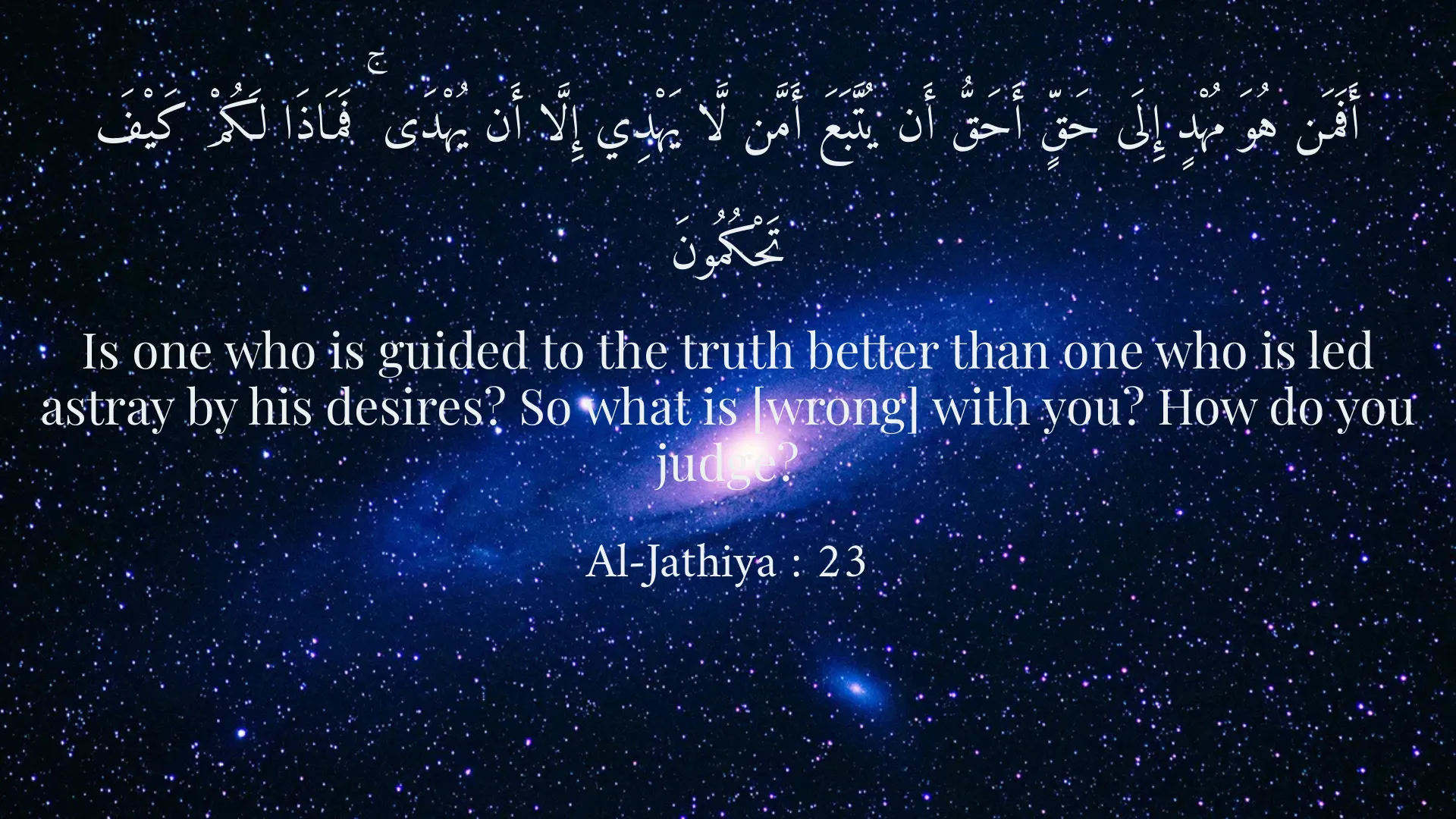
أَفَمَن هُوَ مُهْدٍ إِلَى حَقٍّ أَحَقُّ أَن يُتَّبَعَ أَمَّن لَّا يَهْدِي إِلَّا أَن يُهْدَى ۚ فَمَاذَا لَكُمْ كَيْفَ تَحْكُمُونَ
Is one who is guided to the truth better than one who is led astray by his desires? So what is [wrong] with you? How do you judge?
Al-Jathiya : 23
وَأُولَـٰئِكَ هُمُ الْخَاسِرُونَ
And they are the losers.
Al-An'am : 141
إِنَّا هَدَيْنَا هُدَىٰ إِمَّا شَاكِرًا وَإِمَّا كَفُورًا
Indeed, We have guided him to the way; be he grateful or ungrateful.
Al-Insan : 3
Short Story
Once, a young man named Amir, despite having great knowledge, found himself in a pit of misguidance. He was using his knowledge for show and financial gain. But one day, he came across a verse from the Quran that shook him: 'Is one who is guided to the truth better?' From that day on, he decided to work on his faith and behavior and strengthen his connection with God.