Quranic Answer
The question you've raised is profoundly significant and, unfortunately, a persistent challenge throughout human history. Religion, in its essence, is a path for humanity to connect with the Creator, a means to purify the soul, establish justice, foster love, and serve creation. However, history clearly demonstrates how some individuals have exploited this sacred instrument to achieve material objectives, gain power, fame, or wealth. The Holy Quran, as a book of divine guidance, explicitly addresses this phenomenon and warns against those who turn religion into a means for their worldly ends. To understand why this occurs, we must examine several key factors from a Quranic perspective: 1. Weakness of Faith and Inner Hypocrisy: One of the most crucial reasons emphasized by the Quran is the inherent weakness and fragility of inner faith. An individual who lacks genuine, deeply rooted belief in God and the Day of Judgment will perform religious acts merely as an outward display to impress others. The Quran refers to such individuals as 'hypocrites' (munafiqoon). Hypocrites are those who verbally profess faith but whose hearts are devoid of sincerity. Their true aim is to deceive God and the believers, while in reality, they only deceive themselves. This weakness of faith renders eternal values insignificant to them, pushing them to focus solely on worldly gains. They employ divine commandments not out of obedience to God, but to achieve social status, wealth, or power. Such individuals are willing to distort God's verses, alter religious laws, or even issue erroneous religious edicts (fatwas) to reach their goals. The Quran frequently details the bitter fate of hypocrites, revealing how their deceptive appearances will ultimately be exposed and yield no benefit for them. These individuals transform religion into a tool rather than a genuine path for life. 2. Love of the World (Dunya) and Prioritizing It Over the Hereafter (Akhirah): The Holy Quran repeatedly warns against 'Hubb al-Dunya,' or an excessive love for worldly life and prioritizing it over the Hereafter. This is a primary root of all deviations, including the misuse of religion. When the love for wealth, status, fame, and transient worldly pleasures dominates a person's heart, they become willing to transgress any principle, even religious and ethical ones, to achieve their desires. The Quran explicitly mentions those who 'sell God's verses for a small price.' This 'small price' refers to the fleeting worldly gains that, in comparison to eternal rewards and divine pleasure, hold no true value. Such individuals are prepared to conceal the truth, lie, commit injustice, and even mislead people to attain wealth or position in this world. They forget that this world is temporary and what remains are one's deeds and their consequences in the Hereafter. 3. Thirst for Power and Domination: Religion, due to its profound influence on human hearts and souls and its elevated moral standing, can be a potent instrument for control and dominance over the masses. Individuals driven by a thirst for power and control may exploit this immense potential. They present themselves as exclusive interpreters of religion, or even as special representatives of God, thereby gaining legitimacy to rule over people. By using religious language, they can compel people to obey them, confiscate resources for their benefit, and suppress any opposition under the guise of opposing religion. This misuse can lead to the formation of religious dictatorships or extremist groups that commit great atrocities in the name of religion. The Quran vehemently condemns those who call people to other than God and who set themselves up in God's place, labeling them as tyrants (Taghut). 4. Ignorance and Deliberate Distortion: Sometimes, the misuse of religion stems from genuine ignorance and lack of knowledge. However, more often, those who misuse religion deliberately and intentionally distort and misinterpret verses and traditions. They highlight parts of the sacred text that serve their interests while ignoring the rest. They may even twist words from their proper context to extract their desired meaning. This intentional distortion is done to mislead people and justify their wrongful actions. The Quran severely reprimands such distorters, placing them among the misguided. The Quran's Message: The Holy Quran defines the primary objective of the prophets' missions as establishing justice and pure monotheism. True religiosity means sincere service to God and humanity, avoiding all forms of hypocrisy and pretense, and prioritizing otherworldly values over worldly ones. The misuse of religion not only harms the religion itself but also erodes public trust in truth and propagates corruption. The Quran consistently emphasizes honesty, trustworthiness, and pure intentions in all actions, especially religious ones. It warns believers to be vigilant against those who seek personal gain in the name of religion, and to judge what is right not by individuals' appearances, but by the conformity of their actions with God's word and the Prophet's conduct. Ultimately, the misuse of religion is a sign of spiritual sickness and inner weakness, the cure for which is a return to sincerity, piety, and deep contemplation on the true meaning of the prophets' missions.
Related Verses
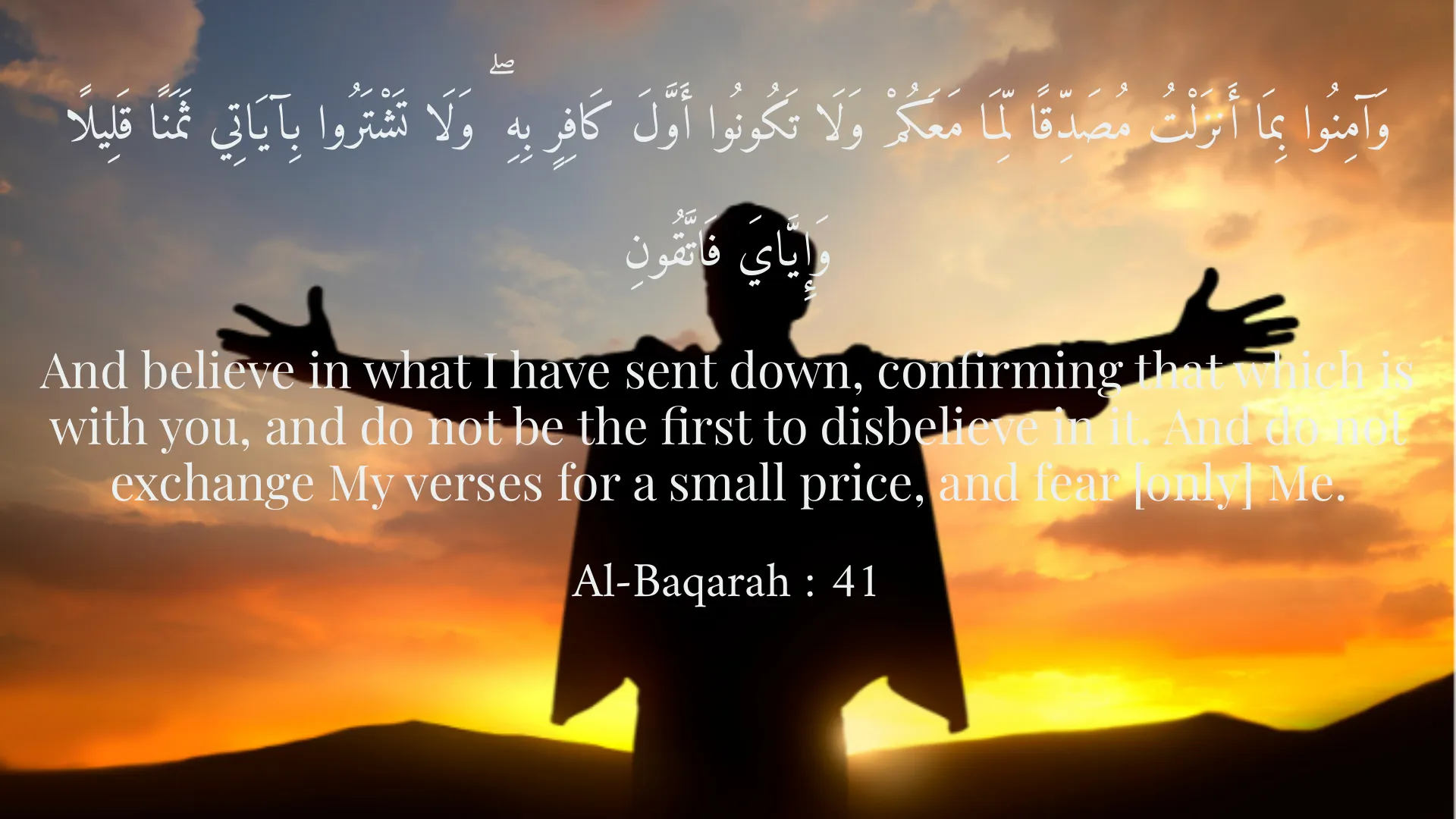
وَآمِنُوا بِمَا أَنزَلْتُ مُصَدِّقًا لِّمَا مَعَكُمْ وَلَا تَكُونُوا أَوَّلَ كَافِرٍ بِهِ ۖ وَلَا تَشْتَرُوا بِآيَاتِي ثَمَنًا قَلِيلًا وَإِيَّايَ فَاتَّقُونِ
And believe in what I have sent down, confirming that which is with you, and do not be the first to disbelieve in it. And do not exchange My verses for a small price, and fear [only] Me.
Al-Baqarah : 41
اشْتَرَوْا بِآيَاتِ اللَّهِ ثَمَنًا قَلِيلًا فَصَدُّوا عَن سَبِيلِهِ ۚ إِنَّهُمْ سَاءَ مَا كَانُوا يَعْمَلُونَ
They have purchased with the verses of Allah a small price and averted [people] from His way. Indeed, it was evil that they were doing.
At-Tawbah : 9
إِذَا جَاءَكَ الْمُنَافِقُونَ قَالُوا نَشْهَدُ إِنَّكَ لَرَسُولُ اللَّهِ ۗ وَاللَّهُ يَعْلَمُ إِنَّكَ لَرَسُولُهُ وَاللَّهُ يَشْهَدُ إِنَّ الْمُنَافِقِينَ لَكَاذِبُونَ
When the hypocrites come to you, [O Muhammad], they say, 'We testify that you are the Messenger of Allah.' And Allah knows that you are His Messenger, and Allah testifies that the hypocrites are liars.
Al-Munafiqun : 1
اتَّخَذُوا أَيْمَانَهُمْ جُنَّةً فَصَدُّوا عَن سَبِيلِ اللَّهِ ۚ إِنَّهُمْ سَاءَ مَا كَانُوا يَعْمَلُونَ
They have taken their oaths as a cover, so they averted [people] from the way of Allah. Indeed, it was evil that they were doing.
Al-Munafiqun : 2
Short Story
In Saadi's Gulistan, it is narrated that a just king saw a dervish clad in patched robes, outwardly appearing to be a man of great asceticism and piety. The king was pleased by his apparent simplicity and contentment and wished to honor him. He ordered a bag of gold to be brought to him. When the gold was placed before the dervish, he, with an ascetic demeanor, said: 'O King, we dervishes have no need for gold, for our hearts turn only to the Beloved!' The king was even more impressed by these words. However, the wise vizier, who had spent years observing people and knew their outer and inner states, smiled and whispered to the king: 'My Lord, this man's words are good and his appearance is pleasing, but let us test him a little.' The king agreed. The vizier secretly sent several people to follow the dervish during the night. After moving away from the city, the dervish went to a luxurious house and greedily counted and hid the bag of gold that the king had given him, which he had outwardly seemed to refuse. The next morning, the vizier told the king: 'My Lord, beware of those whose words are as sweet as sugar and whose clothes are as soft as cotton, but whose hearts burn with the fire of greed. Whoever raises the banner of religion for worldly gain shall ultimately be exposed and find nothing but loss.'