Quranic Answer
A deep and significant question that resonates with many and can sometimes lead to misunderstanding is: why is it that, despite the immense emphasis Islam places on prayer (Salah) and its role in human development and purification, some individuals who appear to be devout in their prayers exhibit weaknesses in their behavior and ethics towards others, sometimes even committing actions contrary to moral and human principles? This question requires a deeper analysis of the concept of prayer and worship in Islam. From the perspective of the Holy Quran and Islamic teachings, prayer is not merely a ritual act or a set of physical movements and verbal recitations; rather, it is a fundamental pillar for building a virtuous character and an ethical life. The main purpose of prayer, as explicitly stated in Surah Al-Ankabut, verse 45, is: "…and establish prayer. Indeed, prayer prohibits immorality and wrongdoing, and the remembrance of Allah is greater. And Allah knows that which you do." This noble verse indicates that prayer is a powerful tool for self-discipline, strengthening willpower, and cultivating Taqwa (God-consciousness combined with piety) within the human being. A prayer performed with mindfulness (khushu'), contemplation of its meanings, and sincere intention will undoubtedly yield positive fruits in an individual's behavior. This prayer reminds a person of God and makes them mindful of their actions and words at every moment of their life, whether in solitude or in public. Therefore, if it is observed that someone prays but exhibits undesirable behavior, the flaw is not in the prayer itself, but in the quality and depth of its performance. One of the primary reasons for this inconsistency is the lack of sincerity (ikhlas) and the contamination of the act of worship with showing off (riya') and hypocrisy. The Holy Quran strongly condemns showing off in worship and regards it as a characteristic of hypocrites. In Surah Al-Ma'un, Allah Almighty severely reprimands those who pray but are heedless of their prayers or whose prayers are merely to attract others' attention: "So woe to those who pray, [But] who are heedless of their prayer – Those who make show [of their deeds] * And withhold [small] aid." These verses clearly state that prayer without heartfelt attention, without sincere intention, and with a non-divine purpose (such as gaining social status or people's praise), not only lacks spiritual value but can also be a source of divine condemnation and punishment. Such a prayer, though outwardly performed, has not deeply penetrated the individual's soul and has not led to their inner purification and transformation. In essence, this prayer has merely become a habit that has lost its true spirit and essence. Another reason for this phenomenon is the lack of a deep understanding of the comprehensive philosophy of Islam and the separation of worship from daily life. Islam is a holistic and complete religion that encompasses all aspects of human life, from individual worship to social relations and ethics. Prayer, as the pillar of faith, should be a bridge between the individual and the Creator, and this connection must manifest in all dimensions of their life. Some individuals may view prayer merely as a dry, soulless obligation to be performed at specific times, with no connection to other aspects of their lives afterward. This superficial view prevents prayer from becoming a catalyst for cultivating Taqwa and rectifying behavior. Taqwa, which is one of the most important goals of worship, means piety and abstaining from sins based on the awareness of God's constant presence. A prayer that does not strengthen Taqwa in a person is like a tree that bears no fruit. The Holy Quran consistently mentions faith (Iman) and righteous deeds (amal salih) together, emphasizing that true faith is fruitless without righteous actions, and righteous actions stem from genuine faith. Prayer, as a symbol of faith, if properly established, should be reflected in an individual's good deeds, good speech, and pure intention. If someone prays but lies, backbites, oppresses, or violates the rights of others, it indicates that their prayer has not reached the degree where it can deter them from these transgressions. Such individuals may not be deprived of the otherworldly reward of prayer, but they have not experienced its educational and deterrent effect in their worldly lives. They have created a gap between worship and ethics, whereas in Islamic teachings, these two are inseparable. Finally, it should also be noted that spiritual and moral growth is a gradual and time-consuming process. Every human being progresses step by step on the path of perfection and self-purification and may be at different stages of this journey. Some individuals may have recently embraced religion or started praying and are in the initial stages of self-rectification; in such a case, expecting complete and immediate transformation in their behavior is unrealistic. The important thing is to have the intention for reform and movement towards perfection, and for prayer to be used as a tool for this growth. Islam emphasizes patience, perseverance, and continuous effort to improve character. Therefore, this phenomenon (praying and having bad behavior) does not indicate a flaw in the prayer obligation itself, but rather highlights the need for deeper contemplation on the quality of its performance and the necessity of accompanying it with sincerity, mindfulness, and a correct understanding of the comprehensive philosophy of worship. True prayer is a powerful factor for educating, purifying, and building a complete human being whose relationship with God is good, and whose behavior with God's creation is also good. If these goals are not achieved, the root cause should be sought in the individual's intention, quality, and depth of connection with prayer, not in this divine obligation itself. This serves as a reminder for every Muslim to review their acts of worship and see whether their prayer has brought them closer to Allah Almighty and kept them away from sins; and whether this connection with the Creator is also manifested in their ethics and interactions with creation. In truth, any prayer that does not bring a person closer to justice, kindness, honesty, and benevolence needs serious reconsideration, because the very nature of true prayer is to build a better human being.
Related Verses
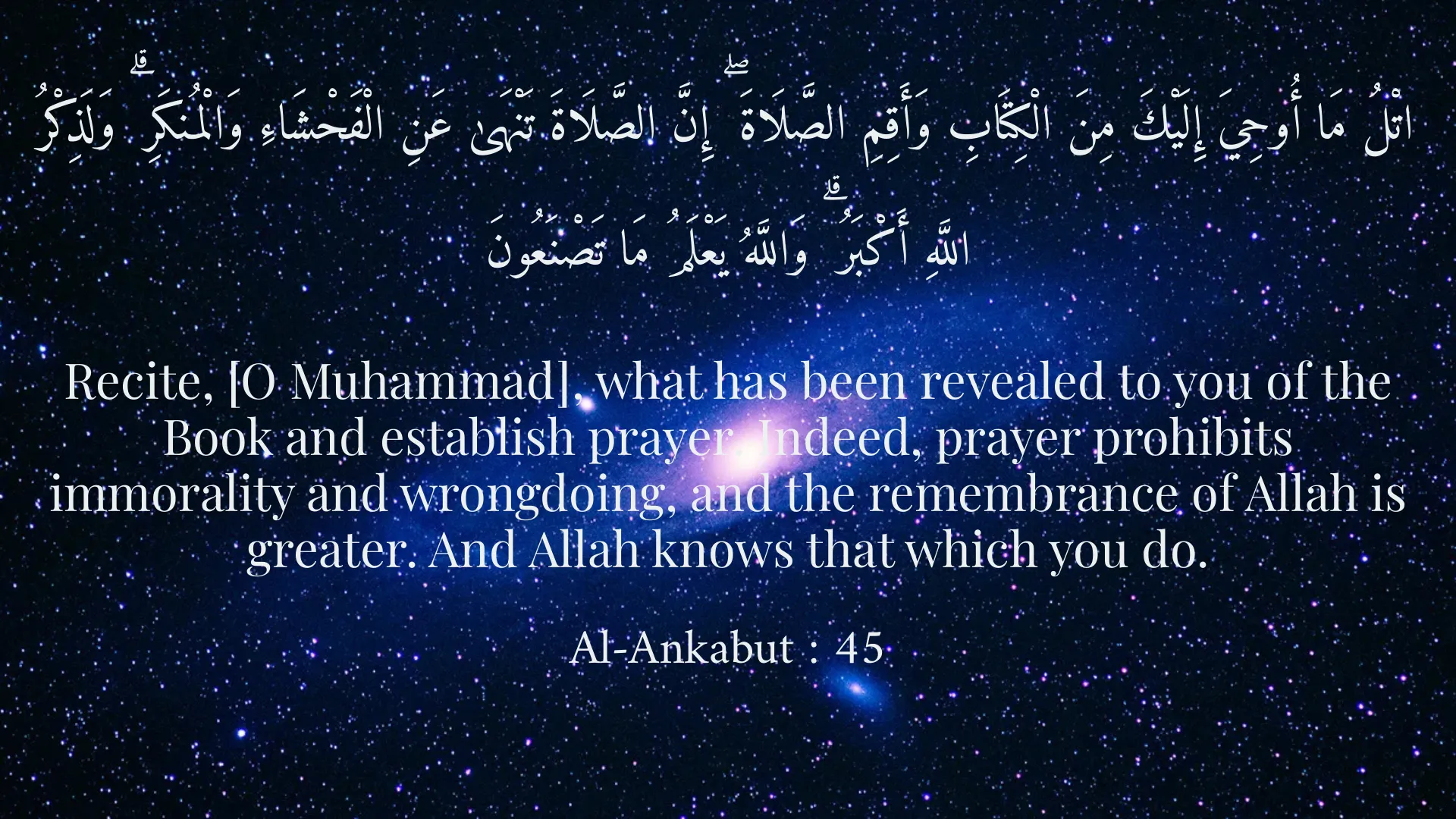
اتْلُ مَا أُوحِيَ إِلَيْكَ مِنَ الْكِتَابِ وَأَقِمِ الصَّلَاةَ ۖ إِنَّ الصَّلَاةَ تَنْهَىٰ عَنِ الْفَحْشَاءِ وَالْمُنكَرِ ۗ وَلَذِكْرُ اللَّهِ أَكْبَرُ ۗ وَاللَّهُ يَعْلَمُ مَا تَصْنَعُونَ
Recite, [O Muhammad], what has been revealed to you of the Book and establish prayer. Indeed, prayer prohibits immorality and wrongdoing, and the remembrance of Allah is greater. And Allah knows that which you do.
Al-Ankabut : 45
فَوَيْلٌ لِّلْمُصَلِّينَ * الَّذِينَ هُمْ عَن صَلَاتِهِمْ سَاهُونَ * الَّذِينَ هُمْ يُرَاءُونَ * وَيَمْنَعُونَ الْمَاعُونَ
So woe to those who pray, * [But] who are heedless of their prayer – * Those who make show [of their deeds] * And withhold [small] aid.
Al-Ma'un : 4-7
إِنَّ الْمُنَافِقِينَ يُخَادِعُونَ اللَّهَ وَهُوَ خَادِعُهُمْ وَإِذَا قَامُوا إِلَى الصَّلَاةِ قَامُوا كُسَالَىٰ يُرَاءُونَ النَّاسَ وَلَا يَذْكُرُونَ اللَّهَ إِلَّا قَلِيلًا
Indeed, the hypocrites [think to] deceive Allah, but He is deceiving them. And when they stand for prayer, they stand lazily, showing [themselves to] the people and not remembering Allah except a little.
An-Nisa : 142
Short Story
It is narrated that in ancient times, there lived a worshipper who would go to the mosque every morning and evening, performing long and magnificent prayers. People praised him for his piety and asceticism, seeking his prayers. Yet, this very worshipper would speak harshly and rudely in the market, shortchange people in transactions, and not treat his neighbors kindly. One day, a wise sage saw him shouting angrily at a poor person after a long prayer. The sage turned to the worshipper and said, "O friend, I see you prostrating at the threshold of the Beloved, seeking detachment from the world, yet how is it that the same tongue that utters the remembrance of Truth wounds the hearts of His servants? A prayer that does not deter you from harming creation is, as it were, merely a lifeless posture and a meaningless movement. Remember that the abode of the Beloved is in the hearts of people, and whoever breaks the heart of a servant of God has blocked their own path to the Truth." The worshipper was ashamed by the sage's words and realized that although the outward form of his worship was beautiful, the essence of his deeds was unpleasant. From that day on, he strove not only to perform his prayers with purer intentions but also to improve his character, so that his prayer would truly restrain him from evil and guide him towards good, thereby manifesting the fruits of his prayer in his actions.