Quranic Answer
Dear brothers and sisters in faith, one question that sometimes occupies our minds, and might even lead to a sense of bewilderment, is why, despite numerous and heartfelt prayers, some of our desires seem to take years to be fulfilled, or sometimes even come to pass in a way different from what we expected. Understanding this requires a deep insight into divine, infinite wisdom and the nature of our relationship with the Lord. The Holy Quran, this guiding book, does not provide a direct and definitive answer regarding the exact timing of prayer fulfillment. However, it establishes principles and foundations that help us understand this phenomenon with a faithful and trusting perspective. This apparent delay is neither a sign that our prayer has gone unheard, nor an indication of a lack of divine grace and mercy; rather, it is a manifestation of Allah's infinite wisdom, knowledge, and boundless love. Let us explore these truths from the Quranic perspective to fill our hearts with greater tranquility. The first and perhaps most crucial principle we must consider is 'Divine Wisdom' (Hikmah). Allah Almighty has absolute knowledge of all dimensions of existence: past, present, and future. He knows better than anyone else what is truly beneficial for us and what might be detrimental in the long run. We, as human beings, have a limited view of time and space; our desires are often shaped by immediate needs, momentary emotions, or incomplete perceptions of good and evil. We might intensely ask for something that, in reality, if granted, would bring us harm or deviate us from the path of guidance. The Quran clearly states this truth: "But perhaps you hate a thing and it is good for you; and perhaps you love a thing and it is bad for you. And Allah knows, while you know not." (Surah Al-Baqarah, verse 216). This verse illuminates our ignorance regarding the future and our true well-being. Allah is like a gardener who knows which seed will yield the best fruit in which season and with what amount of water. Sometimes, the delay in the answer to a prayer is because that request, at the present time, is not truly good for us, or the conditions for its proper reception and utilization have not yet materialized. This delay is itself a hidden mercy that saves us from what we do not know and guides us toward what is genuinely better for us. It is an act of divine foresight, preventing potential pitfalls that our limited vision cannot perceive, and ensuring that when the blessing arrives, it is truly beneficial and lasting. The second point embedded within the apparent delay in prayer fulfillment is 'Patience' (Sabr) and 'Reliance on Allah' (Tawakkul). The Quran repeatedly emphasizes the virtue of patience, considering it a key to attaining many blessings and goodness. Allah says in Surah Al-Baqarah, verse 153: "O you who have believed, seek help through patience and prayer. Indeed, Allah is with the patient." The process of waiting and persistent supplication, without allowing despair or hopelessness to enter the heart, is a profound spiritual exercise. This period of waiting is an opportunity for the soul to be refined, for spiritual capacities to increase, and for the bond with the Creator to strengthen. If every prayer were answered immediately, perhaps we would never truly appreciate divine grace, or we would never reach the depth of reliance and trust in Him. This patience teaches us to entrust our desires to Allah and to trust His management, even if the path and timing of the answer are not what we imagine. This trust itself brings a kind of inner peace, freeing us from many worldly attachments. In this journey, waiting becomes not a hardship, but a sweet act of worship, wherein the servant daily realizes more of the greatness and power of his Lord and draws closer to Him. It cultivates humility and a deep sense of dependence on the One who truly holds all power and knowledge. Furthermore, 'Divine Testing' (Ibtila') also plays a significant role in these delays. This world is a realm of trial, and Allah tests His servants with difficulties, deficiencies, and delays in their desires to reveal the sincerity of their faith and their steadfastness. These tests are essential for our spiritual growth and elevation. Just as a student needs to solve difficult problems for deeper learning, our faith is strengthened through life's challenges and patience in the face of delayed answers to prayers. Allah does not want us to remember Him only in comfort and ease; rather, He wants us to consider Him our sole refuge and problem-solver even in hardships and periods of waiting. These trials cause us to distance ourselves from selfishness and material dependencies, turning our entire being towards our Lord. As stated in Surah Al-Ankabut, verse 2: "Do people think that they will be left alone because they say, 'We believe,' and will not be tested?" This delay can be part of this test, to see if our faith is steadfast only when desires are fulfilled or if it remains firm under all circumstances, proving its genuineness and resilience. Another important point is that 'the answer to prayer is not always the exact fulfillment of our request.' Allah Almighty responds to our prayers in various ways that we might not immediately perceive. Firstly, He might grant our exact request at the best time and with the best quality. Secondly, instead of our worldly desire, He might bestow upon us a far greater good; for example, instead of worldly wealth, He might grant us inner peace and spiritual richness, which are more enduring and valuable. Thirdly, He might avert a calamity from us that would have afflicted us if our prayer had not been 'answered' in that preventive way, and we would never even know about it. And fourthly, and perhaps most importantly, Allah stores the answer to His servant's prayer for him in the Hereafter, rewarding him in the best possible way there. This reward in the Hereafter is so immense that on the Day of Judgment, the servant will wish that none of his prayers had been answered in this world so that he could receive all of them in the Hereafter. This storing for the Hereafter is itself a sign of the utmost generosity and benevolence of Allah, who plans for His servant a lasting and eternal reward, truly reflecting His attribute of Al-Wahhab (The Bestower) in its most magnificent form. Finally, we must remember that Allah Himself has said: "And your Lord says, 'Call upon Me; I will respond to you.'" (Surah Ghafir, verse 60). This divine promise is definite and unfailing. No prayer goes unanswered. However, the manner and timing of this response depend on His infinite knowledge and wisdom. These delays give us the opportunity to turn prayer into a habit, and ultimately into love; a direct and continuous relationship with our Creator. So, let us never despair of praying, and remember that every time we raise our hands in need to Him, we are building a stronger bridge toward eternal peace and divine pleasure. The wisdom of Allah in delays is a hidden mercy and a test for growth. Therefore, with hearts full of faith and reliance, let us continue on the path of servitude, knowing that the best awaits us, both in this world and in the Hereafter. This process of waiting and believing in the unseen allows one to attain a deeper understanding of Tawhid (Oneness of God). They realize that not only in moments of urgency but also in moments of calm and patience, Allah is present and observing. This understanding transforms their perspective on life and divine decree, making them more resilient in the face of adversities. With this perspective, we see every moment as an opportunity for a deeper connection with Allah, knowing that whatever He has decreed is the best and most perfect path for our perfection and happiness. This is where our prayers, beyond simple requests, transform into a means of drawing closer to Allah and attaining human perfections, and their acceptance is manifested not only in the fulfillment of a need but in the cultivation of a soul full of submission and contentment.
Related Verses
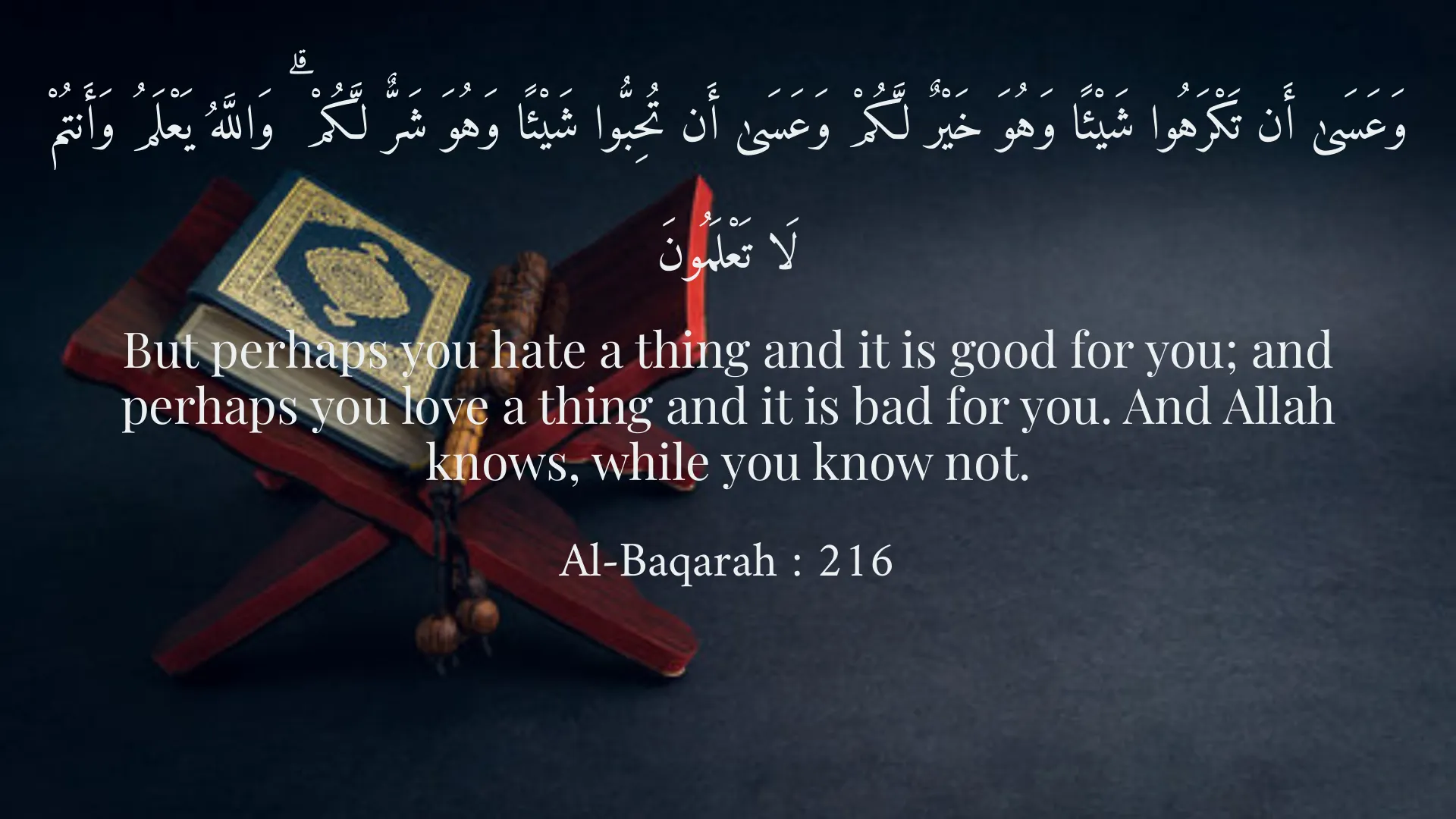
وَعَسَىٰ أَن تَكْرَهُوا شَيْئًا وَهُوَ خَيْرٌ لَّكُمْ وَعَسَىٰ أَن تُحِبُّوا شَيْئًا وَهُوَ شَرٌّ لَّكُمْ ۗ وَاللَّهُ يَعْلَمُ وَأَنتُمْ لَا تَعْلَمُونَ
But perhaps you hate a thing and it is good for you; and perhaps you love a thing and it is bad for you. And Allah knows, while you know not.
Al-Baqarah : 216
يَا أَيُّهَا الَّذِينَ آمَنُوا اسْتَعِينُوا بِالصَّبْرِ وَالصَّلَاةِ ۚ إِنَّ اللَّهَ مَعَ الصَّابِرِينَ
O you who have believed, seek help through patience and prayer. Indeed, Allah is with the patient.
Al-Baqarah : 153
وَقَالَ رَبُّكُمُ ادْعُونِي أَسْتَجِبْ لَكُمْ ۚ إِنَّ الَّذِينَ يَسْتَكْبِرُونَ عَنْ عِبَادَتِي سَيَدْخُلُونَ جَهَنَّمَ دَاخِرِينَ
And your Lord says, 'Call upon Me; I will respond to you.' Indeed, those who disdain My worship will enter Hell [rendered] contemptible.
Ghafir : 60
Short Story
In ancient times, there lived a righteous and pious man who yearned for a righteous child for many years. Every night, he would raise his hands in fervent supplication, asking Allah for offspring. Years passed, and his hair turned gray, but his wish remained unfulfilled. His friends sometimes tried to discourage him, but he would respond with profound tranquility: 'Allah is All-Hearing and All-Knowing. He knows when and what is best for His servant. If He has not granted it yet, surely there is good in the delay.' With this spirit, he continued his night vigils and prayers, his heart overflowing with reliance and contentment. His faith and patience became renowned among all. One day, in his middle age, his wife became pregnant and gave birth to a virtuous and intelligent child, who brought eternal joy and peace to him and his wife. At that moment, the pious man realized that not only had his wish been granted, but his patience and reliance over those years had elevated him to a spiritual station and knowledge that no wealth or child alone could bestow. He understood that the apparent delay was a stepping stone to attaining wisdom and depth of faith, a blessing far greater than the mere fulfillment of a desire.