Quranic Answer
The question of why some sinners appear to lead easier lives is one of the most profound and frequently asked human inquiries, which has preoccupied minds since ancient times. At first glance, it might seem that certain individuals who disobey divine laws and are immersed in sin live prosperous and trouble-free lives, while believers and righteous people grapple with numerous hardships and challenges. However, the Holy Quran, with its deep and comprehensive insight, addresses this phenomenon, clarifying its various dimensions to correct our superficial understanding and reveal the truth beyond appearances. Understanding this issue not only helps to resolve ambiguities but also strengthens our faith in the justice and wisdom of Allah Almighty, reminding us that worldly life is merely a stage for trials, not the ultimate place for reward or punishment. The first and most crucial point emphasized by the Quran is the deceptive and temporary nature of worldly life (Dunya). In the Quranic view, the world is a transient abode, a fleeting amusement, and a place of trial. What appears as 'ease' within it might simply be a deception or a tool for testing. In Surah Al-Hadid (57:20), Allah states: "Know that the worldly life is only play and amusement, an adornment and boasting among yourselves, and competition in increase of wealth and children - like the example of a rain whose [resulting] plant growth pleases the disbelievers; then it dries and you see it [become] yellow; then it becomes [scattered] debris. And in the Hereafter is severe punishment and forgiveness from Allah and approval. And what is the worldly life except the enjoyment of delusion." This verse clearly articulates that all material manifestations of this world, from wealth and power to children and beauty, are transient and unstable. This 'enjoyment of delusion' (mata’ al-ghurur) distracts humans from the ultimate truth. Therefore, the apparent ease of sinners is not a reward; rather, it can be the very deception that distances them from the true purpose of creation and the Hereafter, engaging them in a brief and baseless pleasure. This perspective shifts our focus from 'what we have' to 'what we will have' in the eternal world. The second Quranic explanation is the concept of 'Istidraj' (gradual drawing towards destruction). Istidraj means being led step-by-step towards perdition. Allah grants respite to sinners and even increases their apparent blessings, not as a sign of pleasure or satisfaction, but to immerse them deeper in their sins, and then seize them suddenly and without prior warning with His punishment. In this way, sinners, engrossed in material comfort and pleasures, become oblivious to the truth and assume that worldly prosperity is a sign of divine acceptance. In reality, this ease is a tool to drag them into an abyss. In Surah Al-A'raf (7:182), it is stated: "And those who deny Our signs - We will progressively lead them [to destruction] from where they do not perceive." This 'progressive leading' is Istidraj, which takes an individual stage by stage towards destruction, while they remain unaware, even considering this ease a sign of divine favor. This demonstrates Allah's profound wisdom; sometimes, delaying punishment provides an opportunity for repentance, while at other times, this very delay leads to an increase in sin and, consequently, a more severe punishment in the Hereafter. Third, the distribution of sustenance (rizq) and worldly status is based on divine wisdom, not necessarily on faith or disbelief. Allah Almighty is the Absolute Provider, granting sustenance to everyone, whether believer or disbeliever. This distribution is based on criteria known only to Him and can include various trials for individuals. In Surah Az-Zukhruf (43:32), we read: "Is it they who distribute the mercy of your Lord? It is We who have apportioned among them their livelihood in the life of this world and have raised some of them above others in degrees [of rank] that they may make one another in subjection. But the mercy of your Lord is better than whatever they accumulate." This verse indicates that disparities in wealth and social status are part of a divine order for managing worldly affairs and do not signify a spiritual superiority of one individual over another. Indeed, great wealth for a sinner might be a significant trial that pushes them towards greater disbelief and rebellion, thereby intensifying their punishment; and poverty for a believer might be a means to purify sins or elevate their rank in the sight of Allah. Therefore, access to material resources and worldly comfort is not the ultimate criterion for evaluating a person's worth or their standing with Allah. Fourth, complete divine justice is realized in the Hereafter. This world is a place of trial, and full punishment or final reward does not occur here. Allah's absolute justice will be fully manifest on the Day of Judgment, when no injustice will be done, and everyone will receive the recompense for their deeds. The Quran constantly reminds us that "the Hereafter is better and more enduring" (Al-A'la: 17). The apparent ease of sinners in this world is insignificant compared to the eternal torment of the Hereafter, and the hardships of believers in this world are negligible compared to the eternal blessings of Paradise. This perspective encourages the believer to remain steadfast on the path of truth and prevents them from envying the apparent situation of sinners. Allah is Just and never oppresses anyone; if a sinner is living in comfort today, this comfort is either the punishment itself (Istidraj), or a prelude to a more severe punishment in the Hereafter, or a test for themselves and others. Fifth, divine respite and opportunity for repentance. Allah Almighty is immensely patient and merciful, granting His servants, even sinners, time, hoping they might repent and return to the straight path. The apparent ease of some sinners can be part of this divine respite. In Surah An-Nahl (16:61), it states: "And if Allah were to impose blame on the people for their wrongdoing, He would not have left upon the earth any creature. But He defers them for a specified term. And when their term comes, they cannot remain behind an hour, nor can they precede [it]." This respite is not only for repentance but can also serve to establish the complete proof against them; meaning, they are given so many blessings and opportunities that no excuse remains for their sins. Ultimately, it must be understood that true ease is the tranquility of the heart and soul, not material comfort. A sinner, even at the peak of wealth and power, may suffer internally from anxiety, emptiness, and fear of the future, whereas a believer, even in poverty and hardship, finds profound peace through the remembrance of Allah and reliance on Him. The Quran states: "Unquestionably, by the remembrance of Allah hearts are assured" (Ar-Ra'd: 28). This true peace has a value far beyond all the wealth of the world and demonstrates that the outward appearance of individuals' lives does not necessarily reflect the true state of their spiritual and moral condition. Therefore, one should not be deceived by appearances; the apparent ease of this world is merely a step, perhaps a step towards ascending to eternal happiness in the Hereafter, or perhaps a step towards falling into eternal torment. Allah is the Most Knowing and Most Wise, and He alone knows the destiny of every individual, in this world and the Hereafter.
Related Verses
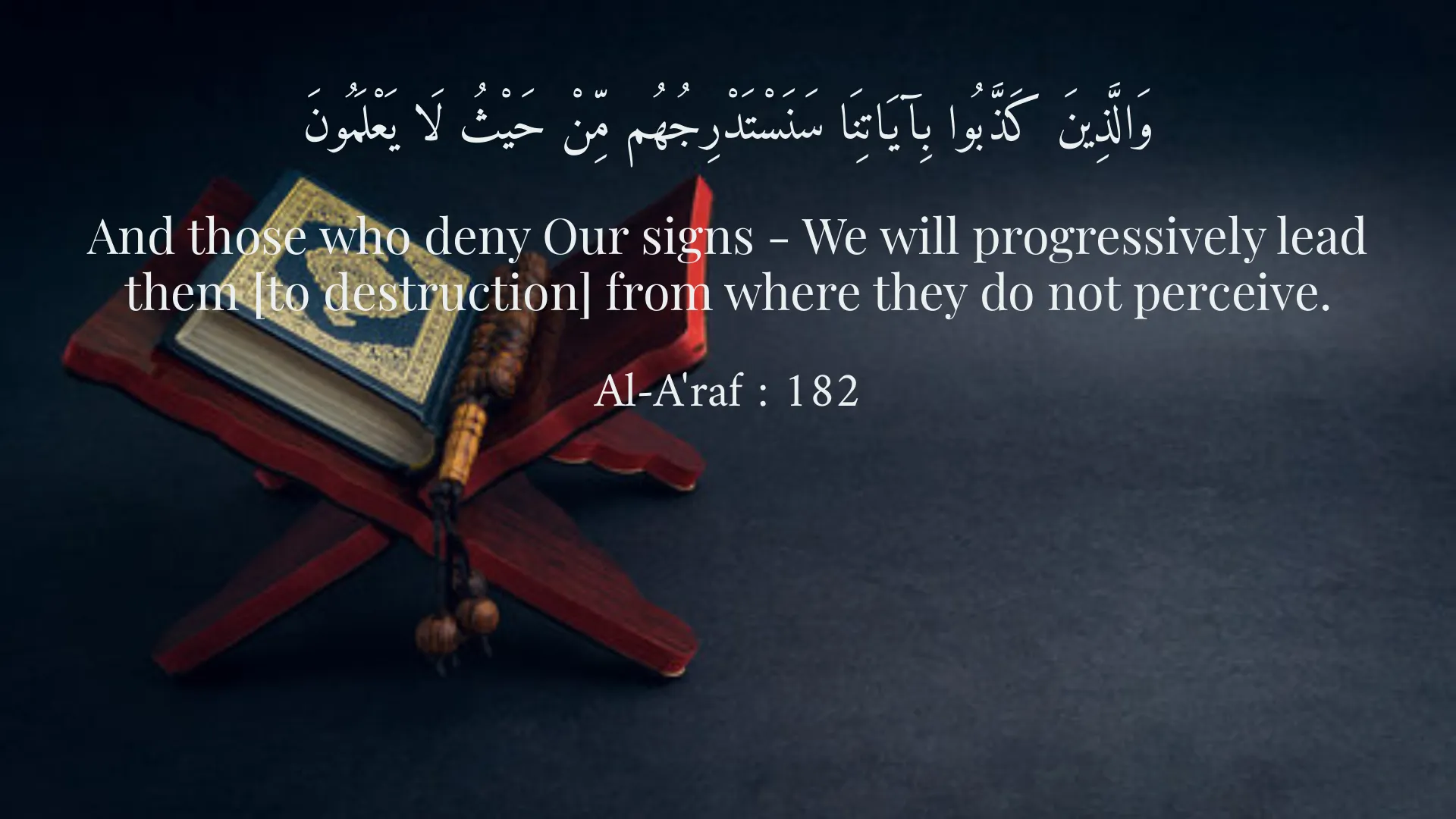
وَالَّذِينَ كَذَّبُوا بِآيَاتِنَا سَنَسْتَدْرِجُهُم مِّنْ حَيْثُ لَا يَعْلَمُونَ
And those who deny Our signs - We will progressively lead them [to destruction] from where they do not perceive.
Al-A'raf : 182
أَهُمْ يَقْسِمُونَ رَحْمَتَ رَبِّكَ ۚ نَحْنُ قَسَمْنَا بَيْنَهُم مَّعِيشَتَهُمْ فِي الْحَيَاةِ الدُّنْيَا ۚ وَرَفَعْنَا بَعْضَهُم فَوْقَ بَعْضٍ دَرَجَاتٍ لِّيَتَّخِذَ بَعْضُهُم بَعْضًا سُخْرِيًّا ۗ وَرَحْمَتُ رَبِّكَ خَيْرٌ مِّمَّا يَجْمَعُونَ
Is it they who distribute the mercy of your Lord? It is We who have apportioned among them their livelihood in the life of this world and have raised some of them above others in degrees [of rank] that they may make one another in subjection. But the mercy of your Lord is better than whatever they accumulate.
Az-Zukhruf : 32
اعْلَمُوا أَنَّمَا الْحَيَاةُ الدُّنْيَا لَعِبٌ وَلَهْوٌ وَزِينَةٌ وَتَفَاخُرٌ بَيْنَكُمْ وَتَكَاثُرٌ فِي الْأَمْوَالِ وَالْأَوْلَادِ ۖ كَمَثَلِ غَيْثٍ أَعْجَبَ الْكُفَّارَ نَبَاتُهُ ثُمَّ يَهِيجُ فَتَرَاهُ مُصْفَرًّا ثُمَّ يَكُونُ حُطَامًا ۖ وَفِي الْآخِرَةِ عَذَابٌ شَدِيدٌ وَمَغْفِرَةٌ مِّنَ اللَّهِ وَرِضْوَانٌ ۚ وَمَا الْحَيَاةُ الدُّنْيَا إِلَّا مَتَاعُ الْغُرُورِ
Know that the worldly life is only play and amusement, an adornment and boasting among yourselves, and competition in increase of wealth and children - like the example of a rain whose [resulting] plant growth pleases the disbelievers; then it dries and you see it [become] yellow; then it becomes [scattered] debris. And in the Hereafter is severe punishment and forgiveness from Allah and approval. And what is the worldly life except the enjoyment of delusion.
Al-Hadid : 20
Short Story
It is narrated that a king of his time, despite possessing countless treasures and a mighty army, always had a turbulent heart and a restless soul. Sleep eluded his eyes at night, and sorrow and anxiety never left him during the day. During the same period, a simple-hearted and contented dervish sat in a corner of a mosque, satisfied with barley bread by day and spending his nights in remembrance and prayer. A smile of tranquility never left his lips, and the light of contentment radiated from his face. The king, having heard of the dervish's peace, went to him and asked in surprise: 'O Dervish, with all my pomp, glory, and blessings, I burn in the fire of suffering, but how are you so carefree and smiling despite all your poverty and destitution?' The dervish smiled and replied: 'O King, you are enslaved by treasures that can never be fully acquired, and from the fear of losing what you have, you never find peace. But I am a servant who has attached my heart to nothing but God. What I have is from His grace, and what I do not have is from His decree. My ease lies in not being attached to this fleeting world and having my gaze fixed on the eternal abode. This apparent ease might be a ladder to a greater fall, but for me, true peace lies in forsaking these worldly attachments.' The king realized from this speech that apparent ease does not necessarily mean true happiness, and perhaps that very comfort is a veil over a bitter truth.