Quranic Answer
Human beings are inherently driven by a desire for improvement and progress, constantly seeking to better their life circumstances. However, this innate desire for betterment often gravitates towards external changes rather than internal ones. We tend to look for superficial, material solutions instead of addressing the root causes of our problems deep within ourselves. We chase more money, a bigger house, a higher social status, or even a change in environment and the people around us, believing that by altering these external factors, we will find happiness and tranquility. This approach stems from various roots, including the materialistic nature of the modern world, social pressure to achieve visible successes, and even a natural human tendency to avoid confronting one's deeper spiritual needs and weaknesses. Internal change requires self-knowledge, self-criticism, and continuous effort, which often seem more difficult than external changes, and their results are not immediately observable. Yet, the Holy Quran repeatedly emphasizes that the true source of happiness and misery, success and failure, lies not in external factors, but in the heart, intentions, and inner deeds of a person. The most fundamental and comprehensive verse expressing this truth is Surah Ar-Ra'd, verse 11: “Indeed, Allah will not change the condition of a people until they change what is in themselves.” This verse explicitly states that God does not change the condition of any people unless they change what is within themselves. This is a foundational principle; it means that external changes, whether positive or negative, are often a reflection of internal transformations within individuals or society. If a nation is engulfed in corruption, oppression, and injustice, or if individuals within themselves turn to sin and heedlessness, the result will be reflected in the decline of blessings and the emergence of external problems. Conversely, if individuals and society move towards piety, justice, and self-purification, their external conditions will also improve. The Glorious Quran also places great emphasis on Tazkiyah al-Nafs (the purification and growth of the soul). In Surah Ash-Shams, verses 9 and 10, we read: “He has succeeded who purifies it, And he has failed who corrupts it.” These verses clearly indicate that ultimate salvation and success depend on purifying the inner self from impurities and cultivating moral virtues. This self-purification involves correcting beliefs, purifying intentions, and nurturing ethical virtues such as patience, gratitude, reliance on God, justice, and benevolence. When a person's inner self is cleansed of grudges, jealousies, greed, and selfishness, and illuminated by the light of faith, love, and humility, their perspective on the world and their interactions with others also transform. In such a state, even if external problems persist, the individual's way of confronting them and their impact on his peace will be entirely different. The Quran also points to the role of the heart in determining one's path. In Surah Al-Hujurat, verse 14, regarding the Bedouins who claimed to have believed, it states: “...for faith has not yet entered your hearts.” This demonstrates that true faith is an internal transformation of the heart, not merely a verbal claim or an outward action. It is internal faith that shapes and gives meaning to external actions. Therefore, focusing on internal change means reviewing beliefs, rectifying intentions, purifying the heart from contaminants, and cultivating moral virtues. This is the path that leads to stability, depth, and true tranquility. When a person changes their inner self, the outer world will transform in their eyes; they will no longer be enslaved by external events, but will face them with inner fortitude and profound peace. In essence, pursuing external changes without internal reform is like trying to fill a leaky vessel; no matter how much you pour in, it will remain empty. True peace, contentment, and happiness spring from an inner well, not from rivers that flow to us from outside. Thus, the Quran invites us on a journey within ourselves; a journey in which we confront our true selves, our intentions, and our spiritual capacities, and with the help of divine guidance, build them to the best possible state. This internal change not only transforms our individual circumstances but can also be the foundation for positive and lasting societal transformations, because society is nothing but a collection of individuals, each possessing their own internal world. So, instead of constantly seeking to change our environment, jobs, or the people around us, it is better to pause for a moment and ask ourselves: “What within me needs to change for my external situation to improve?” This question is the beginning of the path to which the Holy Quran calls us. This focus on inner transformation not only leads to individual peace and contentment but is also the foundation of any sustainable social and global reform, for a healthy society consists of healthy individuals whose hearts and souls are pure and reformed. Ultimately, it is this internal change that leads a human being to perfection and proximity to God, filling their life with blessing and meaning, rather than mere material achievements and superficial external changes. One must learn that the source of all happiness and unhappiness lies within oneself, and by changing it, one can transform one's life and even the world around them. This is the fundamental message of the Quran for anyone seeking true meaning and peace. True change begins from within, and then we will see its reflection in all aspects of our external life. This path of self-building and purification is a way towards a more fruitful and meaningful life. By doing so, we will be freed from the endless cycle of external changes and attain an inner stability and tranquility that no external change can take away. This fundamental truth applies not only to individuals but also to nations; the progress and decline of societies depend on their internal, moral, and spiritual condition. Until this Quranic principle is understood and implemented, humanity will remain trapped in the endless pursuit of perfection and happiness in external factors, while the real treasure lies within their own heart.
Related Verses
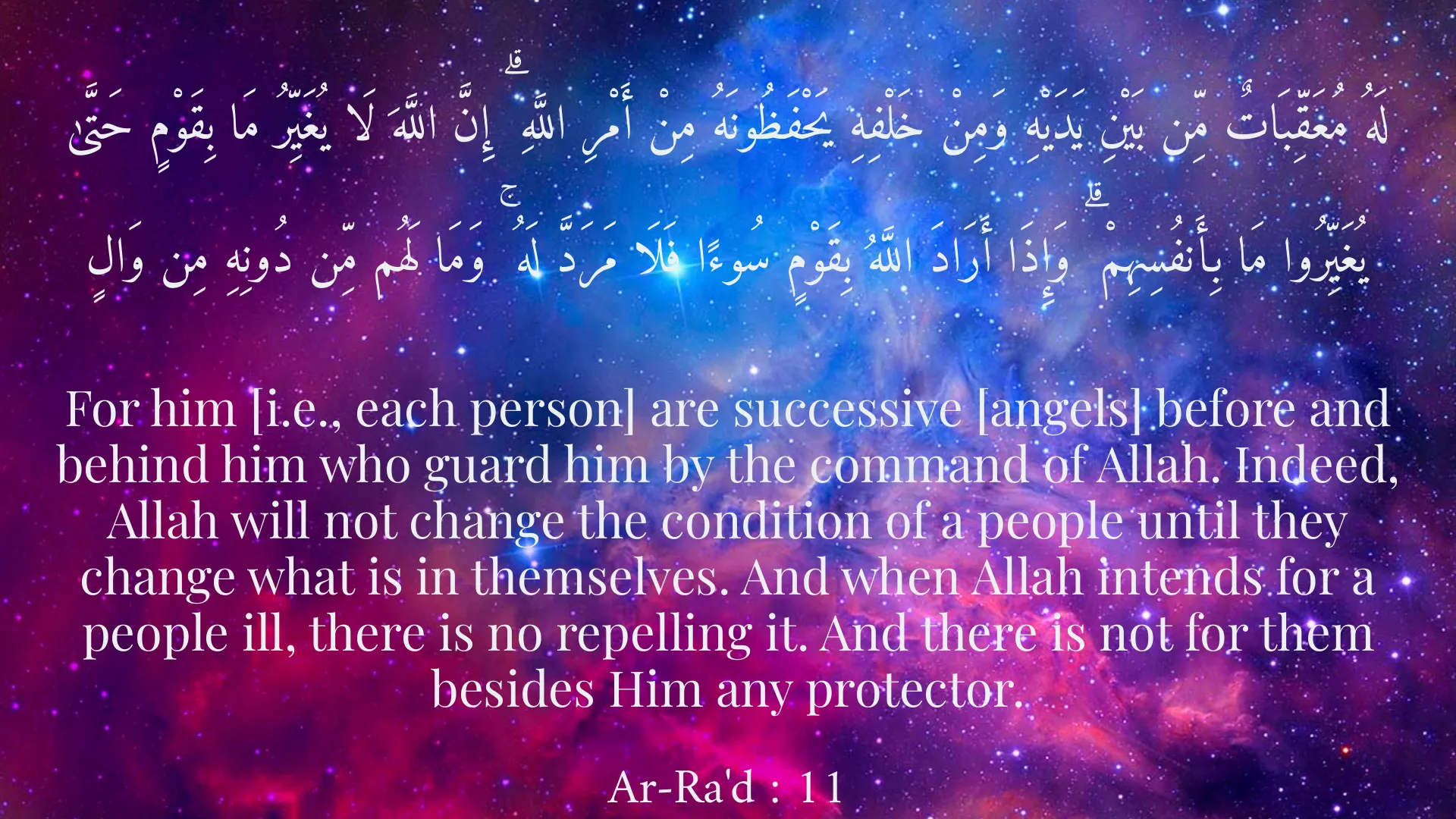
لَهُ مُعَقِّبَاتٌ مِّن بَيْنِ يَدَيْهِ وَمِنْ خَلْفِهِ يَحْفَظُونَهُ مِنْ أَمْرِ اللَّهِ ۗ إِنَّ اللَّهَ لَا يُغَيِّرُ مَا بِقَوْمٍ حَتَّىٰ يُغَيِّرُوا مَا بِأَنفُسِهِمْ ۗ وَإِذَا أَرَادَ اللَّهُ بِقَوْمٍ سُوءًا فَلَا مَرَدَّ لَهُ ۚ وَمَا لَهُم مِّن دُونِهِ مِن وَالٍ
For him [i.e., each person] are successive [angels] before and behind him who guard him by the command of Allah. Indeed, Allah will not change the condition of a people until they change what is in themselves. And when Allah intends for a people ill, there is no repelling it. And there is not for them besides Him any protector.
Ar-Ra'd : 11
قَدْ أَفْلَحَ مَن زَكَّاهَا
He has succeeded who purifies it,
Ash-Shams : 9
وَقَدْ خَابَ مَن دَسَّاهَا
And he has failed who corrupts it.
Ash-Shams : 10
قَالَتِ الْأَعْرَابُ آمَنَّا ۖ قُل لَّمْ تُؤْمِنُوا وَلَٰكِن قُولُوا أَسْلَمْنَا وَلَمَّا يَدْخُلِ الْإِيمَانُ فِي قُلُوبِكُمْ ۖ وَإِن تُطِيعُوا اللَّهَ وَرَسُولَهُ لَا يَلِتْكُم مِّنْ أَعْمَالِكُمْ شَيْئًا ۚ إِنَّ اللَّهَ غَفُورٌ رَّحِيمٌ
The bedouins say, "We have believed." Say, "You have not [yet] believed; but say [instead], 'We have submitted,' for faith has not yet entered your hearts. And if you obey Allah and His Messenger, He will not deprive you from your deeds anything. Indeed, Allah is Forgiving and Merciful."
Al-Hujurat : 14
Short Story
It is said there was a merchant in Shiraz who possessed immense wealth, yet every day a profound sorrow weighed upon his heart. Neither the vastness of his houses nor the splendor of his markets brought him peace. One day, he encountered an ascetic dervish living simply in a corner of a garden, whose face, however, always radiated contentment and serenity. The merchant asked him, “O Sheikh, I have abundant wealth but endless grief. You possess neither wealth nor status, so how do you appear so joyous and tranquil?” The dervish smiled and replied, “My friend, you seek happiness in accumulation, while I seek it in letting go. You search for treasure in the earth, and I seek it within my own heart. If what is within you becomes good, your outer world will also become a paradise; otherwise, no matter how much you roam the world, you will not find paradise. True peace lies not in what you take from the world, but in what you give to your inner world.” The merchant pondered and understood that the path to liberation begins not from the outside, but from within.