Quranic Answer
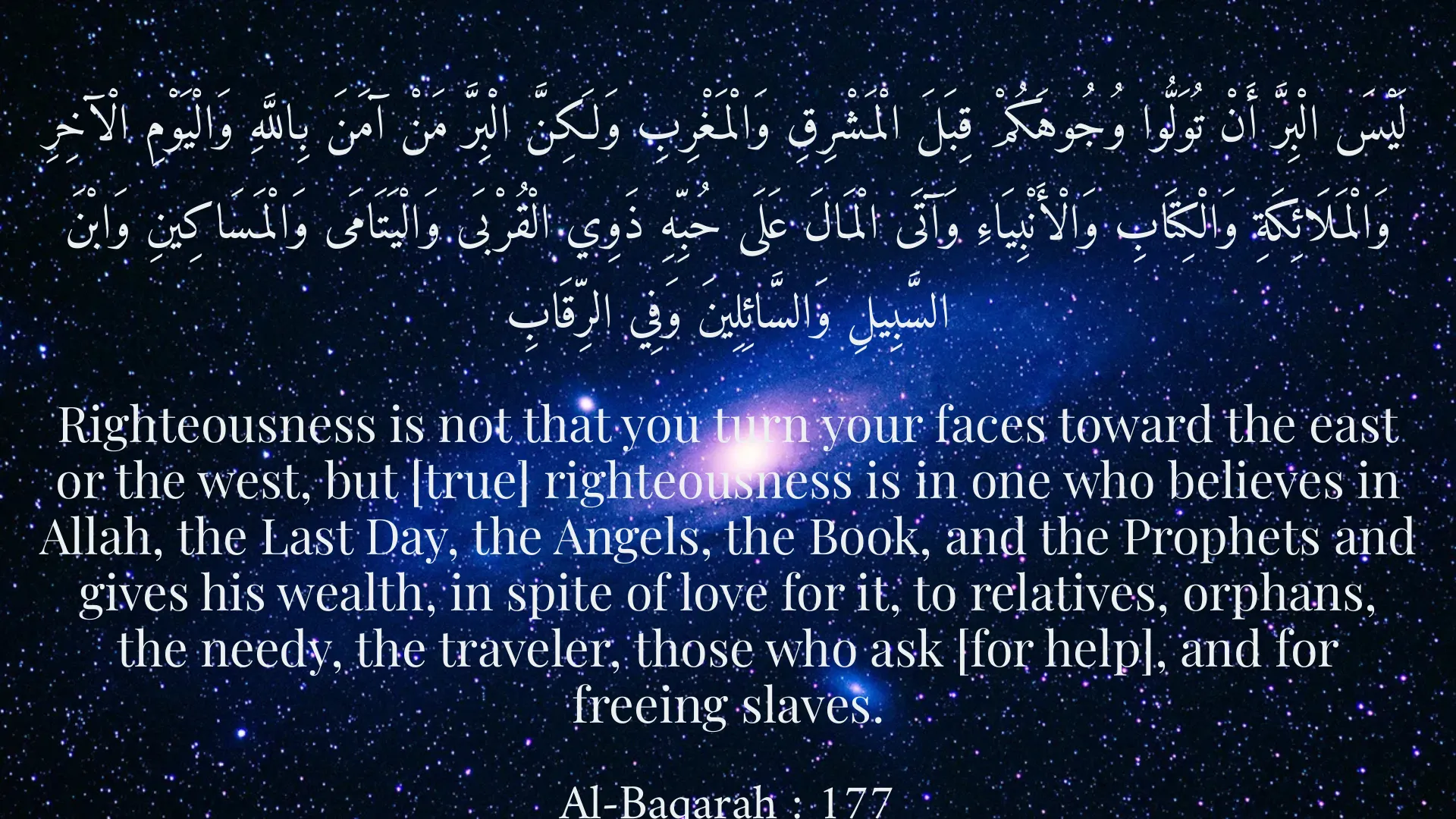
The Holy Quran, the sacred text of Islam, places significant importance on the welfare of the poor and needy. This reflects not only a religious obligation but also a moral imperative that shapes the social fabric of Islamic community life. Central to these teachings is the understanding of righteousness as not merely a matter of individual piety but as an active engagement with the realities of social justice and giving. In Surah Al-Baqarah, verse 177, Allah articulates a comprehensive definition of righteousness which extends beyond mere ritualistic practices. He states: 'Righteousness is not that you turn your faces toward the east or the west, but [true] righteousness is in one who believes in Allah, the Last Day, the Angels, the Book, and the Prophets and gives his wealth, in spite of love for it, to relatives, orphans, the needy, the traveler, those who ask [for help], and for freeing slaves.' This verse emphasizes that the essence of being a righteous person encompasses a deep belief system coupled with tangible acts of kindness and support towards those in need. This Quranic directive highlights that caring for the poor and needy is not merely a commendable action but is intrinsically tied to one’s faith. The act of giving one's wealth, despite attachment to it, illustrates a profound level of altruism that is encouraged among Muslims. This teaching serves to cultivate empathy and compassion, fundamental human values that can bridge divides and build community. It goes beyond simply providing financial assistance; it touches on the responsibility to support the vulnerable members of society through various means, ensuring they experience dignity and a sense of belonging. In Surah Al-Maidah, verse 55, the Quran further reinforces this principle by stating: 'And your ally is Allah and His Messenger and those who have believed – those who establish prayer and give zakah and those who bow [in worship].' Here, the interconnection between worship and social responsibility is made evident. Establishing prayer and giving Zakah, which is a form of almsgiving treated in Islam as a religious obligation, are acts of devotion that go hand in hand with a commitment to serve and uplift others in the community. The emphasis on collective worship unites believers in purpose, fostering a spirit of social solidarity that extends beyond the individual to encompass the community as a whole. In a broader context, one can argue that the Quran does not just encourage giving but also engages with the structural causes of poverty. It provides guidance on creating conditions that alleviate the struggles faced by the needy. With the acknowledgment that poverty can lead to various societal issues, including desperation and unrest, Islam advocates for long-term solutions that involve empowering individuals and enhancing cooperation among community members. Social programs that lift people out of poverty not only help individuals but also significantly contribute to societal stability and security. The Quran also offers reassurance to those who show patience and commit to good deeds. In Surah Az-Zumar, verse 10, Allah asserts: 'Indeed, those who are patient and do good deeds will receive a great reward.' This promise provides believers with both motivation and solace, knowing that their efforts to support others and persevere through life’s challenges are recognized and will be rewarded. This divine promise reinforces the notion that the act of giving is not a mere transaction but creates a virtuous cycle of honor and respect in the eyes of Allah. Poverty is not an isolated issue; it creates a myriad of challenges that affect entire communities, and yet, through the Quran’s teachings, Islam motivates its followers to create a more equitable society. Muslims are encouraged to not only rush to the assistance of the needy but also to embody principles that minimize the conditions leading to poverty and hardship. Social justice, compassion, and ethics must be at the forefront of collective action, thus ensuring a robust support system for those who struggle. Moreover, the Quranic teachings call for a balance between material wealth and spiritual growth, reminding us that wealth is a tool rather than an end in itself. By fostering a spiritual connection while we engage with worldly matters, Muslims learn to appreciate the blessings they have and use these blessings to uplift others, creating a compassionate society that nurtures its most vulnerable members. The teachings in the Quran bind the individual, the community, and the divine into a cohesive unit that seeks to build a world marked by fairness and kindness. Ultimately, the calling to aid the poor and needy outlined in the Quran serves various functions: it acts as a platform for spiritual growth, enhances social solidarity, and initiates necessary change. The Quran’s teachings serve not only as guidance for personal conduct but as a powerful mandate that shapes the ethical landscape of human interaction, presenting the Muslim community with the responsibility to cultivate empathy, cooperation, and proactive support for the impoverished. In conclusion, the Holy Quran imparts wisdom that remains vivid and relevant in discussions on social responsibility and economic disparity. The sacred text acts as a cornerstone for Muslims, guiding their efforts to bridge the gap between the affluent and the destitute while simultaneously deepening their faith and connection to Allah. By committing to the Quranic principles of charity, compassion, and social advocacy, a greater collective effort can emerge, aiming to address the multifaceted challenges posed by poverty in an increasingly complex world.
Related Verses
لَيْسَ الْبِرَّ أَنْ تُوَلُّوا وُجُوهَكُمْ قِبَلَ الْمَشْرِقِ وَالْمَغْرِبِ وَلَكِنَّ الْبِرَّ مَنْ آمَنَ بِاللَّهِ وَالْيَوْمِ الْآخِرِ وَالْمَلَائِكَةِ وَالْكِتَابِ وَالْأَنْبِيَاءِ وَآتَى الْمَالَ عَلَى حُبِّهِ ذَوِي الْقُرْبَى وَالْيَتَامَى وَالْمَسَاكِينِ وَابْنَ السَّبِيلِ وَالسَّائِلِينَ وَفِي الرِّقَابِ
Righteousness is not that you turn your faces toward the east or the west, but [true] righteousness is in one who believes in Allah, the Last Day, the Angels, the Book, and the Prophets and gives his wealth, in spite of love for it, to relatives, orphans, the needy, the traveler, those who ask [for help], and for freeing slaves.
Al-Baqarah : 177
إِنَّمَا وَلِيُّكُمُ اللَّهُ وَرَسُولُهُ وَالَّذِينَ آمَنُوا الَّذِينَ يُقِيمُونَ الصَّلَاةَ وَيُقْتُونَ الزَّكَاةَ وَهُمْ رَاكِعُونَ
And your ally is Allah and His Messenger and those who have believed – those who establish prayer and give zakah and those who bow [in worship].
Al-Maidah : 55
إِنَّمَا يُوَفَّى الصَّابِرُونَ أَجْرَهُمْ بِغَيْرِ حِسَابٍ
Indeed, the patient will be given their reward without account.
Az-Zumar : 10
Short Story
One day, Adel decided to help a charity organization. He made sure to donate a portion of his income to the poor every week. One day, he encountered a needy child on the street who was in dire need. Adel immediately opened his heart and helped him significantly. In doing so, he felt happiness and inner peace, realizing that helping others not only improves their lives but enriches his own life as well.