Quranic Answer
Arrogance is a pervasive trait that plagues human societies throughout history. In Islam, as elucidated in the Holy Quran, arrogance is viewed as a significant flaw that deviates individuals from the path of righteousness and spirituality. The Quran not only warns against but actively discourages this vice, highlighting the importance of humility and submission to the will of Allah. This essay will delve into the Quranic perspectives on arrogance, exploring its ramifications on both the individual and societal levels, as well as the spiritual consequences it harbors. One of the pivotal reasons outlined in the Holy Quran for avoiding arrogance is its detrimental effect on an individual's spiritual journey. Arrogance breeds a sense of self-importance and a misperception of one’s standing in the world, making a person less receptive to the divine guidance offered by Allah. In Surah Luqman, verse 18, Allah cautions humanity by stating, 'And do not turn your cheek [in contempt] toward people and do not walk through the earth exultantly. Indeed, Allah does not like everyone self-deluded and boastful.' Here, Allah rebukes not just the act of arrogance itself, but also the accompanying behaviors, such as contempt for others and haughty demeanor. This verse serves as a reminder for believers to reflect on their attitudes toward others, urging them to cultivate kindness and humility instead of pride. Arrogance desensitizes individuals toward the experiences and emotions of others, leading to a cycle that distances humanity from compassion and empathy. When a person believes themselves to be superior, they may become indifferent to the struggles and plight of others. This emotional detachment has wider societal repercussions, leading to a culture that devalues humility and kindness. As believers strive to embrace humility, they not only elevate their own character but also contribute positively to the community around them, fostering an environment of mutual respect and solidarity. Furthermore, the Quran explicitly mentions the anger of Allah towards the arrogant and the consequences that await them. In Surah Al-Isra, verse 37, it is stated: 'And do not walk upon the earth exultantly; indeed, you will never tear the earth [apart].' This verse emphasizes the futility of arrogance; no matter how powerful or significant a person may perceive themselves to be, their existence is merely a speck in the vast realm created by Allah. The reminder that arrogance has no merit in reality serves to nurture humility within believers and reinforce the notion that all power belongs to Allah alone. The dangers of arrogance extend beyond personal reflection and societal interactions; they can fundamentally undermine one’s spiritual relationship with Allah. The Quran illustrates that arrogance can lead to misguidance, pulling individuals away from the truth and obscuring their understanding of reality. When one is blinded by pride, they may reject the teachings of divine guidance, the very essence of which aims to steer humanity toward righteousness and fulfillment. In counters to these issues, the Quran also posits the concept of humility as a protective measure against arrogance. By embodying humility, believers open themselves to Allah's mercy and forgiveness, reinforcing their spiritual connection with the Creator. Humility allows for self-reflection and recognition of one’s limitations in the grand scheme of existence. As noted in Surah Al-Furqan, verse 63, the true servants of the Most Merciful are characterized by their humility, addressing people with gentleness and refraining from arrogance. Such traits not only enhance one’s spiritual state but also enrich interpersonal relationships, laying a foundation of kindness and respect within communities. Moreover, the Quran emphasizes the virtues of those who actively work against their instinctual tendencies toward arrogance. In Surah Al-‘Ankabut, verse 69, Allah mentions, 'And those who strive for Us, We will surely guide them to Our ways.' This points toward a mutually reinforcing relationship between humility and guidance; as one strives against arrogance, they become more attuned to the truths presented by Allah. Paradoxically, the act of striving for humility unlocks a deeper understanding of self and connection to the divine, fostering spiritual growth and fulfillment. Consequently, removing arrogance from one’s character is a crucial step toward achieving moral standing and virtuous living. The journey to liberate oneself from the clutches of pride is not merely a personal endeavor but a collective aspiration for society at large. When individuals commit to the practice of humility, entire communities flourish as compassion, kindness, and mutual respect take root. As guided by the Quran, the goal is not only to avoid arrogance but to embrace and promote humility as a central tenet of one’s existence. In conclusion, the Holy Quran provides profound insights into the nature of arrogance and the myriad consequences it harbors. It serves as a guiding light, encouraging believers to recognize the spiritual perils associated with pride while simultaneously inviting them toward the virtues of humility. Through the act of relinquishing arrogance, individuals can fortify their connection with Allah, fostering a spirit of compassion and respect both within themselves and toward others. Ultimately, striving for humility enhances one's moral character and spiritual journey, aiding not only the individual but also uplifting society as a whole, steering everyone closer to the mercy and forgiveness of Allah.
Related Verses
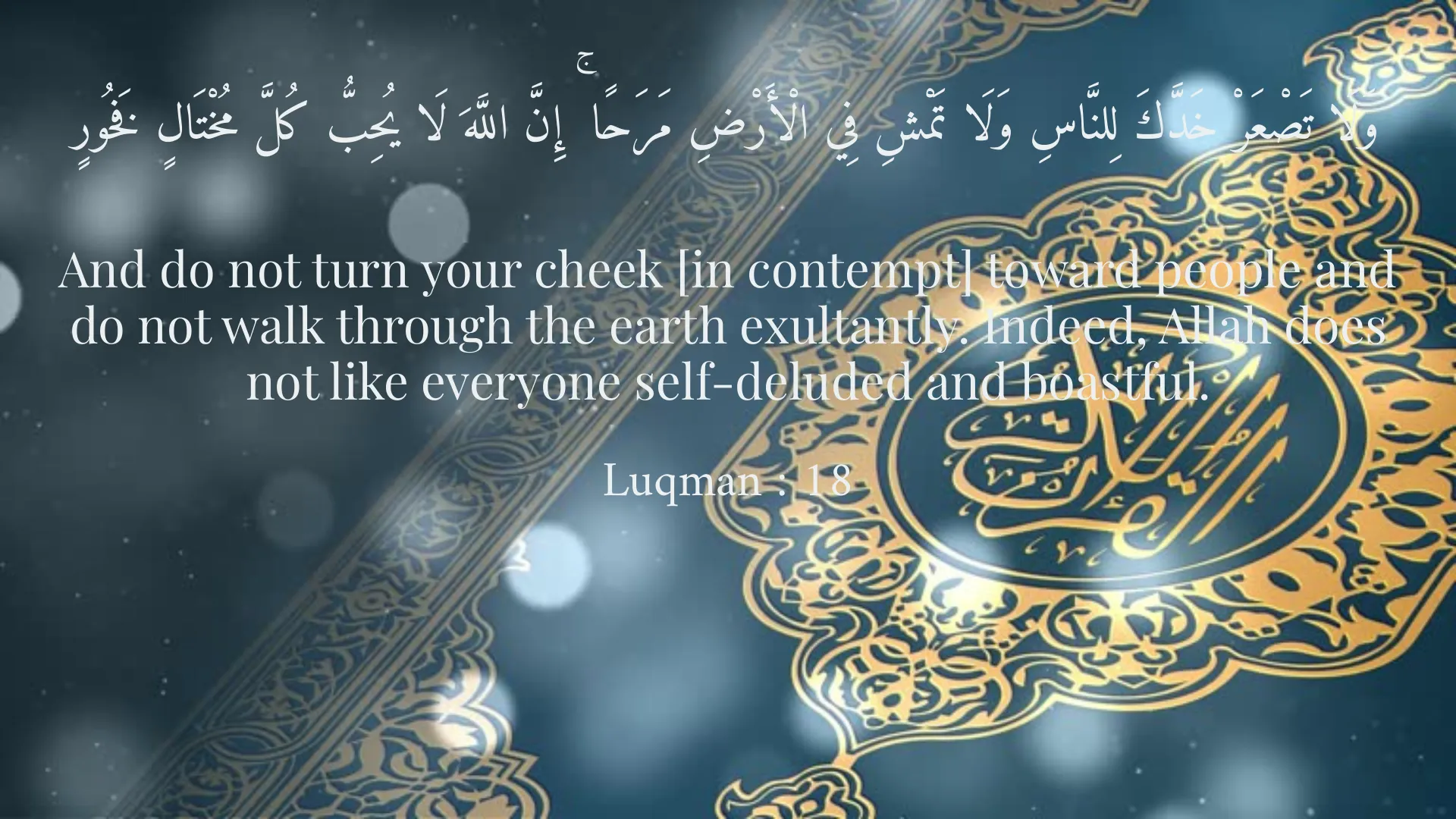
وَلَا تَصْعَرْ خَدَّكَ لِلنَّاسِ وَلَا تَمْشِ فِي الْأَرْضِ مَرَحًا ۚ إِنَّ اللَّهَ لَا يُحِبُّ كُلَّ مُخْتَالٍ فَخُورٍ
And do not turn your cheek [in contempt] toward people and do not walk through the earth exultantly. Indeed, Allah does not like everyone self-deluded and boastful.
Luqman : 18
وَلَا تَمْشِ فِي الْأَرْضِ مَرَحًا ۖ إِنَّكَ لَنْ تَخْرِقَ الْأَرْضَ وَلَنْ تَبْلُغَ الْجِبَالَ طُولًا
And do not walk upon the earth exultantly; indeed, you will never tear the earth [apart].
Al-Isra : 37
Short Story
One day, a proud man went to the market and mocked his surroundings, considering himself superior to all. A child, with innocence, asked, 'Aren't you human like us?' He replied, 'Of course!' The child smiled and said, 'Then no one is above you!' The man realized the depth of simplicity and truth and came to his senses.